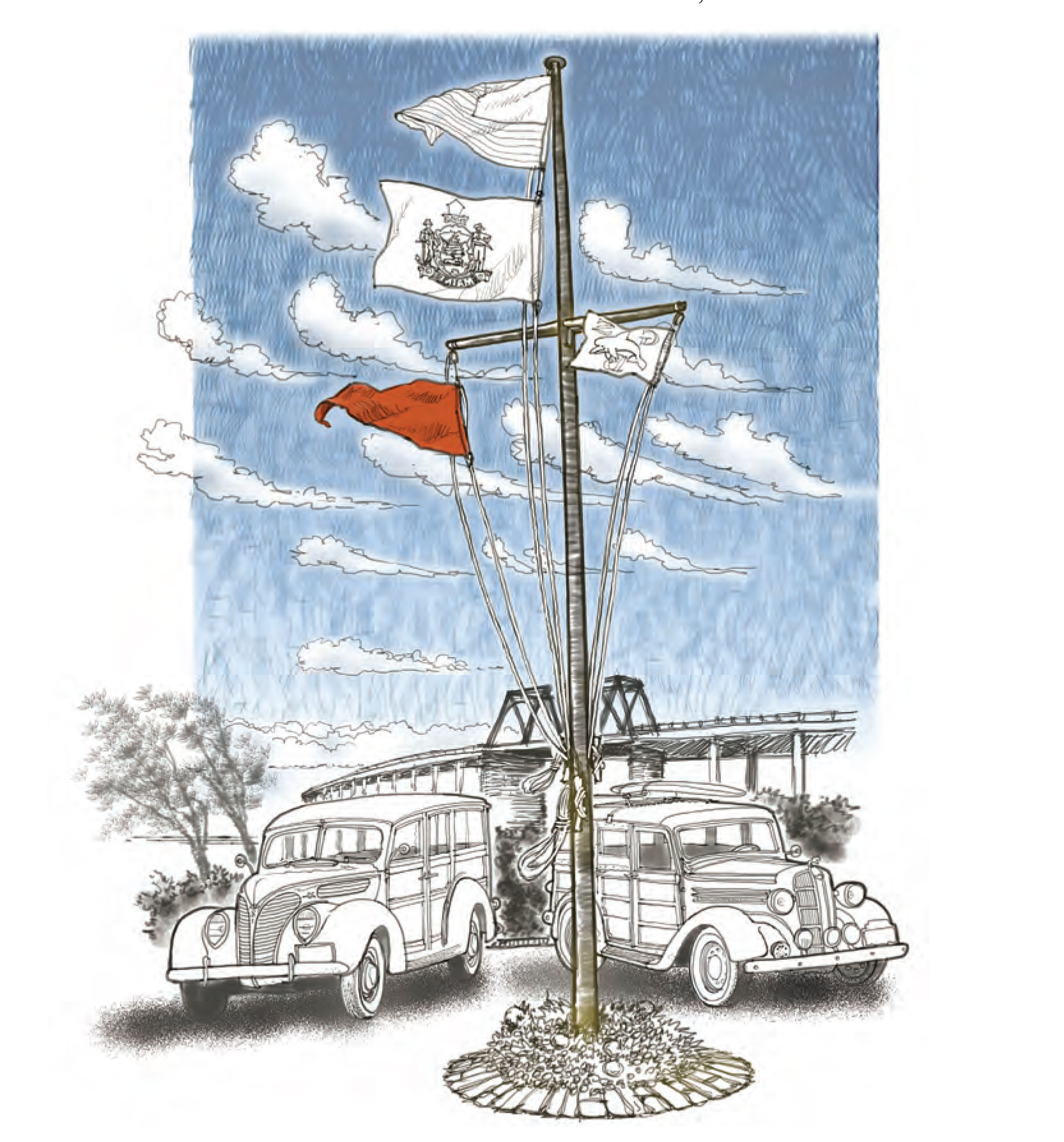
Illustration of two cars near a wooden boat mast.

A Guide to Taking a Tuck

The red flag of a small-craft warning is not a challenge. While you might meet people who enjoy sailing on their ear in a gale of wind while grabbing for all the gusto they can get, they are seldom skillful mariners and certainly not prudent ones.

Extreme sailing is hard on you and your boat. When you’re heeled far over with a torn wake behind you and everyone hanging on for dear life, consider the enormous stresses on your standing and running rigging. The helmsperson is fighting beastly weather helm and ponderous loads are building on deck plates, masts, blocks, sailcloth, and winches.

Your boat doesn’t want to sail at ridiculous angles of heel. It’s a hydrodynamic sculpture meant to “sail on its lines.” The designer factored in a bit of heel, but your boat simply won’t sail well on its side.

The remedy to too much wind is ancient and primary: Take a tuck. Reef down to reduce the area of the sail on which the wind acts to bring the boat back onto its lines. A reefed boat in a bag of wind will go faster and be easier to control, while reducing the stress on the structure. And it will sail closer to wind with less leeway. Less can be more.

Reef early. Make it part of your normal routine. Practice the drill with your crew. Make sailing simpler, easier, less stressful.

Illustration of a boat's mainsail with identifiers.

Addressing the Mainsail

We’ll address the big mainsail first. Unless you’re sailing a class boat with no provisions for reefing, your boat’s designer and sailmaker probably expected you to reef, and the pieces to do so should be in place. On your sail you’ll find one to four “reefs”—a line of points reinforced to resist hard use and high winds. Each reef has a tack cringle forward, at the luff, and a clew cringle aft, on the leech. The line between the reef’s tack and clew may or may not have permanently installed reefpoints, or sail-tie lines often called “reef nettles”.

The task of reefing is to lower the sail part way, secure the tack cringle at the boom’s gooseneck, then use a reefing pendant—often called a reef line— to pull the clew cringle both down and aft, so the foot of the sail is taut; then you raise the main halyard tight to create a smaller sail.

Reefing Details

The Basic Steps

Step 1: Identify lines and coordinate the crew. Bring your boat into the wind. Release the mainsheet to luff the main. Release the boom vang, or the sail won’t come down smoothly. Raise the boom slightly with the topping lift.

Step 2: Lower the mainsail with its halyard so the reef is a little below the boom. The topping lift holds up the boom. Secure the tack cringle to the boom’s dedicated cringle hook if there is one (see image above Addressing the Mainsail section)—or with a lashing if there isn’t. The reefing pendant, which hauls down the clew, is then hauled—by hand or winch—down and aft to tension the sail’s foot with a slight fold.

Step 3: Raise the mainsail with the halyard and set it up tight. Gather up the sail along the boom into a tidy bunt, and secure it with reef points (aka “nettles”) or sail ties, as described below.

Step 4: Ease the topping lift until the sail takes up the boom’s weight. You may need to adjust the leech line to get your best sail shape. When the sail fills, look at the luff and foot. They should be equally stressed: A vertical wrinkle parallel to the mast suggests the halyard is too tight; horizontal wrinkles indicate the foot is too tight.

The Reef Knot

The basic reef knot will be familiar to anyone with a basic knowledge of knots: On land, we call it a square knot, and it’s one of the first we learn as children. It’s composed of two overhand knots—the first going left over right, the second going right over left. (Two identical overhand knots will produce an unacceptable “granny” knot.) Making a loop in the second overhand knot will produce the preferred “slipped,” or “slippery” reef knot, which holds tight and is quick to untie.

Reefpoint Protocol

Do not tighten the reefpoints (“reef nettles”); tension on a taut reefpoint will tear the sail. Treat the reefed sail as loose-footed, secured at tack and clew only. The reefpoints are meant to keep the unused portion of the sail out of the way and tidy. If possible, pass the reefpoint between boom and sail and tie a reef knot (see drawing, right) or a slipped reef knot only tight enough to hold the extra sail. If you must tie the reefpoints around the boom, as in the example on the far right, do it loosely.

Reefing Strategies

Your reefing strategy depends upon your boat’s rig. Your goal is to reduce sail area while keeping the rig balanced fore-and-aft. The center of effort (the theoretical location where the entire sail’s effort is concentrated) shifts forward as you reef a catboat. Balancing a ketch as you reduce sail will mean decisions between the area of the mainsail and the mizzen. Sailing a ketch or yawl in strong winds, using a smaller jib and the mizzen, is called “jib and jigger” configuration. As a sail’s center of effort changes when it’s reefed, the boat’s center of effort for the pattern of all your sails combined shifts with reefing. Yes, it’s physics; it’s also intuitive and learned—like riding a bicycle. Experiment on some milder days. Feel the boat’s motion and drive. Listen to your boat.

One of the reasons schooners were used for so long and for so many commercial jobs is that their rig was so responsive to weather: Spread an acre of sail to a light breeze or a few balanced tablecloths to a storm.

Storm sails

Stormsails

Proper bluewater passagemakers probably have more than one suit of sails. Among them will be a storm trysail and storm jib, built of reinforced heavy sailcloth, that present a small but balanced shape to the storm.

Scandalizing

If time were short, a singlehanding skipper could drop his sail’s gaff behind the triangle of sail between clew, tack, and head. This is called scandalizing.

Roller-Reefing

Traditional boat rigs included several jib sizes to suit the weather. This is practical, but it requires a crew to work on a pitching foredeck. We’re fortunate today to have a proven, robust alternative: the roller-furling jib, as shown at the far right. It uses a shaped extrusion around the forestay turned by a drum at the deck end, with a swivel near at the mast end. While the strain on the bearings of drum and pivot is enormous, a well-cared-for roller-furling rig will turn easily in response to one of the furler’s three controls: two jibsheets, which unroll the sail, and the furling line, which rolls it back up. To reef with a furler, luff the jib but maintain control of its lee sheet, then “wind in” a little or a lot of area, depending upon the situation.

Some older boats have a roller-reefing system on the main boom, employing a crank to turn the boom and “wind down” the main like a window shade, as seen above. But the “slab reefing” described on pages 4 and 5 has largely replaced this mechanism. Some big new boats, however, now employ a variation of old-style roller-reefing: They have roller-furling units housed within the mast or the boom. They’re expensive and complex, but they may be a future alternative to the common sailor’s art of taking a tuck.