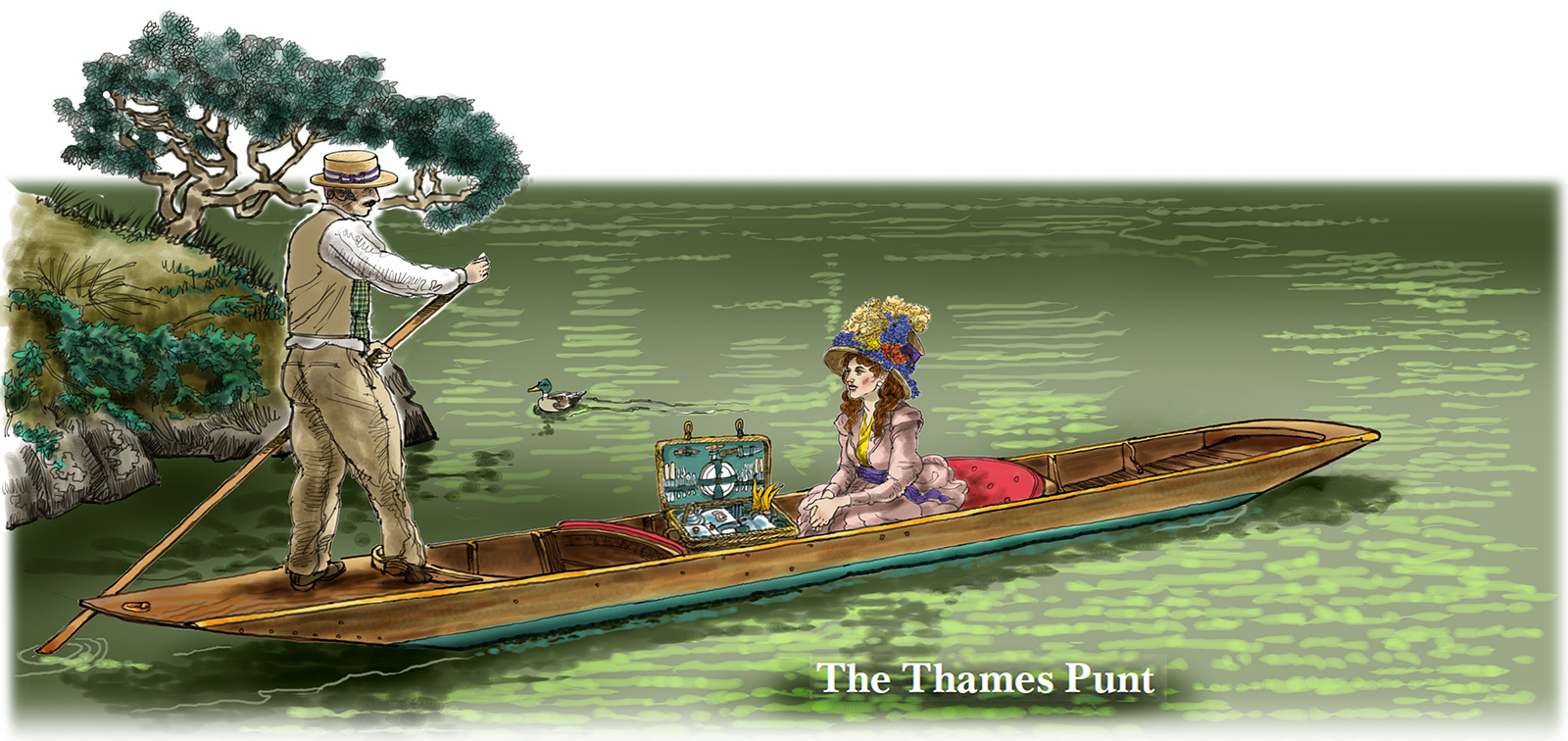
The Thames punt is a simple, flat-bottomed good-time boat, memorialized by Cambridge and Oxford “punters” carrying cucumber-sandwich picnics in elegant hampers. We suppose there are powered punts, but the traditional locomotion is the sensible punting pole, often of bamboo. Oh, la, how jolly!
Bluewater sailors have bragging rights, and bully for them. But as you get started in boats your task is to avoid ordeals, cataclysms, and full gales. You will range farther and farther from your home dock, but you may discover that the most fascinating waters are shallow. As we consider the history of boatbuilding ingenuity, we leaf through the elegant solutions created for thin water.
Gargantuan tankers and container ships churn great-circle routes between oily commercial ports. Gilded yachts cut courses from one high-dollar marina slip to the next, sure of eager service and amenities. As a small-boat skipper, poking your bow into inlets, creeks, tiny harbors, unlikely anchorages, and bypassed coastal villages is your special prerogative. You aren’t driven by commercial mandates, and you probably aren’t expecting a limousine with iced bubbly on the quay. Your mandate is curiosity, the bubbliest and headiest vintage. You shape your course wondering what lies upstream a bit more, what the air is like in a pine-ringed cove, and what the people are like in East Overshoe Harbor. Lucky you.

Pole anchors are more often seen, now, among Southern fishermen casting in mud-bottomed thin water. A brisk trade in actual hydraulic double pronged “anchors” may surprise Yankee anglers beyond the call of Bassmasters. Staying on-station with a simple pole is, however, an ingenious solution to a thin-water problem.
The abyssal plains of the world ocean are sparsely populated deserts, but the littoral apron is teeming. Big estuaries such as the Chesapeake, salt marshes, and bayous are cornucopias of sea life. A huge segment of deep-sea creatures were spawned and matured in coastal waters. Commercial fishing has deeply diminished offshore, but commercial fisheries inshore are (cautiously) active. There is more life in a mile of muddy shore than in many cubic miles of deep blue. Of course our ancestors noodled out clever boats to cruise the teeming, thin, profitable water. Your heritage is the number of hulls and rigs that will take you and your curiosity into these enticing shallows.
Thin-Water Cruisers
Sharpies
Sharpies are quintessential thin-water explorers. They began as inshore commercial-fishing and oystering boats on Long Island Sound and spread naturally to Southern shallow coastal waters. Their hulls are generally flat with a strengthening rocker pierced by a centerboard that allows passage between flats. The rudder is relatively long fore and aft, and is often balanced—its pivot lies aft of its leading edge. Though skittish in following seas, the sharpie is nevertheless a reliable inshore sailer, and is a fine choice for contemporary beach-cruising. Sitting headroom is usual in all but especially long sharpies, but the convenience of stepping onto the beach dry-shod is the reward for this. Original commercial sharpies supported two (typically) unstayed rigs: a summer cat-ketch with spritsails, and a winter rig with one mast amidships flying a single spritsail. Bowsprits for jibs were sometimes added. The traditional sharpie is not a sound choice for offshore passages (some derivatives have proven to be an exception), but, with a good weather eye and a prudent skipper, it’s a fine inshore explorer.
Catboats
Catboats were, historically, Barnegat Bay fishing boats, but they grew in popularity and traveled north and south. The traditional cat has a broad, stable beam (the legendary beam dimension is “a foot less than half the length”) and a single lightly stayed or unstayed mast near the stemhead. Most catboats, even today, are gaff-rigged to keep the big single-sail plan low. As commercial servants, catboats were hard-jawed with “barn-door rudders,” but easily handled by a single fisherman. They had a docile way of stopping quickly beside a lobster pot buoy or trot-line when the sheet was slacked. Catboats reached a high level of finish and reputation in the Crosby Cats of Cape Cod, and these big fishermen of 25′ to 35′ in length had vast cockpits in which to haul and stow gear and catch. The big-cockpit cats often had a three-season life: in spring and fall they fished; in summer, cleaned of fish gurry and scrubbed, they ferried “drowning parties” of Cape Cod swells “down for the weekend.”
Designs for Beaching
Bilge Keels
Bilge-keel boats are common in Britain and Europe, where tides sluice in and out with impressive authority. One wonders why Maine and the Bay of Fundy, no strangers to tidefall, don’t have more bilge-keel boats, which sit upright on the bottom when the tide is out.
Atalanta
Atalanta was a runner from Greek mythology, a daring woman. This namesake sloop designed by Uffa Fox reflects her adventurous nature. The original hulls for these remarkable thin-water cruisers were made of laminated wood hot-molded in very large pressure vessels. The resulting tough-as-nails rescue boats were dropped out of bomb bays (!) into the North Sea to rescue downed flyers. After World War II, Uffa used the hulls as the basis for an unusually adroit sailboat, which was both stiff in a blow and shallow of draft,—an impossible combination but for two 600-lb swing keels raised and lowered by 60 turns of a screw windlass. The rudder was also articulated. A small cabin aft with two bunks, and a commodious double-bunk main saloon ahead of a tiny compartment containing the galley, navigation station, and pilot berth made the Atalanta a marvelous family cruiser.
Higgins Boats
Higgins boats are enormously successful shallow-water vessels for unusual difficulties. These were the LCVPs (Landing Craft Vehicle and Personnel) that opened their gate-mouth bows to launch troops on Normandy D-Day beaches, and on many other beaches worldwide. They were tough, able, and durable, and you can still find Higgins boats among the Maine islands delivering bulky cargo right to the beach.
Drawing from Local Genius: Herreshoff’s Meadowlark
Meadowlark
L. Francis Herreshoff (LFH) designed many blue-water wonders, but his heart was with thin-water cruisers. His book The Compleat Cruiser (1956) idealizes casual coastwise adventures without a rag of contemporary political correctness or apology. LFH designed the sublime 28′ canoe yawl Rozinante, which is among the most beautiful and mannerly small boats ever launched, with only 3′9″ of draft and a sloping forefoot that, in his mind, offered a step off the boat to dry land if the bank was bold.
His real hymn to thin water was, however, the merrily named Meadowlark, a leeboard ketch designed for coastwise pleasure. There are tales of the Meadowlark racing against macho yachts between East Coast boat show appearances: in a boat drawing 15″ of water, her crew slid her across grassy shoals and caught eddies along the shore, cutting corners so drastically that they occasionally shouldered the boat over sandbars. But there was no real contest: the thin-water specialist shamed the deep-keeled, high-aspect, tightly strung SORC champions.
It is not a commodious yacht for 33′–37′ (the plans were adapted by various builders) due to its narrow beam and sitting headroom, but it speaks to Herreshoff’s dicta of simplicity and economy and wholesome family cruising.
The Meadowlark is basically a sharpie, and short-gaffed to keep the rig low. Her big 8′ lead-weighted leeboards owe something to Dutch boier jacht practicality (see WB No. 228). The design is a benchmark of thin-water cruising and Yankee parsimony: LFH designed the halyards, sheets, and leeboard tackle to operate sweetly without the expense of winches.
Queen of the Shoal
Paddle-Wheel Steamers
The business of supplying, communicating, developing and entertaining middle America before the Civil War was carried on by the grandest, fanciest, most powerful thin-water boats ever conceived: the paddle-wheel river queens.
The March 1846 battle between the screw-propelled HMS RATTLER and the paddle-wheeler HMS ALECTO proved conclusively that propellers were superior: RATTLER pushed ALECTO backwards at 2 knots. Even antique screws were hydrodynamically advanced over the paddle-wheel, but in the practical chore of slipping up and over changing shoals and snag-mined rivers, the paddle-wheel’s superiority was uncontested for many years. Paddle-wheel tugs still propel enormous barges on America’s rivers.
The shallow-draft challenge is complex. A snag may tear out a propeller, but a paddlewheel will probably “walk over” it. Grounded on a shoal, a stern-wheeler in reverse churned water up under the wide, flat hull of a riverboat and drew it back into deep water. The shallow-water boats could, as Mark Twain wrote, “navigate on a heavy dew.” They were, in their heyday, wood-fired. One or two arched, long brows could be manipulated with steam donkey-engines to reach the river banks for passengers or to take on fuel, often from crude woodlot camps along the bank.
It’s doubtful that, getting started in boats, you will find a good value on a stern-wheel steamboat, but these now-obsolete tools of interior commerce are part of your maritime heritage, and worth remembering for their local solutions. They were designed brilliantly, with structural engineering that stiffened the great sheet of wide hull, sometimes employing stayed cable-braces fore and aft and athwartships.
A few contemporary designers have dared to draft river cruisers with paddle-wheels to revisit the advantages the river queens carried.
Cargo Scows
Cargo scows rigged as sloops and schooners fit an important commercial link. Blue-water freighters were limited to deep-water quays. Scows could range far upriver, sailing or sweeping or poling right onto banks and beaches to pick up or deliver goods. Their broad rectangular deck plans maximized cargo-carrying as they minimized draft. They were cheap and simply built. At a time when coastal cities depended on horsepower for transportation, big scows delivered enormous loads of hay from inland farms, stacking the bales on deck 12′–14′ high. The skipper called down helm directions and sail trim from a ladder, looking across tons of horse fodder. Today, a few scow sloops and schooners profitably deliver supplies among islands up and down the East Coast, running right up on dry land, carrying livestock or even cars for the summer months.
Jet Boats
Jet boats aren’t new. Some ideas, ahead of their time, simply don’t catch on. Benjamin Franklin played with the water jet concept. Engineer James Ramsey demonstrated his successful steam-powered water jet boat in 1787 on the Potomac River. Our contemporary experience with jet boats is usually the braying of a jet ski. Though the PWC (Personal Water Craft) may sound like a colicky baby in a tuba, be charitable: the technology is high engineering and has been efficient in many thin-water situations. The “brown water navy” on Vietnamese rivers used water-jet propelled PBR (Patrol Boat River) and PCF (Patrol Craft Fast) “Swift” boats to navigate the shallow, silty delta water. Their ducted jets made them fast and phenomenally nimble: their combat-survivable control included a crew-straining stop from full speed within two boat lengths. Jet boats can navigate thin, rocky streams and even rapids without concern for a delicate spinning propeller. Fishing boats for flats and shoal waters sometime use a variation on the jet concept: they have conventional propellers protected by a “tunnel hull.”
The Beauty of “Form Follows Function”

The trip from beach to boat is sometimes all a dinghy is asked to do. A very old solution is the wheelbarrow dinghy: a wheel is axled within a bulkheaded compartment forward and the rubrails are extended aft as handles. The little tender is kept dry and safe on land, but is ever-ready to be rolled down the beach and launched. Its configuration does not yield to ideal racing hydrodynamics, but it’s just fine for a short row to the mooring.
Physicists aren’t gee-whiz, New-Age guys. They’re obliged to mistrust what “seems to be.” Their spare faith rests in simplicity. They’re very like sailors, who mistrust gimcracks and easy fixes; sailors have the same kind of reverence for plain strength and familiar tools.
When physicists discover a solution that not only explains natural processes but breaks through complication to simplicity, they say the solution is “elegant.” Their sense of this word is far from Duke Ellington’s or Coco Chanel’s understanding of it: by “elegant,” they mean the explanation is intellectually sleek, rigorous, subtle, and solid. A good sailor understands this sense of elegance. We should also recognize the broad gulf between the elegance of perfectly kept, fabulously appointed, gleaming yachts, and the elegance of true solutions to waterborne problems. We’ve celebrated boats that aren’t necessarily lovely—scow sloops, Higgins boats, Banks dories (see WB No. 253)—yet the elegance of their solutions to real-ocean questions gleams with the genius of plain sailors in their generations of tinkering and “what if.”


