
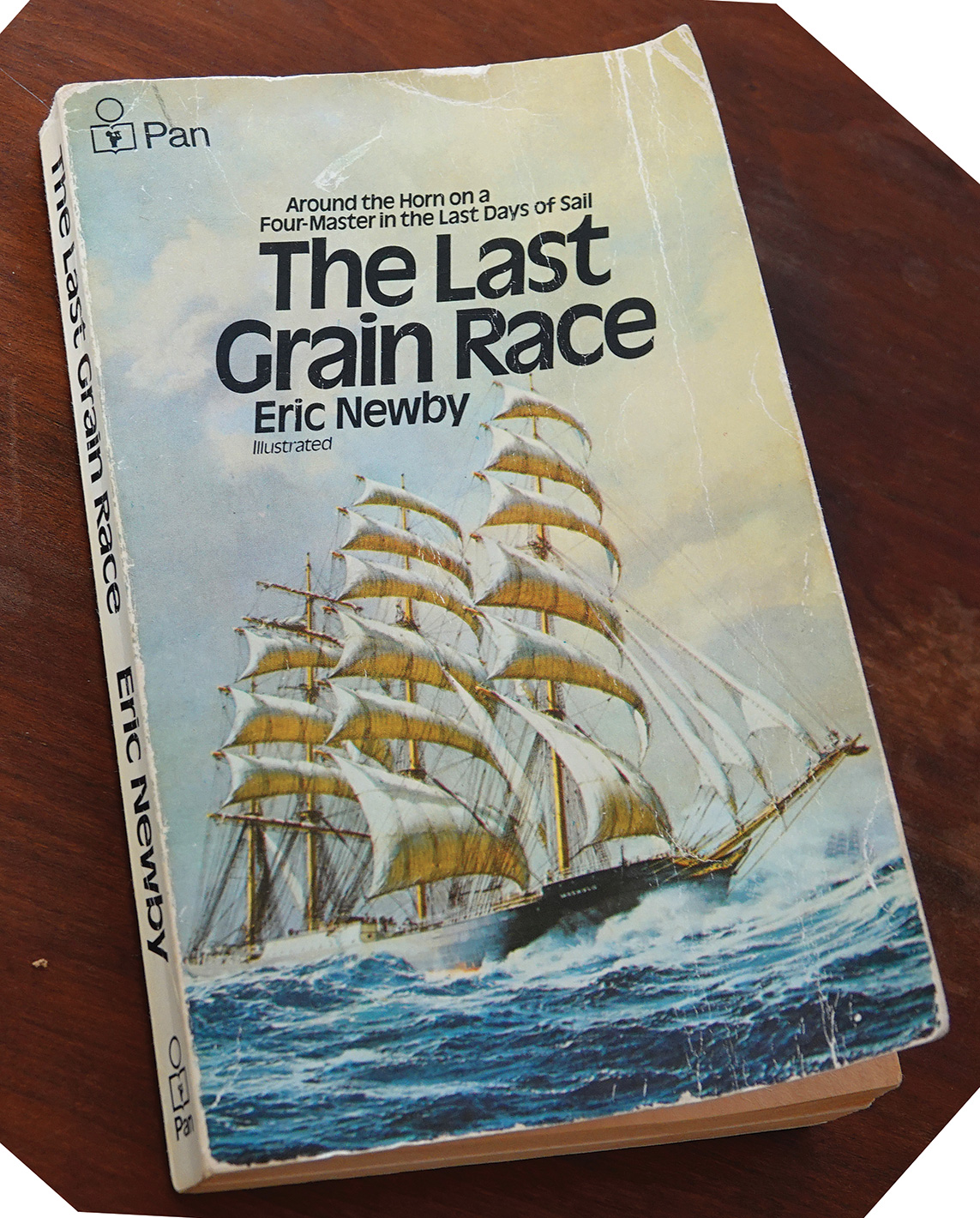
The Last Grain Race, by Eric Newby. HarperCollins UK Publishers Ltd., 2014, 352 pp., softcover. $24.98. (Kindle available.) Reviewed edition: Pan Books, London, 1976, softcover, drawings, photos, appendix. Available from used-book sellers.
In the day we lost the cereal account I finally decided to go to sea.” So begins Eric Newby’s The Last Grain Race, an extraordinary, firsthand account of life aboard a great sailing ship on the eve of World War II. Newby was an 18-year-old at a London advertising agency when his job evaporated in 1938, and he decided to scratch the itch he’d developed reading Joshua Slocum’s Sailing Alone Around the World and other sea stories.
The most obvious way to find employment aboard a sailing ship then was to write to Capt. Gustav Erikson, proprietor in Mariehamn, Finland, of the world’s largest fleet of square-rigged, deep-water sailing vessels. Newby received what he called a “suspiciously” prompt response offering him an apprentice berth aboard the 359′ four-masted, steel-hulled bark MOSHULU.
Two physical exams and a clergyman’s letter testifying to good moral character were required. Newby’s father then paid a £50 indenture fee, refundable should young Eric not survive the voyage from Belfast, Northern Ireland, to Port Victoria, Australia, and back. The elder Newby never knew how close he came to getting his money back.
The dangerous nature of work aboard MOSHULU became evident before the ship left the dock. A young American apprentice fell backwards down a hatch, landing 20′ below and suffering multiple serious injuries. The next day, one of the ship’s “doonkeymen,” responsible for MOSHULU’s two donkey engines and its winches, fell off the donkey house and broke an arm. Newby’s introduction to MOSHULU by her sailmaker was not encouraging.
“It’s a funny thing that most of the people who get killed in these ships are Englishmen,” John Sommarstrom told Newby. “You hang on tight.”
Newby had already experienced hanging on tight. The second mate had ordered him “op the rigging” to the top of the 198‘ mainmast. It was a terrifying climb made worse when a rotten ratline broke under his foot.
Newby’s first chores provided a sobering introduction to his new life. He was ordered to clean the filthy toilets in the skit hus. Next was the order to knacka rost (scrape rust) while standing precariously on a platform slung 20′ under the bow. When Newby discovered he lacked the strength to climb the rope to the deck, the crew of young Finns and Swedes taunted him for being “noh strong.” Proving he could eventually become a “strongbody” was the only way to gain full respect.
As a greenhand, Newby had to learn MOSHULU’s 41 sails (in total 45,000 sq ft) and the maze of running and standing rigging that included nine backstays for each of the three square-rigged masts. A couple hundred belaying pins along the shoulder-high bulwarks secured some 300 lines, each with a specific function. Adding to Newby’s challenge was that the ship’s language was Swedish. So, the lonely English lad learned babord (port) from styrbord (starboard), that the overmärs was the lower topsail, that lat ga babords ankaret meant lower the port anchor. Stagvända was the command to tack, a process that took an hour. Once, when on uitkik (lookout) in the South Atlantic, Newby spots dead ahead through the mist three enormous rocks rising from the deep sea below. “Hart babord,” he screams.
Swedish terms and Swedish pidgin English are integrated into this narrative in a natural way that adds to the reading experience of a book that is alternately painfully frank, incredibly informative in technical respects, and laugh-out-loud-funny. “Make horry up,” one of the mates urges. “Orlright.”
During the nine-month voyage, Newby learned the challenge of helming a square-rigger. A mate, standing beside him, would lean to one side or the other, indicating how the wheel should be turned “joost a liddle.” Still, early on, he makes a nearly disastrous mistake. He also describes helming MOSHULU, under topsails only, in a Force 7 gale. “She was,” he wrote, “a terrible, wild stranger to us.” Yet, when the wind is right and MOSHULU’s sails are trimmed just so, she is “like a bird skimming the water.” Running at up to 16 knots, the ship sometimes covered nearly 300 miles in 24 hours.
The crew’s sufferings are an ongoing theme. Eating mainly salt beef, salt pork, and potatoes, the young men seldom get enough calories. In the tropics, they are plagued by an infestation of bogs that emerge from the wooden bunks and straw mattresses. As the doonkeymen winch up some 59,000 sacks of grain in Port Victoria, MOSHULU is swarmed by enormous horseflies in 114-degree heat.
Of the 13 ships that left Australia loaded with grain bound for the British Isles in March 1939, MOSHULU made the best time, arriving after 97 days on June 27 in Queenstown, Ireland. Newby was discharged having earned his papers as an ordinary seaman. More important perhaps, midway through the voyage, he had defeated the strongest man in the crew in a bloody fight. “Now you strongbody,” says his opponent after the captain orders them to stop and shake hands.
Inevitably, readers will ask themselves if they could have done as well as the author.
During World War II, Newby served in Britain’s Special Boat Service and endured captivity as a prisoner of war. After The Last Grain Race was published in 1956, he became a successful travel writer. MOSHULU had many ups and downs but ultimately proved more fortunate than other vessels. Restored, she survives today as a waterfront restaurant on the Delaware River in Philadelphia (www.moshulu.com).
I once spent an unusual afternoon sailing back and forth there aboard a 22′ catboat whose owner had turned his sail into a novel billboard emblazoned with the name of another popular Philadelphia restaurant. But that’s another story.
If you aren’t fascinated by this book, I’ll eat my hutt. 
Stan Grayson is a regular contributor to WoodenBoat. His latest book, Boat Crazy, is available from The WoodenBoat Store.