
In my years of teaching boatbuilding and repairing wooden boats, I’ve noticed many mistakes owners make in the upkeep of their boats—common practices, done with good intent, that can often do more harm than good. I’ve distilled these into a list of the ten most common ones I’ve observed. Being aware of these things should help to eliminate some frustration and expense. My list loosely follows the common order of seasonal work, from springtime commissioning to autumn haulout.
1. Sanding and painting when the hull is dry
 Jan Adkins
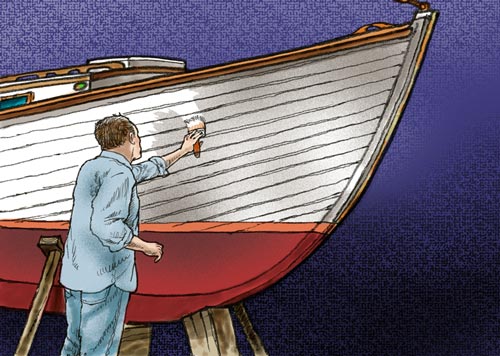
Sanding and painting a dry hull invites dust and debris to accumulate in open seams, potentially restricting the ability of those seams to swell.
At some point, our boats spend time out of water. Whether hauling out for the winter, or for just a few weeks of maintenance, it is important to keep an eye on your hull’s moisture content. Is the paint cracking at the seams? Can you see through the seams? If so, it’s important to get some moisture into your boat so she will swell up before you paint, and even before you sand. Why do this before sanding? Because if the seams are open, dirt and sanding dust can work into them, and even good vacuuming doesn’t always clear them out. Painting then traps this debris in the seams. As the planks then swell after launching, their edges will encounter that accumulated crud. Chances are that a bit of stray sanding dust won’t hurt the seams after one year, but over a span of years its accumulation will restrict plank swelling and possibly cause leaks.
Before painting, a bit of “pre-swelling” by means of wet towels, a sprinkler, or some other method should close the seams. Resist the temptation to put more than a few inches of water in your bilge: boats are engineered to keep water out, and not to hold it in.
There’s another common malady caused by inadequate swelling, and I often end up repairing the resulting damage. Many boats have their planking screwed directly to the transom edges. When the transom’s thickness shrinks with drying, the plank ends can stand proud of the transom. It’s tempting to want to sand these projections off. But after several years of sanding plank ends flush with a dried-out transom face, critical planking material is eliminated, and splits develop at the fastening holes. Rot may soon follow. The well-intended sanding has eliminated the “relish”—the all-important material between the plank-end fastenings and the ends of the planks. Leave those projecting plank ends alone. After the transom swells back up, everything will align.