
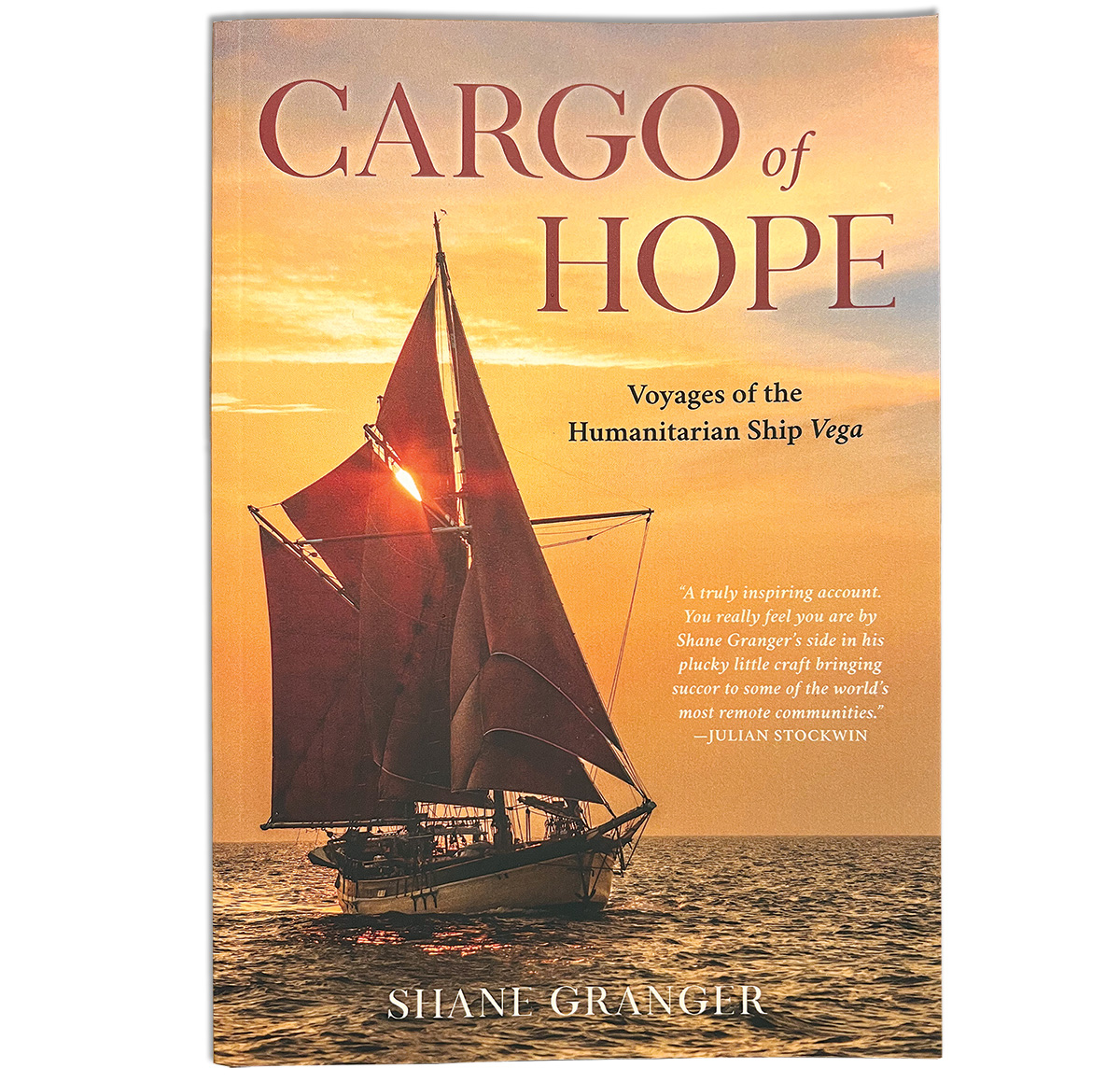
After my own long career in traditional sail, I was surprised to find that I’d never heard of Shane Granger or his adventures in his ketch, VEGA, delivering humanitarian supplies across the sprawling archipelago of Indonesia. This serves to show how many otherwise rational people remain enthralled by the conveyance of sail in the current age of seafaring, a time when most professional mariners can leave the dock with all the comforts of home and a reasonable chance of returning as planned.
Launched in 1891, VEGA is a Hardangerjacht, one of a famous fleet constructed along Norway’s southwest coast amid the final epoch of commercial sail. Commissioned to haul cement, she is an extra-heavy model of a type already renowned for its ruggedness—built of Swedish oak to massive scantlings, with full ceilings and mere inches of open space between her double-sawn frames. It was probably this sheer material bulk that allowed VEGA to survive intact until 2002, when Granger and his partner, Meggie, found her moldering in the Canary Islands after someone else’s failed attempt to take her voyaging.
Over the next year—a grueling interval of long days and costly shipyard bills—VEGA’s new owners eventually prevailed and set out on their own dream voyage to the Indies. Things did not go as planned. After an easterly rounding of the Cape of Good Hope, VEGA and her crew endured a nearly lethal beating by a tropical cyclone, complete with a steering failure and subsequent distress call sent out on the last breaths of a fading satellite phone. Bad as this all was, the harrowing rescue that followed resolved happily into an unexpected spell of recuperation in the delightful Seychelles Islands—perhaps first on the list of places where one might choose to be towed by the Coast Guard.
Later on—and most pivotally—Granger’s new book about his life with VEGA, Cargo of Hope, recounts another harrowing brush with shipwreck, this time on December 26, 2004, a day that begins with VEGA lying peacefully in the idyllic harbor of Lankgawi, Malaysia. This idyll doesn’t last, however, and the afternoon is shattered by the horrific arrival of the Boxing Day tsunami—an event that killed 230,000 people and laid waste to an untold number of coastal settlements across Oceania. The damage in Lankgawi is substantial, but with their own indestructible hulk of a vessel still intact, Shane and Meggie find themselves cast into the ad-hoc role of relief agents, their ship loaded to the scuppers with goods consigned to communities left stranded by the disaster. This proves to be a watershed moment for VEGA’s owners, one in which any previous vision that may have existed for their lives afloat is superseded by an ongoing mission of goodwill. Their 2004 departure from Lankgawi turns out to be merely the first in a 20-year series of regular voyages carrying supplies back and forth across the Indonesian archipelago—a labyrinth of settlements whose needs, it becomes quickly apparent, run well beyond a simple recovery to life before the tsunami.
The energetic prose in Cargo of Hope carries the reader along as a ship-rider on these eventful voyages—sailing promptly off into a full cyclone in Chapter 1, pausing at random for flashbacks to an imagined dramatization of VEGA’s construction in Norway long ago. The howling winds left abruptly behind, the latter bit reads not unlike a Ruth Moore novel—recounting a place of cold water and long Arctic nights, populated by sharp-eyed sea captains, clever merchants, and ingenious shipbuilders. From this busy departure, the book moves to a more conventional (if no less eventful) account of all that VEGA and her crew have accomplished in their years of plying the Indian Ocean, the ship laden with donated computers, school backpacks, children’s shoes, chairs, sewing machines, chalk, dry-erase markers, and neonatal resuscitators.
Every page is an adventure, and Granger is an enthusiastic creator of images: abrupt cones of volcanic islands ringed by coral reefs, the villages behind them stretched along white beaches and nearly unreachable by a vessel of any size. The larger towns teem with activity, their harbors jammed with craft of every type—all floating in water you’d pray to never swim in. This is a monsoon climate, a place ruled by seasonal wind shifts where timing is everything, particularly in an aged sailing vessel with an auxiliary diesel that is neither powerful nor particularly fuel-efficient. I have been on such trips elsewhere and can empathize: wind and current on the nose, making a desperate 2½ knots, the engine roaring and throwing heat like a furnace until a fitting fails and you must shut it all down, giving up all that you’ve just painfully gained.
Behind the sea stories are fascinating side-trips into history, and an informative account of day-to-day life in remote communities with limited support from their governments. It is an inspiring throughline, a tale of two people who’ve found a mission and simply set about accomplishing it, apparently learning enough along the way to meet real needs on a local scale, 40 or 50 tons at a time. These details appear as episodes, no two quite alike: A punishing jeep ride to visit dignitaries in a remote village, a day in the bare-bones clinic of a local doctor or midwife, lunch at a club with some wealthy patrons who incongruously arrive astride their Harley Davidsons on a weekend junket from Jakarta.
It would be interesting to know even more about how Shane and Meggie built their extraordinary network across Indonesia’s complex web of islands and politics, but the evolution of VEGA from cruising yacht to micro-NGO is set forth as a series of vignettes more than a contiguous story. Such is the overall architecture of Cargo of Hope—a significant history told in the way of a seafarer’s yarn, with elements the armchair sailor might recognize from Sterling Hayden or Irving Johnson. It evokes a rich sense of place, but if you are planning your own voyage to Indonesia, you will also want a copy of the Admiralty Sailing Directions. This is a book of atmosphere, not journalism, and its author-captain sails where the wind takes him—a swashbuckling stylist who fears no metaphor or simile. Just listen:
I pulled myself up on all fours. Coughing up seawater and struggling to breathe in that waterlogged atmosphere of savage wind-driven rage, I fought my way back to the wheel. Squinting through salt-encrusted eyes that must have been redder than the devil’s business card, I could just make out the compass and our present course.
Avast! And one need only navigate to page 13 for this passage. Cinch up your oilskins; adventure awaits. 
Elliot Rappaport is a faculty member at Maine Maritime Academy and has sailed as a captain since 1992 in sail-training ships and oceanographic research vessels. His first book, Reading the Glass: A Captain’s View of Weather, Water, and Life on Ships, was published in 2023.