
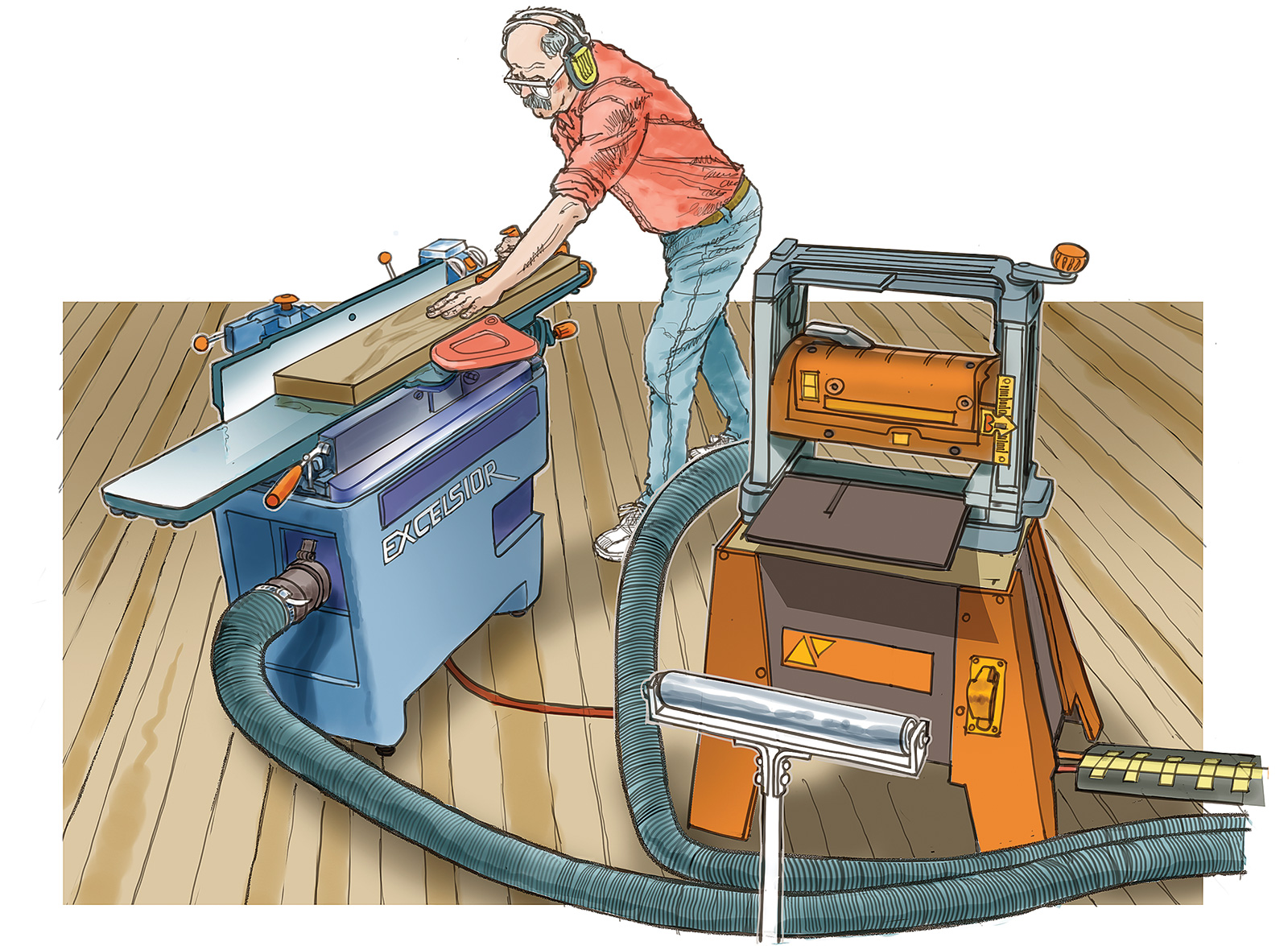
The jointer and the planer are powerful tools that turn rough, approximately dimensioned wood from the sawmill into finely tuned stock, ready to become components of a boat. There are some similarities between the two machines. Both have spinning cutters that shave wood surfaces, but they’re not the same machine in different boxes. This is a superficial illusion. Their cutters are no more redundant than a ripsaw and a crosscut saw: they achieve different results. Though their work can overlap in some ways, and occasionally they can substitute for one another, they’re partners in precision.
Both tools are technical marvels that replace hours and days of fantastically accurate hand skills of riving, adzing, chiseling, and—think mountains of shavings!—planing. Be grateful. The jointer straightens the edge of a board or flattens its face. When dressing a board’s edge, it matches the spinning cutter with a precisely angled fence—typically 90 degrees, but not always—to create a precisely milled edge. The planer, on the other hand, is a thicknessing tool designed to dress a plane parallel to its mate on the other side of the board, and bring the board to a desired thickness.
These are prodigiously dangerous machines that maim the careless worker. Recall our tablesaw precautions in the previous issue: keep your fingers out of harm’s way and use a thoughtful set of commercial and shop-made pushers, not a convenient stick or two. Also, these beasts are louder than the tablesaw and can damage what hearing you have left after the rock concerts of your teens; always use ear protection. Flying chips hurt your eyes; wear safety goggles or clear face shields. Wood dust can be toxic and fine airborne particles are always unkind to your lungs: use masks or respirators.