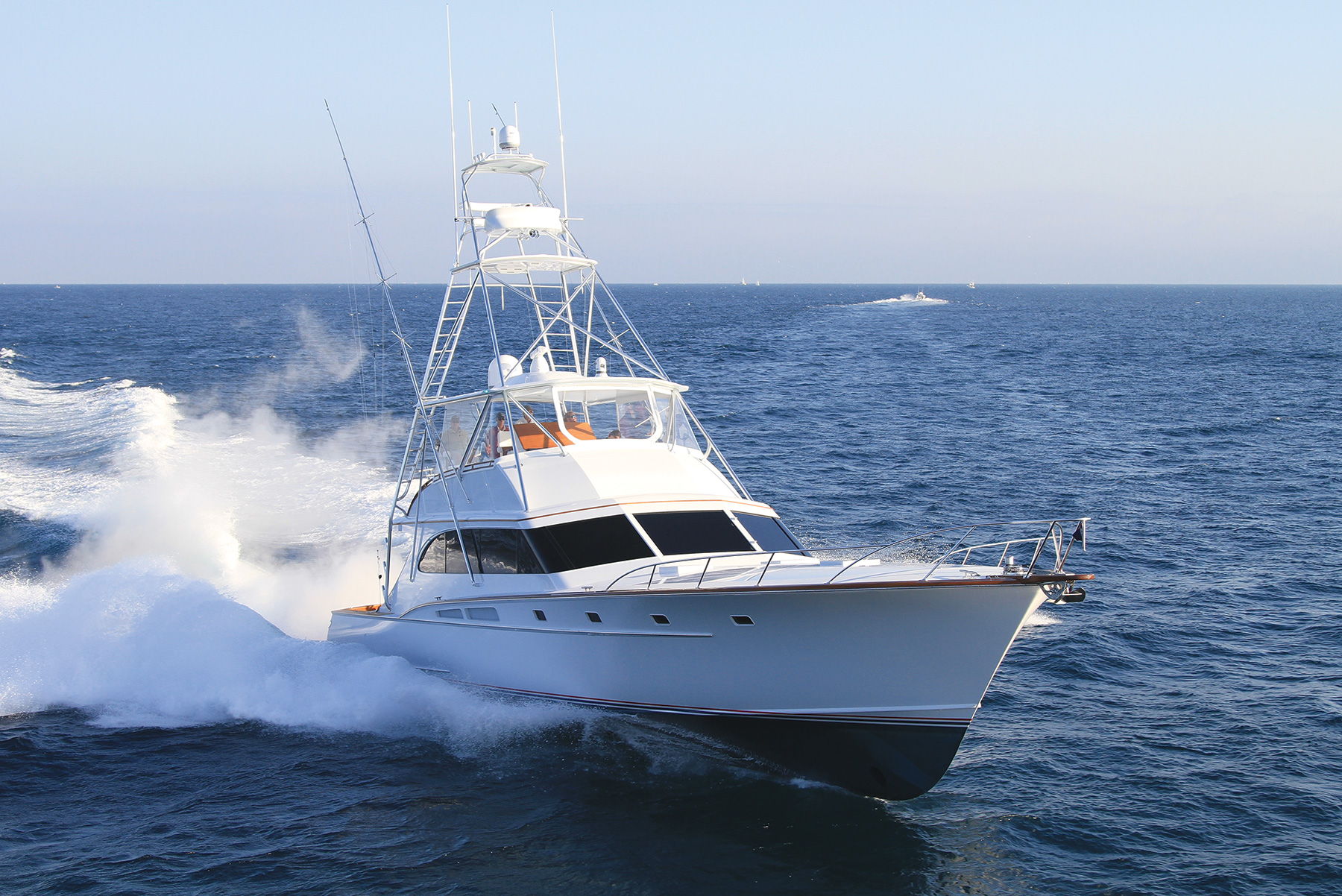
LADY REBECCA, a 68-footer.Rybovich Family Archives

LADY REBECCA, a 68-footer, is exemplary of the latest generation of sportfishing yachts associated with the legendary Rybovich boatbuilding name. Launched in 2017, she was the third yacht built by Michael Rybovich & Sons, based in Palm Beach Gardens, Florida. The yard is currently constructing its hull No. 9, a 70-footer.

It has been shaping up to be just another busy morning at Michael Rybovich & Sons boatyard on the Intracoastal Waterway (ICW) in Palm Beach Gardens, Florida.

But then, what appears to be a stray tiger cat comes racing down the dock, makes a flying leap aboard the spanking new 62′ PERLAMAR, and dashes across the cockpit for the open engineroom companionway.

“Grab that cat!” shouts 37-year-old Dusty Rybovich.

His brother, Alex Gill, age 36, bolts aboard the sportfishing boat in pursuit.

Michael Rybovich, right, and his son Alex Gill, left.Randall Peffer

Michael Rybovich, right, and his son Alex Gill, left, relax in the cockpit after the first sea trials of the yard’s latest construction, PERLAMAR, a 62-footer launched in November 2024.

Dusty and Alex are the fourth generation of the Rybovich family’s boatbuilding dynasty. The storied designer and builder Michael Rybovich (of generation three) is nearly 70, and he has handed over the day-to-day operations of the family business to his two sons. These days he roams the yard consulting with more than 40 employees working on dozens of projects. Currently, there are no fewer than five custom cold-molded sportfishing yachts under construction, ranging from 42′ to 84′ LOA, and an equal number of repair jobs.

As Rybovich customers, visitors, and that crazy cat could tell you, there’s something old-school about Michael Rybovich & Sons. This ain’t no factory. It’s a family business, pure and complicated. Dusty, a trained naval architect, works on the endless tweaks to design and engineering choices and manages the flow of materials and sub-contractors. Alex oversees the proper installation and operation of the mechanical and electrical systems on the customers’ boats.

This winter morning, Dusty and Alex have been focused on PERLAMAR. They have recently launched this state-of-the-art sportfishing yacht and are scheduled in a few weeks to load her aboard a ship bound for Costa Rica. But the yard still has a few gremlins to shake out before sending her off to her owners. Today, the issue is the autopilot’s interface with the navigation system.

Dusty Rybovich is the firm’s lead yacht designer.Rybovich Family Archives

Dusty Rybovich is the firm’s lead yacht designer. He and his brother, Alex, who specializes in mechanical and electrical systems, are leading the family into its fourth generation of boatbuilding and continuing its legacy of cold-molded wood construction.

“The gerbil hasn’t learned to talk to the hamster yet,” says Michael, who harbors a healthy skepticism for how technologically complex modern boats have become.

He has instilled in his sons the conviction that delivering the highest-quality vessel possible has been job No. 1 for every Rybovich boat since his grandfather John “Pop” Rybovich set up a boatshop here in the Palm Beach area more than a hundred years ago. A glitchy autopilot would not be a good look for a vessel with such a pedigree. Neither would a stray cat in the engineroom. So, Dusty is trying to call in his A Team of electronic subcontractors today…and Alex is in cat-capturing mode.

Meanwhile, there is a twinkle in Michael’s eye. He seems to sense that once again the gods are about to smile on the Rybovich family. Maybe the cat’s dash aboard PERLAMAR is an omen. It showed up in the yard shortly after the yard’s colorful machinist, Dick “Bobo” Morrison, died. The cat set up camp in the machine shop and has never left. After it started turning up for regular team meetings and making a show of its feisty personality, this cat seemed to the Rybovich crew to be Morrison’s re-incarnated soul. They started calling it “Bobo.”

“We might get lucky today,” Alex says after he has ushered Bobo ashore.

PERLAMAR in the shop for final touches.Rybovich Family Archives

PERLAMAR was in the shop for final touches—in this case, painting the boottop—ahead of her November 2024 sea trials, after which she was immediately bound for Costa Rica on a sportfishing trip.

“You want to run?” Dusty asks—and by “run,” he means take PERLAMAR for a sea trial.

Alex grins as if to say, “Hell, yeah.” A cold front has just blown through South Florida overnight and left in its wake one of those cloudless, crystal days that make you crave casting off the lines and leaving your troubles ashore.

Early in the afternoon, plaintive phone calls have been made, and three marine electronics whisperers are now scrambling over PERLAMAR. Michael is rigging the new anchor and rode. Dusty has downed his usual bowl of cereal for lunch. Alex has had some one-on-one time with Bobo; he and the cat just get each other.

After the electronics gurus believe they have fixed a bad connection in a wiring harness, it’s thumbs up for the test run. Someone fires up the twin MTU diesel engines. Dusty takes the helm. Alex and his dad cast off the lines. The electronics guys gather on the flying bridge. There’s a lot of happy chatter as Dusty pivots the yacht away from the dock and turns south on the ICW toward Lake Worth.

“Show time,” someone says.

The Early Days

Those words—“show time”—have probably been uttered aboard newly launched custom Rybovich boats for more than a century. In 1900, Michael’s grandfather, John Rybovich Sr., emigrated at the age of 16 from Austria-Hungary to the United States. He was a carpenter. After clearing through New York’s Ellis Island, he heard stories of a place called Florida and its Palm Beach winter playground for the rich and famous. By 1911, Rybovich had chased his dreams to Palm Beach and was dividing his time between building houses and commercial fishing. He and his young bride, born Anna Pollack in Czechoslovakia, bought a house on the shores of Lake Worth, where they began raising five children and keeping milk cows.

As it happened, local fishermen took note of Rybovich’s skills at building and maintaining his skiffs. Soon, they began to bring their own boats to him for repairs and modifications. In 1919, John “Pop” Rybovich’s boatyard was born.

“Although it had never been his intended vocation,” Michael says, “it all seemed to make sense…as if it was meant to be.”

For the next 20 years, the business grew despite hurricanes and the Great Depression. Pop’s oldest son, John Jr. or “Johnny,” began working in the yard alongside his father. It was during those years that Johnny caught his first sailfish.

“The many hours Johnny spent fishing for fun awakened him to the idea that a boat could—and should—be set up specifically for sportfishing,” Michael says.

Johnny’s interest in the sporting side of fishing led to innovation. Soon a growing number of Palm Beach’s wealthy boatowners were coming to the Rybovich yard for outriggers, fighting chairs, gunwale-mounted rod holders, and topside-mounted controls.

By the mid-1930s, Zane Grey and other authors were thrilling their readers with stories about big-game-fishing adventures. Bimini, Cat Cay, and other Bahamian islands across the Gulf Stream from South Florida began hosting game-fishing tournaments. Boats that had been modified by Rybovich were there, often with Pop’s three sons—Johnny, Tommy, and Emil—aboard.

During World War II, Pop kept his yard busy converting civilian pleasure craft for military service. He repaired and maintained patrol boats and launches with the help of his daughters, Ethel and Mary Irene. Meanwhile, the boys went to war. Johnny became an army procurement officer. Tommy flew B-17s in Europe. Emil crewed air-sea rescue boats.

A half hour later, Dusty is clicking PERLAMAR’s engines in and out of gear, holding the boat’s position as he waits for the bridge tender to open the span over the ICW at PGA Boulevard (named after the Professional Golfers Association to honor another of the area’s passions). On the flying bridge, the men have begun to talk in a higher octave and shift their weight from one leg to the other. Anticipation is building for the run that lies ahead, the moment when PERLAMAR breaks out of the ICW channel onto Lake Worth as Dusty opens the throttles and the twin MTUs unleash nearly 2,000 hp apiece. Everyone is anxious about whether the gerbil will talk to the hamster when he snaps on the autopilot as the hull jumps up on plane and starts screaming along at more than 40 knots.

Down in the cockpit, Michael and Alex lounge against the transom rail. They are not talking. Both men seem lost in thought. No doubt, they are letting go of a hundred challenges left behind with Bobo in the boatyard. Maybe they are musing over the twists and turns of the Rybovich family story.

Revolutionary Icons

After World War II ended and Pop’s sons returned home from military service, he turned over the operation of the yard, now Rybovich & Sons, to “the boys,” just as Michael is doing now with Dusty and Alex.

“Johnny’s service taught him business skills and introduced him to the emerging material technology in military hardware,” Michael says. “Emil, a self-taught mechanical engineer, was exposed to the engineering and performance standards within the fleet of Army boats for which he was responsible. Tommy was absorbed with aerodynamics, aircraft construction, and the beauty and efficiency of a clean line.”

In 1946, opportunity came calling. A big-game fisherman named Charles Johnson wanted something special. He asked the Rybovich boys to build a new boat specifically for tuna fishing. Johnny developed the concept for a 34′ design. Tommy, the most artistic of the three brothers, gave the boat a skin of high-gloss paint and varnished mahogany.

“My father, Emil, installed a pair of eight-cylinder Chryslers with aircraft-style steering, instrumentation, and full dual-station controls,” Michael says.

MISS CHEVY II of 1947 and BLUE FOX, a 50-footer.Rybovich Family Archives

Left—The 32′ MISS CHEVY II of 1947 was the first sportfishing yacht built at the boatyard founded in 1919 by John Rybovich Sr. After his sons Johnny and Tommy returned from World War II service, the elder Rybovich turned the yard over to them, and Johnny’s avid sportfishing interest took the yard in a new direction. Right—BLUE FOX, a 50-footer launched in 1961, was the first Rybovich yacht to be cold-molded with three layers of Philippine mahogany planking instead of two.

Launched as MISS CHEVY II in 1947, the new boat was dry, stable, and capable of 20 knots. It carried the world’s first set of aluminum outriggers and a fighting chair that is still what Michael calls “the print and pattern for today’s chairs.” Customers began standing in line to get a crack at owning a tricked-out Rybovich. After fishing MISS CHEVY II for four years, Johnson wanted something new.

Michael remembers how it came to be. “Tommy had been experimenting with an idea he had for eliminating the forward trunk by raising the foredeck to create the headroom needed down below, and in doing so, cleaned up the line of the deckhouse. While Tommy was busy in another part of the yard, Johnny was in the drawing room intrigued by his brother’s attempt. He erased the latest version of the sheer and sketched in one with a convex transition similar to what Chris-Craft had done in the late 1940s…. In 1952, MISS CHEVY IV was launched with a ‘broken sheer,’ an aluminum tuna-tower, and a transom or tuna door for boating big fish without hauling them over the side with a gin-pole. She was the first Rybovich built with Philippine mahogany,” which the Rybovich yard, like Chris-Craft, turned to mainly because of its availability and cost. “Once again, the Rybovich boys had delivered a boat that would define the next phase of sportfishing.”

Over the years, the brothers began edge-gluing the planking on their hulls with resorcinol glue, without using cotton caulking. The result was a seamless painted finish. Then, during the mid-1950s, they began equipping their boats with engines using diesel instead of gasoline. At the same time, they added a trained naval architect, Jack Hargrave, to their team.

In 1958, a customer ordered a boat from Rybovich under one condition: that his boat be built using epoxy resin instead of resorcinol glue. As the construction progressed, the brothers began to see the possibilities of combining epoxy and wood construction. The use of epoxy was fairly new, but cold-molded construction had been around since the 1940s, when it was first used for aircraft.

Cold-molding began to intrigue Tommy, who took over one corner of the construction shed to build a small, cold-molded hull upside down over a jig. “The boat had no conventional frames to define its form,” Michael says. “A series of fore-and-aft stringers ran from stem to stern,” supported by a few temporary transverse molds. “Tommy had mahogany planking sliced to ⅜″ thick, and it was only after the planking was applied in opposing diagonal layers that the onlookers could determine the hull shape. The planking was glued and held together ‘wet’ with bronze nails and fastened to the longitudinals. After the hull had been sanded, two layers of fiberglass cloth were applied and saturated in epoxy. The hull was again sanded smooth, at which point the temporary stations were removed, leaving a stiff one-piece wooden hull that was 20 percent lighter, had more room inside, and took less time to build than a conventional hull.”

In 1961, Rybovich built the 50′ sportfishing boat BLUE FOX with a cold-molded hull. There was no turning back. By 1968, the yard was using cold-molding
exclusively for building hulls, at least two decades before the technique became the industry standard for custom sportfishing boats. Since then, the yard has been an industry leader in improving cold-molded hull construction techniques. They always use Philippine mahogany, a marketing term that covers a number of species, principally meranti.

But the Ryboviches were not just innovators in the boatyard. For years, Johnny had been an advocate for catch-and-release fishing for billfish and became a founder of the Master’s Angling Tournament, the world’s most prestigious tournament of the type. He also introduced the Tournament of Champions, a fishing derby designed to raise money for conservation. Discovering that billfish mortality was much higher when using live bait, Johnny founded the Gold Cup Tournament in 1972 to award more points for fish caught on dead bait.

Meanwhile, Tommy and the naval architect Giovanni Cardelli were carving models and towing them behind a Boston Whaler with a scale fitted to a boom to measure resistance and observe the models’ trim angles. When they refined a model that satisfied their performance parameters, Tommy would incorporate the lessons learned into his latest hull. After the hull was built, Cardelli took the lines off the new hull and drew the body plan accordingly. The method led to ever-faster and more seakindly hull shapes. And the Rybovich legend grew.

A quarter-hour after clearing the drawbridge, an increase in the MTUs’ rpm seems like a call to arms aboard PERLAMAR. Michael and Alex climb the ladder from the cockpit to join Dusty and the electronics guys on the flying bridge. There is only one more span to clear on the ICW channel before it’s show time, when this floating piece of furniture will turn into a sea dragon that would have brought a smile to Pop’s face.

PERSISTENCE’s main saloon.Rybovich Family Archives

Accommodations for many years have responded to demand for increasingly luxurious appointments, as shown by PERSISTENCE’s main saloon.

Big Changes

Pop Rybovich died in 1970. Tommy died in 1972. “When Tommy passed, the soul of the yard was lost,” Michael says. By then, Michael was a teenager working at Rybovich & Sons with his father and uncles. “The day-to-day challenges at the yard without Tommy, along with familial and financial concerns, eventually proved too great for the surviving brothers and the yard was sold in 1975,” he said.

Michael stayed with the new owners until 1984, long enough to complete the journeyman phase of his boatbuilding career. Then he branched out on his own to build sportfishing yachts as Rybovich International with his father, Emil; his brother, Marty Evans; and a family friend, Ed Bussey. Meanwhile, Rybovich & Sons, with a crew of artisans who had matured under the family business, continued building custom sportfishing yachts in South Florida through four subsequent ownerships.

“By the mid-1990s, we were building a 60′ sportfisherman under the name Ryco Marine,” Michael says. Legal action by the latest corporate owners of the former family boatyard had forced him to drop the use of the family name from his business as well as to avoid using Rybovich signature details such as the broken sheer and double handrails on his new boats.

Still, things were going well for Michael’s boatbuilding enterprise, until Hurricane Wilma destroyed Ryco Marine in 2005. But, as luck would have it, the Florida businessman Wayne Huizenga Jr. had purchased the original Rybovich yard in 2004. By 2005, he needed a management team for the boatbuilding division, and he invited Michael and Ryco into a merger. The arrangement, under the name of Rybovich & Sons, brought the family business and the family name back together again after more than 30 years of separation.

For the next four years, the company thrived, delivering five boats between 54′ and 78′ long. But as the recession of 2008 deepened, orders for new boats dried up. In 2010, management shelved new construction altogether to focus on the development of a full-service marina for top-end yachts. Repairwork was three times more profitable than boatbuilding.

“Facing the end of the creative process with Rybovich & Sons, I was forced to rethink the partnership,” Michael says. “I made the decision to leave, and to proceed on my own with a new company, Michael Rybovich & Sons. It was a pretty crazy thing to do for a man in his 50s. My wife, Julia, and I threw every cent we owned into the new venture. It was a huge leap of faith.”

But for Julia, there was never a question about risking the family nest egg. “I have always trusted Michael’s decisions, and it has been a wonderful journey,” she says. “He really loves what he does, and it shows.”

The cockpit of PERSISTENCE.Rybovich Family Archives

The cockpit of PERSISTENCE, elegant as it is, still has a central purpose: the pursuit of trophy fish.

Dusty has just cleared the final road bridge over the ICW and is steering PERLAMAR toward the open water of Lake Worth, a saltwater lagoon about 21 miles long and a mile wide behind barrier islands, including Palm Beach. On this Thursday afternoon, there is virtually no boat traffic around. The lake is wide open to the Singer Island Bridge, about 6 miles ahead. It is the perfect place and time for a drag race.

Michael and Alex, standing behind Dusty at the helm, reach out to the struts on the aluminum tuna tower to steady themselves.

“Hold on,” says Michael to the electronics technicians.

PERSISTENCE's flying bridge.Rybovich Family Archives

Her flying bridge is loaded with electronics, including a lower array for engine monitoring and control; a central array of large Garmin multifunction displays, including a fishfinder; and an upper array of a Furuno multifunction display (center) and two VHF radio monitors.

Then Dusty starts nudging the throttles forward. PERLAMAR rises up on a step and goes ballistic. It’s so quiet on the bridge, with only the rush of the wind around the side curtains, that it seems as if the boat has broken the sound barrier. No creaking of superstructure or furniture, no hull chatter. The mansions on the shore are just whizzing past.

PERLAMAR’s interior construction.Rybovich Family Archives

PERLAMAR’s interior construction follows the Rybovich tradition of showcasing the beauty of wood combined with elegant and purposeful design.

A New Generation

With coastal fisheries in decline, Michael says, tournament competitors and those passionate about sportfishing are traveling farther offshore in search of game fish. Their boats require more capacity for fuel and fresh water, better accommodations, more sophisticated galleys, ample storage, and the elegant interiors formerly reserved for motoryachts. In the past, many of those pursuing game fish went to sea to get away from it all. Today they want to take it all with them: air conditioning, ample refrigeration, laundry facilities, the latest home theater, internet service, watermakers, scuba gear, drones, AIS, and computer-driven weather and navigation systems.

“They want sonar that can spot a game fish at a quarter of a mile,” Alex says, “and a gyro stabilizer like a Seakeeper.”

All these additions require boats of considerable size. The average length of a Rybovich in the 1950s was about 40′. In the ’60s, that number increased to 50′. Today’s custom sportfishing yacht is about 70′ LOA, and that number is still increasing.

“And, of course, the boats have gotten lighter and faster,” Dusty adds. “We try to build each one better than the one that came before.”

Michael says that today the truly competitive tournament boats are all very similar in appearance and performance. The one big thing the Ryboviches have to differentiate their boats from the next guy’s is a 105-year-long reputation for uncompromising quality and a long history of building boats with wood.

“We are still building a cold-molded hull with [Philippine] mahogany,” Dusty says, “usually with three layers of ⁵⁄₁₆″ veneers on the bottom and sides. Both the inside and outside of the hull are sealed with 1708 biaxial cloth set in epoxy. The keel and stem are laminated meranti. The main engine stringers are Douglas-fir. Teak is still our go-to for any varnished trim.”

But the rest of construction is pretty different. Today, Rybovich uses composites such as Tricel honeycomb panels to reduce weight and Coosa board for exterior applications to avoid rot. The yard subcontracts with fabricators to cut the jig sections and interior furniture with five-axis CNC machines. They have found an Italian glassmaker to provide a wraparound tinted windshield for the saloon, bringing abundant light inside.

Dusty learned computer design for hulls when he studied naval architecture at Webb Institute in Glen Cove, New York. But in his office, “The Perch,” which overlooks the Rybovich yard’s construction bays, various hull models hang from the ceiling. “You can design something that looks perfect on a computer screen, but nothing beats a model and tank-testing to find those little tweaks,” Dusty says.

Alex is also a hands-on, sawdust-on-the-T-shirt kind of guy, like his brother and his father. He studied machinery, engineering, electrical systems, and plumbing systems during his years in community college, but he says his real education came from working alongside professionals in the shop, such as Michael and the late Dick Morrison.

Keel assembly.Randall Peffer

Even as PERLAMAR was launching, a 70-footer was nearly ready for hull setup, with bulkheads and molds standing by as keel assembly advanced.

Both Alex and Dusty are in boatbuilding for the long haul, just like the three generations that came before them, and they have their work cut out for them. PERLAMAR is hull No. 8 for Michael Rybovich & Sons. No. 9, a 70-footer, is coming together in a construction bay, as is No. 10, a 42′ day boat, and No. 11, a 75-footer whose construction started a year ago. The jig sections for No. 12, which will be 84′ overall, are cut and waiting for the yard to set up the jig and start planking.

Michael has just four words of advice for his boys as they take the company reins: “Listen, think, and create.” It has been the family mantra for as long as any Rybovich can remember.

Just over an hour after setting out, PERLAMAR has completed a series of perfect S-turns at speed, performed under the control of the navigation system and the autopilot, the men on the yacht’s bridge are slapping high-fives and grinning as Dusty directs the autopilot to turn north for the run home. It won’t be long before she’s ready to chase millions of dollars in tournament prize money. Now she’s charging into the chop stirred up by the 25-knot northwest breeze. Even though the Seakeeper gyro has not yet been installed, the yacht holds her course, as straight and true as an arrow.

AMIGOS, a 94-footer launched in 2021.Rybovich Family Archives

Like other types, sportfishing yachts have trended larger in recent decades; the yard’s longest boat so far is III AMIGOS, a 94-footer launched in 2021.

Finding the Zen

Dusty says the creativity of boatbuilding is his favorite part of the work. He loves the moment when he sees and feels the thing he shaped on a computer finally breathing fire and taking flight.

What Alex likes best about his job is “seeing the look of joy on my dad’s face when she gets up and goes like this.”

“I’m out here breathing the salt air,” Michael shrugs. “It’s all good.”

The first yacht built.Rybovich Family Archives

The first yacht built at the latest iteration of the Rybovich company, Michael Rybovich & Sons, was LIZZY BEE, a 64-footer launched in 2014.

He might well add that PERLAMAR is turning out to be one hell of a boat. Sometimes a stray cat knows a thing or two.

PERLAMAR sportfishing yacht.Rybovich Family Archives (both)

PERLAMAR, like all the other sportfishing yachts bearing the Rybovich name, was built with a cold-molded hull (left) and her cabin, too, was built of wood (right).

Defending wood

In his regular column “Stem to Stern” for Power & Motoryacht, Michael Rybovich wrote “A Wooden Soldier’s Defense,” in support of wooden hull construction:

“Building one-off prototypes out of wood makes it easy to modify the architecture of our hulls. When we want to tweak the hull shape geometry with a new idea, wood is more cooperative than plastic with the tools in the hands of a competent shipwright. It is easy to cut and shape, and it bends in a predictable manner. A cold-molded wood hull is lighter (stop smirking, skeptic, and weigh one against the other!) than solid or composite FRP hulls when built with proven engineering and not over-built because you didn’t run the numbers. This allows us to run faster and burn less fuel. Wood is economical, readily available, and easily repairable.”

—RP

  Article ends.

Randall Peffer is a regular contributor to WoodenBoat.