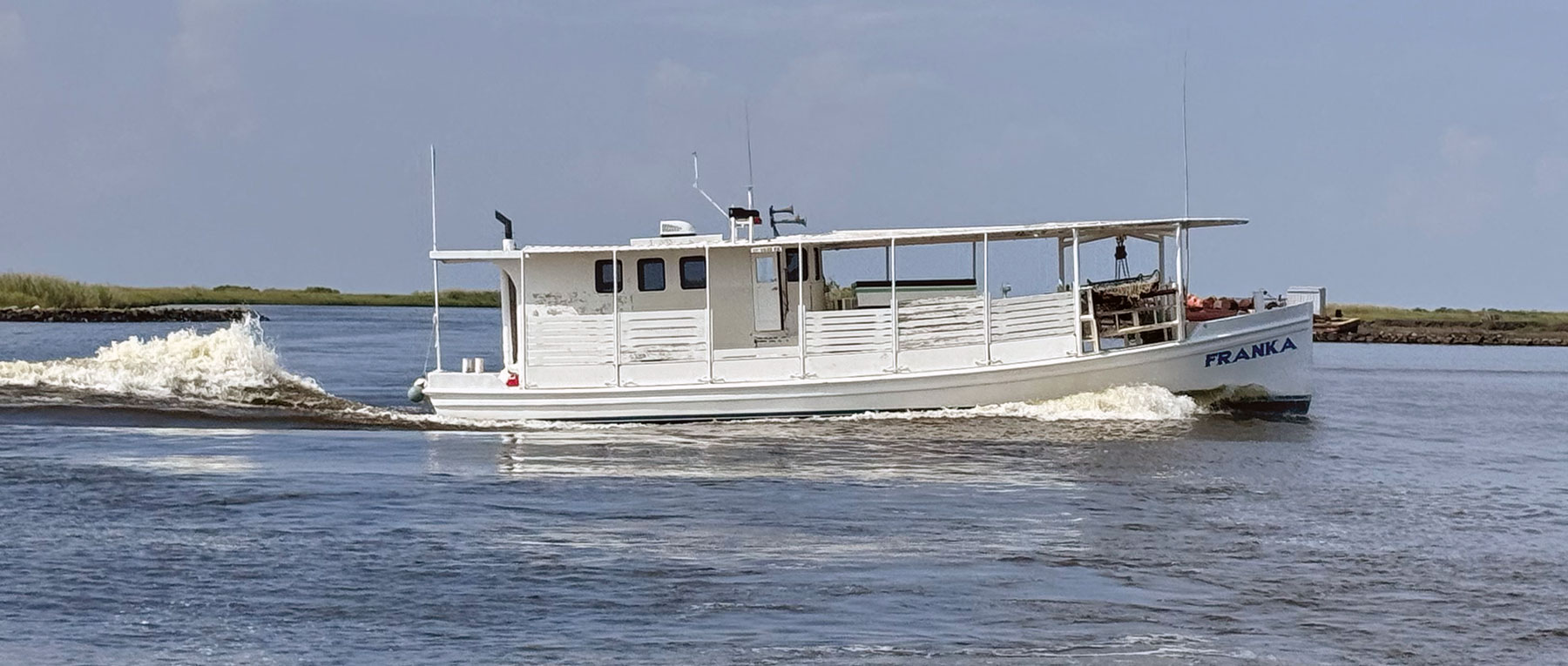
Randy SlavichBiloxi luggers continue a heritage that began with sailing vessels in the middle of the 19th century. FRANKA, based in Bayou la Loutre, Louisiana, was built in 1950 at a Biloxi, Mississippi, boatyard established in 1896 by Jacky Jack Covacevich, one of the region’s many Croatian immigrants. The boat was built for the grandfather of her current owner, Randy Slavich.
You can still find the old girls, though their numbers—once in the hundreds—have dwindled to a few dozen. South of New Orleans, Louisiana, traditional wooden luggers tie up at Empire, Buras, St. Bernard Parish, and other oystering ports deep down in the Mississippi River Delta in shrimpers’ enclaves from Bayou Lafourche east to Biloxi, Mississippi, and you see them in yacht marinas along the northern rim of the Gulf of Mexico. On a fair day, you can see luggers towing oyster dredges near the Chandeleur Islands east of the Delta or dragging shrimp nets. You might spot one of their yachty cousins on a family cruise to the nature preserve at Deer Island off Biloxi or the red-brick bastion of the Civil War–era fort on Ship Island south of Gulfport.
Many of the luggers’ builders and crews are descendents of about 20,000 Croatians who emigrated to the Gulf Coast of the United States, mostly between 1865 and 1915. They brought their heritage of watercraft and commercial fishing with them from the Dalmatian Coast of the Adriatic Sea, and they took the local seafood industry by storm. The immigrants settled in stilt houses above the swamps in the eastern Delta and along the Gulf Coast, where they were known as Dalmatians, Slavonians, or even Austrians.
Library of CongressLining the levee to offload oysters and shrimp for markets in New Orleans, Louisiana, the distinctive single-masted lug-rigged fishing boats shown in this 1910 photograph were very likely built in Biloxi. Biloxi was a center for boatbuilding, especially by Croatian-Americans, and New Orleans was a prime market for fresh oysters and shrimp.
“Here in southern Louisiana, I’m what y’all might call a ‘tako,’” (pronounced “talk-oh”), says 69-year-old Capt. Dave Cvitanovich. “It’s because when people ask Croatians how it’s going, we tend to say, ‘Tako, tako,’ which means in the Croatian language, ‘a little of this, a little of that.’ You hear me?”
Like a lot of people in the Croatian and Cajun communities of the Gulf Coast, Cvitanovich learned the ways of muddy water early in life. At 17, he began working as the captain of his family’s lugger, dredging oysters out of his hometown of Buras in the Mississippi River Delta.
He says that over a century ago, his Croatian-American ancestors used steam tugs to tow fleets of their sailboats loaded with oysters 60 miles to the New Orleans market. The boats came from the lower regions of the Delta up the Mississippi to the city; from points to the east, they arrived via Lake Pontchartrain and the New Basin Canal. These plank-on-frame, round-bilged workboats were small, fully decked, shallow-draft craft, generally 20′ to 30′ LOD. The keel timbers were usually pine. The boats were built with double-sawn frames of local cypress cut in the swamps. Cypress, juniper, or pine were used for hull and deck planking. Few of the boats had bowsprits. The type took its name, “lugger,” from the Dutch word logger, meaning a trawler or dragger, and from their single, trapezoidal, dipping-lugsail rig.
No one knows for certain when or how the type migrated to the Gulf Coast, but it was adopted, modified, and popularized before 1900 by immigrant oystermen and shrimpers from Croatia. Possibly the lugger reminded them of the lateen-rigged falukas they had used in the Adriatic.
Randy SlavichRandy Slavich is still using FRANKA in the work for which she was intended: oyster dredging.
The luggers became a picturesque attraction a hundred years ago as they moored at landings along the New Orleans levees. On almost any given day, you could find them at the foot of Canal Street, drying their tanbarked sails and tendering their oysters to the restaurant- and tavern-keepers of the French Quarter. On their return trip from the city, the luggers carried all manner of freight to their rural homeports. Old-timers tell stories of rafts of watermelons washing onto the lee shore of Lake Pontchartrain after a squall struck a fleet of homeward-bound luggers.
With the advent of gasoline engines, luggers shed their sails, centerboard trunks, and eventually their masts. But they retained their handsome plumb, or nearly plumb, bows; sweeping sheerlines; and low freeboard aft of amidships for hauling aboard oyster dredges or shrimp nets.
As time went by, builders lengthened their motorized luggers to as much as 60′. They added a pilothouse, usually aft, to protect the engine and helm.
Randy SlavichNew hydraulic winches make dredge-hauling more efficient.
According to Cvitanovich, some luggers came from Mississippi boatyards, among them F.B. Walker & Sons in Pascagoula and Toche Brothers Boat Works in Biloxi. There were also builders in the Delta and elsewhere on the Gulf Coast. But so many luggers came from builders around Biloxi, which was a major fishing port, that the motorized luggers eventually became known as “Biloxi luggers.”
Over generations, J.D. “Jacky Jack” Covacevich’s yard in Biloxi produced over 100 well-regarded Biloxi luggers. Covacevich emigrated from Croatia and started building boats on Biloxi’s Back Bay in 1896. His three sons, A. W. “Tony Jack,” Oral, and Neil, continued building wooden luggers until 1982. In addition to fishing vessels, the Covacevichs built lugger-style freighters, party boats, and yachts. They also constructed a few oyster schooners in the 1920s, and in 1992 Neil Covacevich built the replica Biloxi oyster schooner MIKE SEKUL, operated today by the Maritime & Seafood Industry Museum in Biloxi. The yard continued as a repair business until its facility was destroyed by Hurricane Katrina, which flooded New Orleans and pulverized the Gulf Coast east of the Delta in 2005.
In recent decades, Bill Holland of D’Iberville (see WB No. 129), which is across Back Bay from Biloxi, became a respected builder. By the time of his death in 2022, he had not only built the classic oyster schooner GLEN L. SWETMAN, which is also operated by the Biloxi museum, but also built refined Biloxi lugger yachts such as WINE DOWN (ex-MAMA DOLL).
Luggers were ubiquitous on the Gulf Coast until 1969, when Hurricane Camille swept the region with savage winds and a storm surge of well over 20′. The destruction wrought by Hurricane Katrina, along with a shrinking local seafood industry and old age, brought additional blows to the fleet. These ravages left local maritime museums, wooden boat festivals (see Gulf Coast watercraft museums and festivals below), regional Croatian-American clubs, and the dedicated owners of a few lucky survivors to preserve what has been an essential part of Gulf Coast maritime traditions for over 150 years.
Randy SlavichRandy Slavich is still using FRANKA in the work for which she was intended: oyster dredging.
FRANKA
If you are lucky enough to tag along on a road trip down into the Mississippi River Delta with Dave Cvitanovich in his mud-splattered pickup, you are sure to feel as though you have entered a time warp into a world of traditional fishermen and their boats.
“I’m a bayou man, a boat man, a lover of my Croatian culture, and an old bullshooter,” Cvitanovich says with his thick Delta drawl. “I’m going to show you some things you might not believe still exist. You hear me?”
He steers his pickup down Louisiana Route 46 in St. Bernard Parish along the east bank of the Mississippi River, through small towns such as Meraux and Violet. Houses south of here are built on stilts more than 20′ above the marshland, and the Delta is a maze of bayous, sloughs, and canals. Almost all of these narrow waterways have docks with fishing boats tied to them.
When Cvitanovich turns down the Hopedale Highway, in the central Delta, we enter a community that predates by centuries the coastal interstate highway, the waterfront high-rise casinos of Biloxi, the destruction by hurricanes of the magnitude of Camille, and the 2010 Deep Water Horizon oil spill in the Gulf. We are approaching a haven that prizes cultural heritage, self-reliance, and rugged individualism, with a symbiotic relationship with wind and tide, the Delta marsh, and traditional wooden boats.
“Wait till you see the FRANKA,” he says.
A few miles north of the spot where the Hopedale Highway dead-ends in the marshes, the road skirts Bayou La Loutre. There are docks along the edge of the bayou where scores upon scores of oyster and shrimp boats tie up. Many are Biloxi luggers with their distinctive sweeping sheer and aft pilothouses. Most are painted white with sun awnings over their work decks. A dozen or so are big and wooden. Some of the boats have classic American names like MAGNOLIA, LADY ELLA, and LIBERTY. But you can sense the unmistakable influence of Croatia here when you come across a lugger named DUBROVNIK.
FRANKA lies nearby. Measuring 56′2″ × 17′6″ × 4′ and displacing 21 net tons, she slid down the ways at Jacky Jack Covacevich’s yard in 1950. FRANKA and her sisters here on Bayou La Loutre are the remnants of an era when commercial fishing could reliably support a family, with a lugger passed down from generation to generation. Despite her age and traditional design, FRANKA has the well-loved look of a workboat fresh from a builder’s yard. And even though Cvitanovich has known this lugger since his youth, he’s eager to follow her owner and skipper, Randy Slavich, aboard to bear witness to the boat’s recent renaissance, and, of course, “to shoot the bull.”
“I think she is one of the best around the Delta,” says Cvitanovich, taking a seat behind the helm.
Slavich says his grandfather had the Covaceviches build FRANKA. She is named after Slavich’s grandmother.
“After my deeda [grandfather in Serbo-Croatian] got the FRANKA, Pops, my father, worked her. He died right here in the cabin at that table.” There is reverence in his voice as he talks about his father’s death, and it’s clear that Slavich feels an emotional bond to his lugger.
“I couldn’t let her go,” he says. Slavich is in his mid-60s, muscular with a silver ponytail, a goatee, and a ready smile. “A couple of years back, I totally rebuilt the hull, deck, and house. I took out the old GM 6-71 and replaced it with a new 450-hp Cummins QSM11. She’s some fast.”
He tells Cvitanovich that he also added state-of-the-art hydraulic-powered oyster dredges and a modern autopilot. Then he points to the open front of his electrical panel.
“I’m still finishing the wiring,” he says, “and I want to add interior paneling in the pilothouse. But I’ll get her there.” He speaks like a man making a promise to his family, and maybe to his ancestors and the traditions of the Croatian-American community of the Gulf Coast. Someday he will pass this lugger on to the next generation.
“Won’t that be something?” Cvitanovich closes his eyes and smiles, possibly picturing FRANKA still fishing on her hundredth birthday…like one tough tako.
Cynthia PowellIn 1980, KING ARTHUR’s hull was framed by Bill Holland, planked by George Peleaz, and finished out by Ronald “Boogie” Baker and his brothers Alvin and Donald, who configured her for shrimping.
KING ARTHUR
“Don’t get me wrong,” Cvitanovich says: “Not everyone with a lugger is a tako.” We are back on the road again, heading for Biloxi. He wants me to meet the Baker brothers, who he says are lugger royalty. Ronald “Boogie” (pronounced Boo-jee) Baker keeps his shrimper KING ARTHUR at the Biloxi Commercial Harbor. In essence, KING ARTHUR is a working example of a wooden Biloxi lugger for tourists on the docks to see.
Robert CarterKING ARTHUR is a regular at the Billy Creel Memorial Gulf Coast Wooden & Classic Boat show at the Maritime and Seafood Museum in Biloxi, where this photograph was taken in 2023. Below right—Shrimp nets call for elaborate winch systems.
Boogie and his older brother, Alvin, are in their 80s now. We meet them at what amounts to something like a family compound in the center of Biloxi where Boogie is recuperating from heart surgery. He explains that although he has never been more than 200 miles from Biloxi, he has not always lived in this spot. The Baker brothers grew up on Deer Island off the entrance to Biloxi Bay. They rowed to the mainland every day to go to school; sailed for fun; worked on their father’s Covacevich-built, fishing-party lugger, DORIS MAE; and went shrimping with their cousin.
“Our great-grandfather came to Biloxi from Norway on a lumber schooner. You could say boats are in our blood,” Boogie says. “I rebuilt a sailboat when I was 16. I courted my wife in a sailboat. We liked moonlight sails. I was married at 19. Had three children by the time I was 24. It was a different time. I’ll tell you that. It was a good time, living on Deer Island with all our wooden boats.”
Robert CarterShrimp nets call for elaborate winch systems.
“Until Hurricane Camille came along,” says his brother Alvin. “I lived out there for 28 years, 1 month, 17 days, and 12 hours. We got off just as Camille hit. She took everything. All four of our houses. The tidal surge peeled bark off the trees on Deer Island up to 30′. You can’t live there now.”
But the Bakers still had DORIS MAE, and they started to rebuild their lives on the Biloxi mainland. They knew the Gulf. They knew how to run and maintain boats, and they knew how to fish. By 1980, the shrimp business was good enough that the Baker brothers decided they needed a new lugger. They went to see Bill Holland in D’Iberville, and he offered them a deal: he would lay the keel and set up the frames for a Biloxi lugger 41′×3′7″×3′7″, 15 gross tons, 13 net tons. The Bakers could finish her.
“George Peleaz and his son planked her up with 6/4 juniper on the double-sawn cypress frames,” Boogie says. “They fastened her with 316 stainless-steel ring-shank nails. Alvin was running supply boats for the oil companies at the time, so my brother Donald and I finished rigging her.” After installing a GM 6-71 engine, the Bakers named the boat KING ARTHUR for Alvin’s son, Arthur, and as a nod to Old World traditions of chivalry. Then it was time to go catch shrimp.
“We’ve been doing it now 44 years, the KING ARTHUR and I. Good times and bad,” Boogie says. “I fish with a single rig. Most fellows fish with two nets, but I can fish a single rig alone. I kind of like being out there by myself, or with my sons when they’re around. It’s just us, the boat, the Gulf, and the shrimp. It’s peaceful, you know? I guess we’ve done all right. The boat raised a family of six kids. We have provided. When I was young and foolish, I used to take her out in the Gulf. These days I work the Intracoastal Waterway inside Ship Island and Horn Island. Brown shrimp and white shrimp mostly.”
For many shrimpers, a lugger is a tool to pursue a yearning for catching things and a means to earning a living. But as Boogie Baker talks, you get the feeling that, for him, boats themselves are his passion. Shrimping is as good an excuse as any to get him out on the water in KING ARTHUR or to grab some timber and tools for one boat project or another.
“She needed a new sheer plank on one side a while back. I got that done at her annual haulout. You know, it’s never just a plank. It was the covering board, the bulwark, stanchions, cap, but I enjoy that sort of thing, fixing wooden boats,” Boogie laughs. “I read WoodenBoat religiously. I may well have more boats than I have sense.”
His point becomes clear as he leads Dave Cvitanovich and me to a metal building behind his house. The building contains a virtual museum of classic wooden daysailers on trailers, each with spars and furled cotton sails laid neatly on top. Among them is a one-design keelboat called a Biloxi Yacht Club Fish Class, a 16′ Albury Brothers Abaco dinghy, and a pair of beamy catboats.
“Shrimping season ends in November. That’s when the KING ARTHUR gets some rest, and I can go sailing all winter,” Boogie says. “Right now, I want to get that round-bottomed catboat overboard so bad and go sailing, I can taste it. That’s the truth.”
Andy FountainRobbie Carter runs sportfishing tournaments, and although he uses LILY FAITH as a company office, he conceives of her more as a family boat. He often takes spur-of-the-moment outings with his three children, and he named the boat after his daughter.
LILY FAITH
As if to prove that Biloxi luggers are not just a passion of an older generation or the domain of shrimpers and oystermen, Dave Cvitanovich’s road show continues east across Biloxi Bay to a snug harbor in Ocean Springs, Mississippi. Here, tied up among the sportfishing yachts, fiberglass sailboats, and shrimpers, is a Biloxi lugger looking like a million dollars. Her brass ports gleam. Her white, two-part urethane paint looks like liquid silk.
“It was two years ago on my 40th birthday,” Robbie Carter remembers as he invites us aboard. “I needed an office and a boat, so my children and I came to look at this lugger that might do double duty. Immediately they started running around and climbing on everything like it was a floating tree house. They were shouting ‘Yeah, Dad, yeah, Dad. Let’s get it.’ That’s when I pretty much knew—no, I absolutely knew—we were going home with a boat.”
While Carter was growing up, he used to look through a photo album of his father Bobby’s cruise as a boy to the Bahamas aboard a lugger named SHAMROCK. “I dreamed of taking a cruise like that,” he says. “At one point my dad introduced me to his favorite movie, Captain Ron,” he says. “I was hooked. I wanted to have a family adventure like that, bringing an old boat back to life.”
Andy FountainAndy Fountain spent three years rebuilding a shrimping lugger launched in 1954 and repurposing her as a pleasure boat. Two years later, in 2022, he sold her to Robbie Carter, who changed her name from MA CHERIE to LILY FAITH.
The lugger that Carter has renamed LILY FAITH, after his youngest child, is a former shrimper (ex-MA CHERIE, ex-SHRIMP QUEEN) built by Covacevich in 1954. Her previous owner, Andy Fountain, had her completely rebuilt over three years, ending in 2016, at Kennedy Marine in Gulfport, Mississippi. LILY FAITH is 47′ LOA, 53′ with her swim deck. Her frames and planking are red cypress on a pine keel. Like so many other Biloxi luggers, she has a GM 6-71 for power. And, no question, today she looks elegant.
“I didn’t know owning a boat would be such a process, but I should have guessed I was in for a marathon when trying to buy the boat started with a serious interview with Andy and his wife,” at McElroy’s Harbor House Restaurant in Biloxi. “There were other interested buyers, and the Fountains wanted her to go to a good home. I think what might have sealed the deal is when I told them I wanted to make memories with my kids on the boat.”
Carter works with his father. They organize major sportfishing tournaments, among them the iconic Mississippi Gulf Coast Billfish Classic (www.ClassicFishingEvents.com), where as many as 90 anglers compete for millions of dollars in prizes.
“I thought it would be cool to make the LILY FAITH a centerpiece on the tournament docks,” Carter says. “The competitors have really fancy boats, but they all grew up with simpler ones. I think the LILY FAITH reminds them of their inner child. They all want to come aboard and tour her. She was basically a done boat when I bought her. All she needed was a personal touch to make her really classy.”
Just about the first thing Carter did was to hire painter Byron Lopez to work his magic.
“He was incredible,” Carter says. “He painted this boat with Tenceur art paint brushes, which we bought in bulk. He said the secret to a good paint job was patience. I learned so much from Byron. This whole evolution of the LILY FAITH has been about patience.”
With patience as his new mantra, Carter and his family went in search of details to make their Biloxi lugger sparkle. He wanted the paint and fabrics to reflect the blonde, blue-eyed appearance of his daughter Lily Faith, so he went to Southern Stitch Canvas & Upholstery for just the right fabrics and cushions. Release Marine, one of the tournament sponsors, provided an elegant helm chair for the steering station and a saloon table with an inlaid fleur-de-lis. Carter has added state-of-the-art Garmin electronics, and Bob Fuller of South Shore Boatworks in Massachusetts is making a custom wooden steering wheel.
But when Carter talks about why he loves LILY FAITH, he never talks about her custom accessories, fine finish, or how much he has spent to make a showboat out of a shrimper. What he talks about is his kids: “When school gets out on Friday, we all jump aboard and go for a ride,” he says.
Sometimes LILY FAITH and her crew do an evening tour around Biloxi Bay. Sometimes they go for an overnight at Horn Island or Ship Island, where Boogie Carter and KING ARTHUR might be shrimping. They may even head southwest to FRANKA’s home waters in the Mississippi River Delta or up through Lake Borgne and the Rigolets strait, to Lake Pontchartrain and New Orleans.
“The boat knows her way, for sure,” Dave Cvitanovich says, as if he is already picturing another road trip, maybe next time to the western Delta and the pirate Jean Lafitte’s hideaway in Barataria Bay. “It’s all lugger country. It’s all about tradition and family. You hear me?”
Robert CarterBateaux and luggers are typically among the boats shown at the Maritime & Seafood Industry Museum’s annual classic boat show in Biloxi.
Gulf Coast watercraft museums and festivals
• Maritime & Seafood Industry Museum, Biloxi, Mississippi. Established in 1986 to preserve and interpret the maritime history and heritage of Biloxi and Mississippi’s Gulf Coast, the museum houses a collection of small boats as well as exhibits on the local shrimping, oystering, and boatbuilding industries. A film brings to life the destruction caused to the area by hurricanes such as Camille and Katrina. The museum also operates two full-sized replicas of Biloxi oyster schooners, the MIKE SEKUL and the GLEN L SWETMAN, which sail with passengers daily.
In late May or early June, the museum’s Biloxi Schooner Pier Complex, near where Boogie Baker keeps KING ARTHUR, hosts the Billy Creel Memorial Gulf Coast Wooden & Classic Boat Show.
• Lake Pontchartrain Basin Maritime Museum. Located in Madisonville, Louisiana, the museum has a large collection of indigenous watercraft. Its annual mid-October wooden boat festival draws thousands of visitors to view traditional pirogues, operating putt-putt bateaux, luggers, and (usually) one of the Biloxi oyster schooners. ![]()
Randall Peffer is a regular contributor to WoodenBoat.