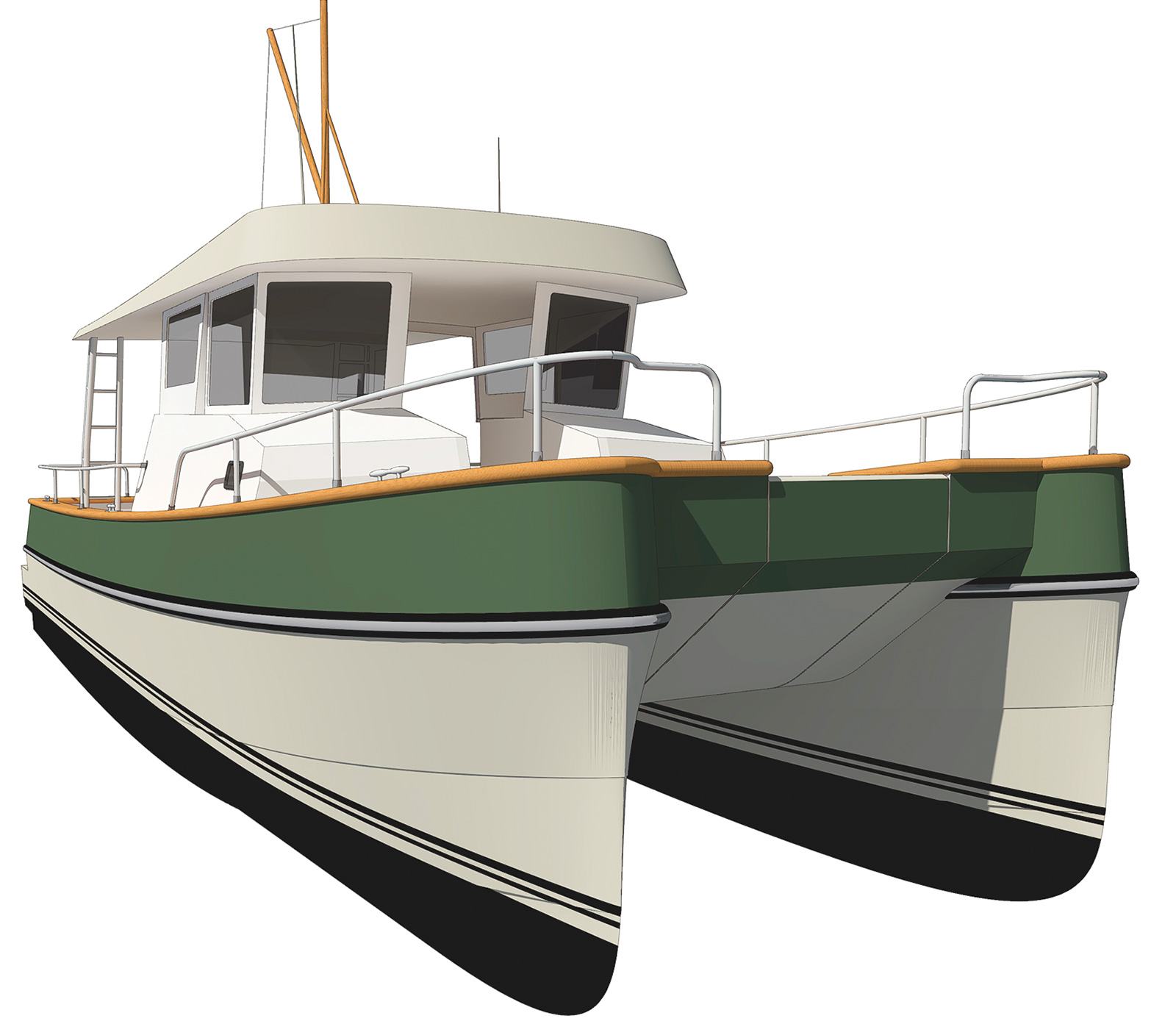
“Electric power mated to a catamaran is a match made in heaven.”

“Electric power mated to a catamaran is a match made in heaven,” says designer JF Bedard, as he explores the pairing in a 34′ concept catamaran meant mostly for day use.


Dear JF,

The cover of WoodenBoat No. 294 (September/October 2023) heralded the presence of an electric catamaran in that issue. You and I had discussed this idea as a Sketchbook concept, and in a burst of enthusiasm I put it on the issue plan. We ultimately pursued a different boat for that magazine, but that catamaran remained on the original lineup from which the cover lines were written; through a combination of deadline fatigue and continued enthusiasm for the boat, we overlooked the error. By “we,” I mean the editorial “we.” I own that error.

However, the correspondence resulting from that mistake serves as a sort of de facto market study for an electric catamaran: many of our readers wanted to learn about this boat. I also want to learn about this boat and am eager to see the possibilities. Here are the parameters:

  • A roughly 28′ dayboat powered either by pod, outboard, or inboard electric motor(s)
  • A catamaran, for stability, space, and efficiency
  • A range of 100 miles at a cruising speed of 12 to 13 knots.
  • Although this is a dayboat, the crew will be spending long days on it, and maybe even camping aboard occasionally. So it needs sheltered space for food storage and preparation—as well as a place to get out of the sun, wind, and rain on long day trips. It also needs sole space for at least two camp mattresses.
  • The traits described above could be achieved in a rather bland pontoon boat, but we wooden boat aficionados have a taste for tradition. Could this boat draw inspiration from, say, a purposeful tugboat? Is that too much of a stretch?

Thanks for your consideration. We look forward to delivering on the promise of that cover line.

Matt Murphy
Editor, WoodenBoat


Matt,

I’m aware of the mishap resulting from our conversation about the electric catamaran, and I was hoping for an opportunity to put that design together. I must smile that the error directly led to this issue’s conceptual design. Here goes:

Electric power mated to a catamaran is a match made in heaven. From the livability standpoint, a cat is a large and stable platform; instead of being long, pointy, and full of nooks and crannies, it is flat and rectangular, like a house. Yet the hulls can be made long and narrow, which, to loosely quote the designer Nigel Irens, makes for “happy bubbles”; in other words, an easily driven, efficient hull. This comes at no cost in stability, and is completely independent of the living space above it. The clincher is in the solar array potential. Take it from a Florida resident: the first thing you do when you live in a place where the sun shines all the time is get out from under it with some sort of shelter. A catamaran, being a large, flat, rectangular platform covered with a large, flat, rectangular roof, begs for solar panels to charge the batteries for its electric motors.

Nice sales pitch, isn’t it? Actually, I think this reality is coming our way fast, but designing an electric boat today requires some compromises that might very well not exist in five or ten years. What better way to go over them than to give the old design spiral a good spin and take you along with me?

The hulls have a few degrees of rocker in the run.

The hulls have a few degrees of rocker in the run, slightly submerged transoms, maximum underwater volume placed forward, and sharp forefeet. For good seakeeping, adequate bridge-deck clearance is imperative.

The Concept

To maximize space in a boat, one must think in layers: I need a helm station, a head, a cabin. How can I use the space available in the hull(s)? Is the structure visually offensive, and how can I integrate it into a multifunctional whole? A monohull has the deepest part of its hull, its maximum volume, on the centerline. The more outboard one goes, the less volume and the more awkward the shape is to work with. It only makes sense to have a monohull’s helm on the centerline because of all the usable volume under it. That’s not so in a catamaran. In fact, the opposite is true: The useful volume of the hull is outboard, and seakeeping requires me to prioritize maintaining a high bridge-deck clearance off the water, and therefore reduce volume to a minimum on the centerline. If I put the helm amidships, not only am I giving up the possibility of using any space under it (unless my client is a Hobbit), but I’m also forgoing the deep, useful hull volume outboard: How else will the passengers walk past the helm? A centerline helm is a great solution for monohulls, but not so great for catamarans.

Particulars

  • LOA:  34′9″ (10.6m)
  • LWL:  34′4″ (10.47m)
  • Beam:  10′9″ (3.26m)
  • Draft:  1′6″ (0.45m)
  • Displ. (50% Load):  10,200lb (4,640kg)
  • D/L Ratio:  112
  • Power:  147hp (109kw)
  • Battery:  240(kwh)

I’m going to put the helm to starboard and place the head in the port hull, which affords it proper headroom at no cost to helm visibility and styling. What am I left with? A wide passageway amidships that connects the forward and after decks into a single integrated space.

Now let’s look at the wide hardtop covered with gear and solar panels. This promises to be rather heavy and will need support. If the helm were on the centerline, I’d have to create columns or pillars outboard to support it. But in this catamaran, the windshield of the outboard helm doubles as a support for the roof. Mirroring this arrangement to port makes the entire superstructure into a traditional-looking, visually pleasing affair. The large opening in the forward center of the cabin is surprisingly inconspicuous, considering the advantages it provides, and it can be closed off with canvas when the weather requires.

This catamaran will primarily be used for single-day outings, with just enough superstructure and accommodation for the users to take advantage of shoulder seasons. The beam dictated by the layout is about 10′, which in turn suggests a length in the low-30′ range. She will be propelled by electric outboard motors, which might bring her to planing speed at full throttle and give her a cruising speed in the low teens. Her range will be typical for single-day use, and she will recharge at the dock.

The helm is to starboard.

The helm is to starboard, leaving space for a centerline walkway and a head in the port hull.

The hull has the typical traits of a semi-displacement form, which are a few degrees of rocker in the run, with a slightly submerged transom; the underwater volume rather forward; a sharp forefoot; and special attention paid to spray deflection forward. Each hull has a length-to-beam ratio of 10:1. The tunnel clearance aft is 12″ at full load and significantly more at the bow. Integrated transom brackets allow the outboards to be mounted higher than they would be otherwise, allowing operation in shallow water. Stylistically, the twin spray rails divide the high vertical topsides. I’m using a displacement of 10,000 lbs, based on a boat weight of 8,000 lbs (more on that later) and 2,000 lbs cruising load. The displacement-to-length ratio is only 112. Despite this being a spacious, 4¼ton beast, from the water’s point of view this kitten is light and slim.

 Propulsion and Efficiency

There is sufficient shelter and accommodation for shoulder-season use.

There is sufficient shelter and accommodation for shoulder-season use. Fold-down steps forward, and a fold-down platform aft, allow for easy boarding.

People have strong opinions on the subject of electric propulsion, so this is a slippery subject. I’m going to steer safely around this reef by focusing on practical design aspects, leaving out the economics of it.

Gas engines waste a significant portion of the energy they consume into heat and inefficiencies. This is less so with electric motors. That fact makes a direct comparison very muddy indeed. But I must compare apples with oranges, so I will allow the electric outboard a 20-percent efficiency increase over the equivalent internal-combustion engine, a number claimed by a leading manufacturer of electric outboards that seems reasonable enough. In other words, side by side and consuming the same energy, the electric outboard will develop 20 percent more power at the propeller. Another argument in favor of electric propulsion is that it is well-suited to low-rpm, high-aspect-ratio propellers, but this is mostly in low-power and low-speed applications, neither of which is the case here.

Twin 50kW electric outboards.

Twin 50kW electric outboards will push eCAT to 19 knots, just a few knots beyond theoretical planing speed.

Our eCat will leave the displacement regime above 8 knots and get up on plane at about 17 knots. I’d like to get enough power on her to barely reach that point so that she’ll cruise comfortably at 12 knots. Twin 70-hp (52kW) gas outboards would top out at 16 knots, and twin 50kW electric outboards would push her to 19 knots, taking into account the efficiency gap.

Range is our next stop. This is where things get problematic, because range is a function of battery capacity. Energy is the same whether it is stored in a fuel tank or a battery; therefore we can compare the power stored within 1kg (2.2 lbs) of gasoline versus that stored in 1kg of battery via mass-based energy density. That of batteries is in the range of 0.05 to 0.27 kWh per kilogram: a Tesla 75kWh battery weighs 480kg (0.16Kwh/kg), and an 8D AGM battery packs 3.2kWh into 76kg, (0.04Kwh/kg). Lead-acid is the heaviest, and LiPo is the lightest per kWh.

On the other hand, 1kg of gasoline contains 13kWh of energy. That is almost 80 times more than the ubiquitous lithium-ion battery. It’s a truly massive difference, and unfortunately it is the reality we must contend with today. There are many ways to skin an eCat, if you’ll allow me the pun: slowing the boat down, reducing the range, increasing displacement to allow for a large battery pack, and choosing the most efficient motors available. Add to this list an efficient hull form, which we’ve already accomplished.

One design direction could be regenerating charge as you go, using solar panels, which I touched upon at the beginning of this article. Let’s explore this avenue for a second: If we cover our entire 34′× 10′ catamaran hardtop with panels that generate 20 watts per sq ft, we could produce 6.8kW, or 9 hp, potentially propelling her to 6 knots. If our design brief was for long-range cruising at displacement speed, this has the potential to be a very interesting scenario. What we’re after here, though, is a continuous 12 knots, which requires 54kW, so the solar array is of marginal use.

Which brings me back to using a battery pack and the compromises that implies. The most obvious compromise I see is reducing range, because people tend to overestimate their actual need by a lot. I’m going to assume a range of 45 nautical miles—almost four hours at 12 knots—to be the minimum acceptable for a day. Using a lithium-ion battery, which I can deplete to 20 percent, means I must store a whopping 240kWh, and this baby will weigh 3,800 lbs. Remember, I had 8,000 lbs to build the boat, so really the entire structure has to come out at 4,200 lbs. This is dicey! The beauty of electric power, though, is that I don’t have to account for fuel, so perhaps 2,000 lbs of cruising load can be reduced to 1,000 lbs most days, leaving us 5,200 lbs for structure, which is attainable with a well-designed wooden hull.

Construction

The hulls are strip-planked in western red cedar sheathed in 10-oz fiberglass cloth.

The hulls are strip-planked in western red cedar sheathed in 10-oz fiberglass cloth; 12mm plywood bulkheads are spaced roughly 42″ on center. The batteries live under watertight lids let into the deck that are opened only for maintenance.

The hull shape is not developable (that is, it can’t be built from sheet material such as plywood), and we’re looking for the lightest option possible. Therefore, I propose strip-planking her with western red cedar sheathed in 10-oz fiberglass cloth and building the hulls with 12mm plywood bulkheads spaced roughly 42″ on center. The sole and foredeck will be of 18mm plywood, the superstructure 9mm, and the roof 6mm. The batteries are roughly on the center of gravity under “soft patches,” which are watertight lids set into the deck that are opened only for battery maintenance.

eCAT is flat and rectangular, and thus livable.

In contrast to a monohull, with its long pointy shape and nooks and crannies, eCAT is flat and rectangular, and thus livable.

Matt, I hope that our eCat scratched your electric itch! I’m grateful to have been given the opportunity to explore this boat further, and I am now quite convinced that it is an excellent solution from both practical and stylistic standpoints. I am also glad for the opportunity to dig a little deeper into electric propulsion, since environmental consciousness nowadays has to be factored in at the design stage. The challenges have the potential to be offset by the very real increase in quality of the cruise (with neither the smell nor noise or gasoline engines). The cost in range might seem steep today, but we can expect that the vast resources allocated to research in the automotive industry will trickle down to boats soon. In the meantime, I’d be perfectly happy to sniff the wind and let my mind drift to the music of water gurgling by the hull…at powerboat speeds. That’s no compromise!  Article ends.


JF Bedard is a graduate of the Westlawn Institute of Marine Technology. He owns Bedard Yacht Design (www.bedardyachtdesign.com) of Tarpon Springs, Florida.

Please send concept proposals for Sketchbook to sketchbook@woodenboat.com.