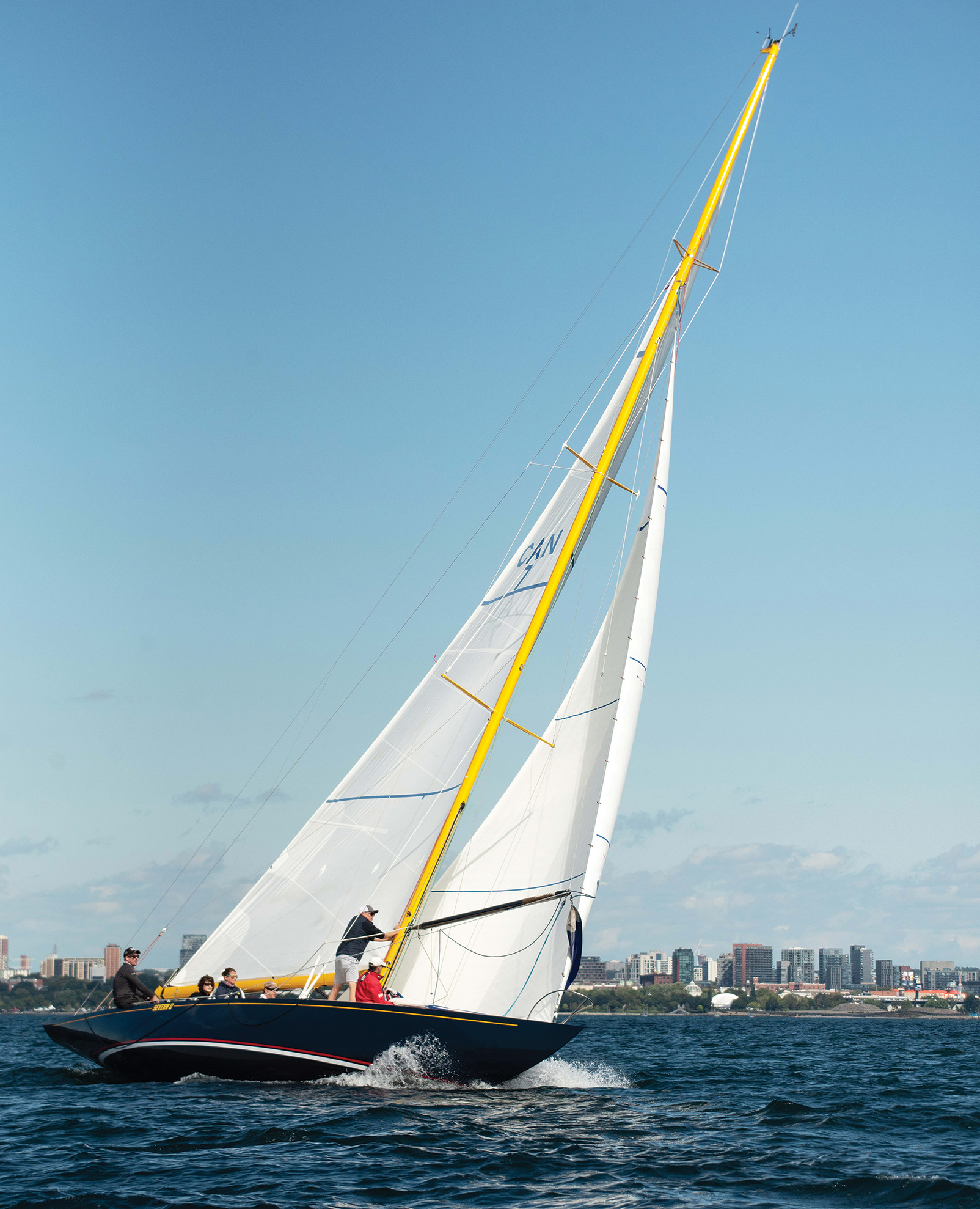
The 8-Meter-class sloop SEVERN II.Bruce Kemp

The 8-Meter-class sloop SEVERN II was designed by Alfred Mylne and built by Bute Slip & Dock Co. in Scotland in 1934. A mid-race collision in 2023 sent her to the bottom of Lake Ontario.

In late spring 2023, Steve Reid, the Ontario, Canada-based owner and skipper of the modern 8-Meter-class sloop YQUEM, was forced, while racing, into a series of fast maneuvers off Toronto Islands that resulted in a collision that sank the historic 8-Meter SEVERN II. Although the event was traumatic for all involved, nobody was hurt, and the recovery that followed was remarkable.

It was a brilliant day with winds gusting between 15 and 20 knots; the seas were lumpy but not concerning. “The collision,” Reid recalled two months later, “was probably the result of a whole bunch of things that started going wrong.” The boats were on the first downwind leg of a double windward-leeward course. “We were hot on the heels of LAFAYETTE—another modern ’glass 8-Meter—and we’d been battling with them the whole downwind leg.”

SEVERN II was refurbished and relaunched.Bruce Kemp

After a delicate and carefully planned recovery, she was refurbished and relaunched last year.

LAFAYETTE was heading for the downwind turning mark but apparently mistook the finish mark—positioned in the same area of the course—for the turning mark and went for that instead. “All of a sudden, we realized that the [turning mark] was actually now upwind of us. So, we quickly got rid of the chute and turned the boat around.”

When YQUEM arrived at the mark, she was crowded in with another fleet and had to dodge and weave, eventually jibing. The jibe left Reid and his crew in a mess and working feverishly to bring the main in and get the boat into upwind trim. It took 10 critical seconds while they were on port tack. “I’ve counted it out on the video of the accident. We were concentrating on getting the boat going and didn’t even see SEVERN II coming across on starboard.” SEVERN II was steered by her owner, Cedric Gyles Jr.

YQUEM was forced to sail by the lee to get around the mark. They jibed around to start going upwind on port tack. “In a normal situation, there wouldn’t be a boat coming from that area—but there they were. We saw them a second before the impact. At that point we really couldn’t do anything. If we’d headed up, we’d have still got hit, and if we’d borne off, we’d have hit him head on. We were trapped. That’s how the collision happened.”

Reid thinks the two boats came together at a 70-degree angle. As SEVERN II crashed into YQUEM, her bow rode up to the point where Reid could see her boottop well above YQUEM’s gunwale. SEVERN II glanced down the side of YQUEM’s cabin. Then SEVERN II’s stem hit YQUEM’s big three-speed Lewmar winch and sheared it off.

To compound the difficulties caused by the collision, YQUEM’s leeward running backstay, which had been fully run out, snagged SEVERN II’s bow. “So now SEVERN II was trapped between our lower runner and as they slid back, that took up the tension on the runner.” YQUEM’s mast then came down on SEVERN II, and Reid recalls that one of his crew dove below to fetch a pair of bolt cutters to cut loose the forestay, which had looped around SEVERN II.

Untangling the boats took a few minutes, distracting the crews from a more serious problem. On SEVERN II, Ced Gyles didn’t notice the intake of water right away. “I think, unfortunately, it was too late by the time we realized it. We started the engine, and it stalled as the water rose up and over it.”

YQUEM’s mast was in two pieces. Reid’s crew recovered both sections but couldn’t free the mainsail from the mast track. A Canadian Coast Guard Rescue boat towed the crippled YQUEM back to her home base at the Etobicoke Yacht Club about 5 miles southwest of Toronto Harbour, where they had to hoist the mast, rig, and sail in one piece to set it on the lawn before it could be sorted.

The Sinking

SEVERN II settled upright into the lake’s bottom sediment.Eric Rogers/Toronto Drydock

SEVERN II settled upright into the lake’s bottom sediment. An inspection of the wreck by remotely operated vehicle revealed that the gooseneck could provide an ideal lifting point for the recovery.

“Both boats certainly would have been doing 6+ knots,” John Gyles said when I went to see SEVERN II, mid-repair, in his shop in Thornbury, Ontario. He is Ced’s brother, and maintains the boat. “Trying to get a time frame out of anybody is going to be next to impossible, only because of the fact they were so preoccupied. I think the people on SEVERN II were so busy trying to separate the boats, they didn’t realize they’d been holed.” Pointing to a 1′-long slash just above the waterline on the starboard side, John said, “By the time they figured out what was going on, there was so much water in the boat this would have been underwater.”

SEVERN II’s 2,000-gallon-per-hour automatic bilge pump’s 1⅛″ hose was insufficient to deal with the flooding. “It’s pretty significant,” John said. “The only thing that probably slowed it down a bit was YQUEM’s genoa car was wedged in the hole.”

As SEVERN II began to settle, the crew was picked up by other boats. “They had time to grab what they needed to and get off the boat,” John said. “My nephew, Will, had to be virtually dragged off. He was not going to let her go. He was bailing in a panic but obviously couldn’t keep up.” Finally, SEVERN II was awash and gently pitched forward as she sank. The lake is 189′ deep at the collision site, and the yacht touched down with a gentle landing into 4′ of muck. The only substantial damage from the landing was to the rudder.

“The bottom was a lot softer than we anticipated,” John said. “Everybody expected her to hit a hard bottom and fall over—or shove the keel up through the bottom of the boat. There’s no evidence of that. She was up to her waterline in mud.” The sinking took place on Saturday, June 17, 2023. There was a lot of video footage of the event, and it was aired by national and international news outlets. Before leaving the boat, the crew recorded the coordinates of the sinking, which proved fortuitous.

Raising the Boat

SEVERN II was raised to the surface.Eric Rogers/Toronto Drydock

Late in the evening of July 29, 2023, 11 days after the sinking, SEVERN II was raised to the surface, towed to a nearby marina, and then trucked 108 miles to Thornbury, on Georgian Bay, for repairs.

SEVERN II was raised 11 days after she sank, late in the night of June 29. Discussion of how to recover her centered on lifting by the gooseneck because of her position in the muck. John Gyles, who was ready to oversee the restoration, called in the naval architect Steve Killing, who was able to give Eric Rogers enough weight and buoyancy information to formulate a lifting strategy; Rogers owns Toronto Drydock, the company hired to raise the boat.

Killing thought she would come off the bottom bow-up at a 30-degree angle if she were hoisted by the gooseneck. “Success depended on how the gooseneck was attached,” he said. “SEVERN II’s gooseneck was fastened with 10, ⁵⁄₁₆″ bolts. The aluminum mast sits in a slotted aluminum step and the mast heel has a tenon that fits into the slot.

“It was a technically very challenging operation for us,” Rogers said. He, like a lot of Toronto Harbour denizens, is a second-generation mariner. His father, Norm Rogers, owned and operated Toronto Drydock Ltd. beginning in 1989. “With SEVERN II being a wooden boat, there isn’t a lot of weight to it underwater,” he said. Killing conservatively calculated the boat’s underwater weight at 15,000 lbs, and determined that the gooseneck would take that weight. Out of the water, she weighed approximately 21,000 lbs. When Toronto Drydock lifted her, the crane’s scale never ticked above 10,000 lbs, not even as the boat broke the suction of the mud.

There was much concern over whether the running backstay was on; without it, the mast would not be secure. The photographs of the sinking boat suggested that the stay was engaged—as did the presence of a handle in its winch. Despite this encouraging detail, “it was very much touch and go,” Rogers said. “It’s always a little bit of a guess. We also had to decide whether the lift would compromise the [hull] structure.”

Boats don’t often sink straight down. Currents, waves, and the changing trim of the boat can send it scurrying in all sorts of directions before it hits bottom. Rogers contacted Orange Force Marine, a company specializing in hydrographic and bathymetric surveys for underwater exploration. Their role was to find the boat on the bottom. “While we had an initial indication of where the vessel went down,” said Derek Niles, president of Orange Force Marine, “nobody knew exactly where it was sitting. For Eric to move his barge and lifting equipment directly overhead to raise the vessel, we had to find it first.”

Orange Force Marine used side-scan sonar to pinpoint the yacht. They started with a rectangular search grid. Each pass of the sonar emitter—the so-called “tow fish”—covered about 300′ on each side of its course. Because SEVERN II’s crew had the presence of mind to log the coordinates before leaving the boat, Orange Force found the yacht within 45 minutes of starting the search.

They then deployed the recovery tug RADIUM YELLOW KNIFE. Once the tug was in position, Niles launched his remotely operated vehicle (ROV) to inspect the boat to determine how she was lying. Although SEVERN II was within technical diving range, the cost of bringing in professional divers would have been prohibitive. So, with the yacht located, Rogers’s crew devised a plan. First, an ROV-mounted pole was used to fish a messenger line across the boat, from one side to the other, below the boom. The ROV then maneuvered to the opposite side and grabbed the line with its manipulator arm and rose to the surface with it. “The goal was to ‘choke’ the mast,” Alex Gold told me, “essentially putting a big slipknot [around it] then gently hauling up with a crane.”

It sounds simple, but there were complications caused by the tangle of loose lines surrounding SEVERN II. “It ended up taking quite a bit longer than we anticipated to get the line threaded properly. It isn’t easy to lasso something entangled by ropes and wire rigging”—especially from a boat that is rocking and rolling as waves on Lake Ontario were beginning to build. “We were very lucky she sank upright, as this meant we could get right to the bottom of the mast and minimize any damage.”

Next, a heavier line, ¾ in diameter, was spliced onto the messenger line and sent back down. It was successfully pulled through the maze of obstacles. Finally, the 4″-diameter lifting line was rigged, which proved challenging because the gooseneck had a very narrow V-shape through which it had to pass, and the two splices connecting the ¾″ and 4″ lines would jam in it—as well as catch in the loose rigging lying about on the deck. Further complicating the process, the lines, and especially the 4″ lifting line, were so buoyant the ROV couldn’t pull them down to pass below the boom. The salvage crew eventually weighted the lines with large shackles. When they finally passed the 4″ line below the gooseneck, it got tangled in the rigging strewn on deck and Gold had to start this part of the operation over again. “We made another attempt to pass the line below the gooseneck but picked up a sheet on the deck.” They finally solved the problem by tensioning the fixed end of the 4″ line that led to the surface, giving a better angle of pull. The large line then passed through, and the shackle-weights allowed Gold to tighten the slipknot on the mast. This phase of the operation took almost eight hours.

They then carefully raised her with a deck-mounted crane over the course of three hours, the crane operator continually adjusting the rate of ascent because the seas were starting to build. Because SEVERN II was in 189′ of water, and the crane had a lift of only 60′, the lifting gear had to be reset three times. The crane’s cable was attached to the 4″-diameter line with a basket hitch. When the crane cable reached its maximum lift, the lifting line was tied off to a bollard on the barge to suspend the yacht while the tackle was reset lower down on the lifting line. It was a slow process.

“We brought SEVERN just to the point where the bow was going to break the surface.” Rogers said. Then they stopped, because when a salvaged boat breaks the surface, the apparent weight increases. This was a critical point in the operation. “It was getting close to midnight. We used the ROV to rig another messenger line to pull a sling around the stern of the yacht” so a second crane could balance the final lift.

The salvage team placed four, 2″ submersible electric pumps aboard SEVERN II when her gunwales broke the surface. Dewatering took an hour. And then, at the end of a very long day, the salvors were able to lash the yacht to their tug and set off for Marina Quay West on Toronto Harbour. The following morning, SEVERN II was towed to Outer Harbour Marina, where she was hauled and loaded onto a truck for transport to Thornbury on Georgian Bay, where John Gyles operates Gyles Sails and Marine.

Repairing and Relaunching the Boat

SEVERN II repairs.Bruce Kemp

Above left—John Gyles, the brother of SEVERN II’s owner, Ced Gyles, managed the yacht’s repairs at his Thornbury shop. Above right, top—SEVERN II’s sinking was the result of a 1′-long gash just above the waterline; immediately after the accident, the severity of the flooding went unnoticed until the hole was underwater and the boat was destined to sink. Above right, bottom—Eleven days of immersion resulted in water penetration that caused varnish failure on the cabin trunk sides. The boat required thorough and careful drying.

The hole from the collision was substantial. Several frames in the bow were damaged but not broken, and big chunks of the stem were gouged out. “As we replaced the planks that were damaged, we also replaced the collision-damaged ribs. Then we found other areas that needed some new planking, so some of it was general maintenance work as well.”

Aside from the evident damage forward, there was a lot of cleanup to do; the yacht was on the bottom long enough for a significant amount of mud to accumulate.

Deck repairs and rudder damage.Bruce Kemp

Left—To prepare for deck repairs, the boat was stripped of hardware and fittings. Right—John Gyles surmises that the rudder likely hit the bottom first, because it suffered significant damage. The lake bottom, however, generally provided a soft, cushioned landing.

SEVERN II sat outside John Gyles’s shop for two weeks as his work crew cleared everything out. “We vacuumed as much debris as we could, then hosed her down while applying a cleanser.” They also scrubbed the entire inside of the boat. In October 2023, she moved into the shop.

Damaged planks and frames were replaced. The bottom planking was remarkably dry despite the sinking; John had splined and epoxy-coated it in 1995, and by careful storage and humidity control, this treatment had maintained a dry and stable structure in the ensuing years of service. The topside planking, however, was saturated with moisture and its splined seams were compromised. The Awlgrip topside finish showed some signs of bubbling. Stripping her of hardware and fittings took the repairwork into the winter of 2024. They began replacing splines in March 2024 and finished two months later.

Spots of delamination in the deck were repaired.Bruce Kemp

Spots of delamination in the deck were repaired and then faired into the surrounding areas before the entire deck was refinished.

The topside seams were opened with a circular saw, leaving a ⅛″ kerf. These were filled with thickened epoxy that was poured into tubes and injected with a caulking gun. Then a mahogany spline was pushed into the epoxy-filled seam. With the splining operation completed, the hull was given a final fairing.

There were spots of delamination in the deck and coachroof plywood. To repair these, John ground away the fiberglass sheathing in these areas, cut out the damage with saws and routers, but left ¼″ of solid plywood as a base. He then laminated new plywood sections into the deck and coachroof and re-sheathed them in 10-oz cloth set in epoxy. He faired the damaged sections before repainting them with non-skid Awlgrip.

The engine and its electrical components suffered the most from the sinking. John has re-installed the Westerbeke gas engine after a thorough overhaul. SEVERN II has minimal electronics. The engine instruments, navigation lights, battery, VHF, and navigation instrument package have all been replaced. John also replaced the aluminum mast.

SEVERN II was trucked back to Lake Ontario for relaunching.Bruce Kemp

In early July 2025, the newly refurbished SEVERN II was trucked back to Lake Ontario for relaunching.

Around noon on July 4, 2025, SEVERN II rolled into the parking lot of Toronto’s Outer Harbour Marina. She had made the 108-mile (175-kilometer) trip from Thornbury on a heavy-lift trailer. Launch day had been scheduled for the start of the 2025 season, but a slow turnaround in installing the overhauled engine bumped the date into midsummer. She gleamed in the morning sun and her brand new, deep-blue Awlgrip paint was so stunning it almost hurt the eyes. After launching she was towed to the Royal Canadian Yacht Club’s island facility, where she was rigged for sea trials. This gave sailmaker Hugh Beaton the opportunity to tune the rig to accommodate the newly stiffened hull and test a new jib that replaced the one ruined in the sinking.

The restored yacht’s hull.Bruce Kemp

The restored yacht’s hull, said Ced Gyles, took on just a shot glass of water upon relaunching—likely through the rudder’s stuffing box.

SEVERN II rejoins the fleet.Bruce Kemp

SEVERN II rejoined the fleet midway through the 2025 season.

“The boat has been doing really, really well,” Ced Gyles Jr. told me in early September. “For the Royal Weekend it finished second in a photo finish. It was a matter of inches. Otherwise, we would have won that series. When SEVERN was relaunched, she took in less than a shot glass of water and I attributed that to the rudder stuffing box, which I soon tightened up. After not being in the water for two years, and all she took in was a shot glass of water, makes me totally believe in the process that we do.”

SEVERN II and the Canadian 8-Meter Class

The 8-Meters NORSEMAN (left) and BANGALORE (right) flank SEVERN II.Bruce Kemp

On Lake Ontario, the 8-Meters NORSEMAN (left) and BANGALORE (right) flank SEVERN II on the starting line.

SEVERN II belongs to a fleet of International Rule 8-Meters based in the western end of Lake Ontario. The most widely known International Rule classes are 6-Meters, 8-Meters, and 12-Meters; boats designed to the rule adhere to a set of parameters that a designer balances to create a particular hull shape. While most of the boats built for the Great Lakes fleet were conceived for light air, SEVERN II was developed for the heavier sea and weather conditions of the North Sea, where she was built. This makes her a superb boat for racing on the lakes in the spring and fall, when the winds are strong.

SEVERN II was designed by the Scottish designer Alfred Mylne and built for Sir Lionel (George) Preston, Fourth Sea Lord, by the Bute Slip Dock on the River Clyde. Mylne had opened his shop in 1896, and a decade later became a major influence on the development of the International Rule, having designed the highly successful 19-Meter OCTAVIA, a string of 15-Meters, and SEVERN II. (There was already an 8-Meter, SEVERN, sailing in the United Kingdom, so when SEVERN II slipped down the ways in 1934 she was formally christened SEVERN II OF ARDMALEISH to prevent confusion.)

She came out of the gate to win the prestigious Coupe de France as Great Britain’s contender in 1935. For nearly four more decades, she was dominant on the Clyde and around the British Isles; her long career was interrupted by World War II, when all racing was put on hold.

The 8-Meter class flourished in Canada after the 1930 Canada’s Cup series, when the Rochester Yacht Club fielded three new 8-Meters for the event: CAYUGA, CONEWAGO, and THISBE. The RCYC offered QUEST as the challenger. The series went to Rochester’s THISBE, which still sails today under the stewardship of RCYC’s Dick Mitchele and his family.

SEVERN II remained competitive in Scotland until 1975, when RCYC’s Steve Cameron brought her to Canada. Cameron didn’t keep her long; he sold her to two other club members, Cedric Gyles Sr. and Dan Molloy. Gyles had come to the RCYC from the Royal Vancouver Yacht Club on the West Coast, where he owned a Universal Rule R-Boat and an 8-Meter named CONCERTO. When Gyles moved his family to Toronto, THISBE, QUEST, VISION, and VENTURE were racing there under the RCYC burgee. Gyles, in an effort to revitalize the fleet, bought NORSEMAN from an American owner and brought her to the club. He also bought the 8-Meter BANGALORE on Martha’s Vineyard, Massachusetts, when she was close to being fed to the chainsaw.

Bryan Gooderham, a helmsman eagerly sought after to drive boats for various owners, grew up with the class. His father, Bill, was an early proponent of the class and skippered the William Fife III–designed QUEST in the 1930s Canada’s Cup events. The younger Gooderham is often described in 8-Meter circles as the “winningest skipper” in the class. Since 1984, he has won three world championships, four North Americans, and eight Sira Cups—the pinnacle 8-Meter award.

“These are tactical boats requiring you to think-ahead,” he said. “They are bigger and slower to turn [than more modern boats], so you have to play the long game and commit to the plan. Making a lot of small quick maneuvers just isn’t as easy as in more modern designs, and sometimes it’s impossible. A lot of tactical thinking goes into trying to ensure you’ve got yourself set up in the right place on the start line, and the same up the racecourse.”

The 8-Meter class still has legs. Its website currently lists 192 registered boats. Europeans are buying and restoring classics from the 1920s and ’30s. Toronto regularly hosts the 8-Meter World Championship, with boats coming from across North America and Europe, and in the interim, they race locally in the Lake Ontario Racing Council and Lake Yacht Racing Association events. New ones are being designed, and more vintage boats await restoration.  Article ends.


Bruce Kemp is a regular contributor to WoodenBoat. He has written about a range of topics, from the AMERICA’s Cup to voyages through the Northwest Passage to fine dining in Europe. He lives in Ontario, Canada.