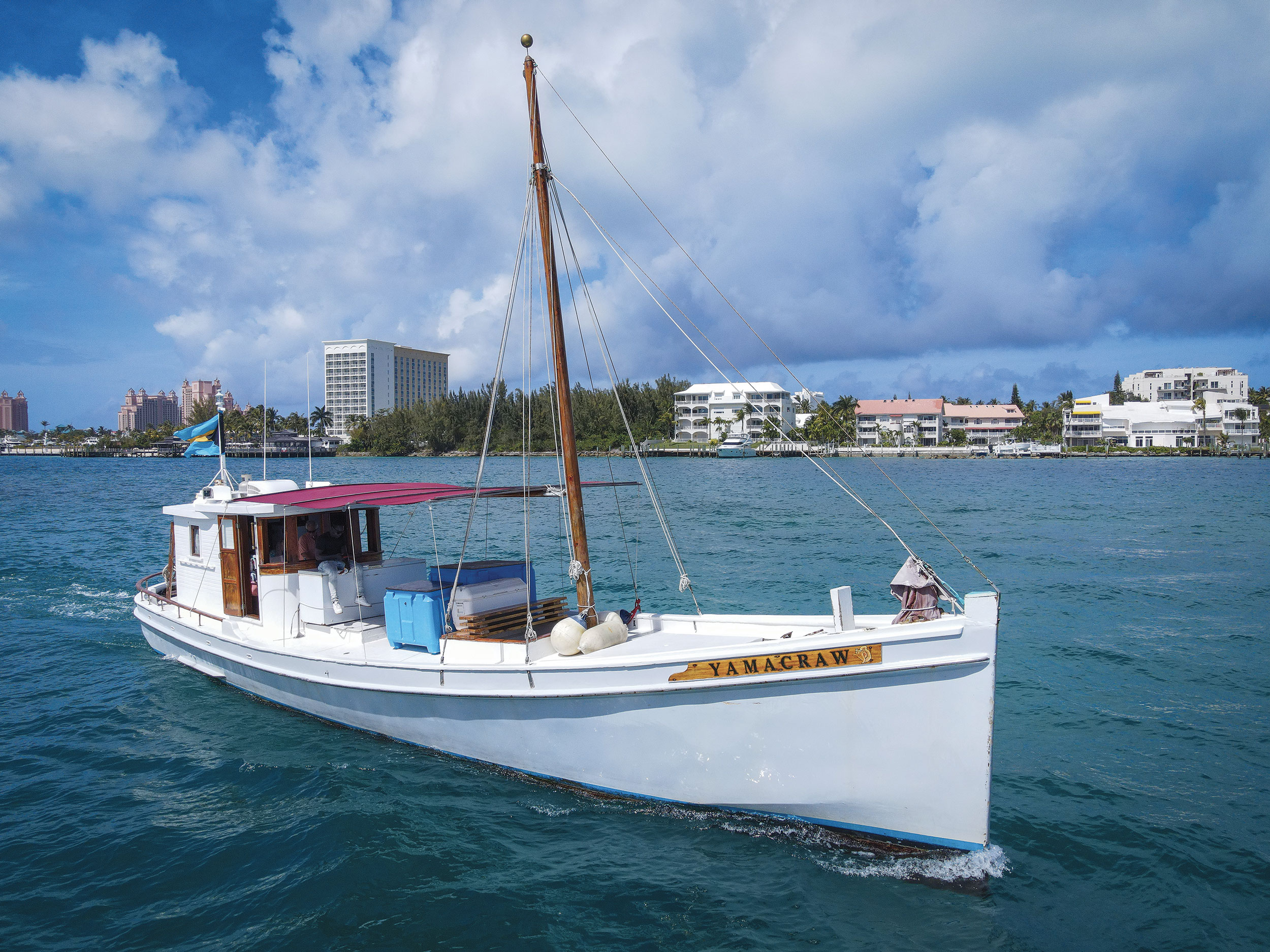
Donny KnowlesYAMACRAW, a 54’6” Chesapeake Bay buyboat, has been in service since her launching in 1922. She still carries cargo among the Bahamian Exuma Islands chain.
1030 hours, January 19, 2024
Central wharves, Nassau, Bahamas
Partly cloudy, wind southwest at 5 knots
“Oh, we were on a mission. Yeah, mon,” remembers Capt. Mike “Mikie” Goodwin. He’s watching a trio of stevedores loading a large miter saw down the main hatch of his cargo vessel, YAMACRAW. Ziggy Marley is blaring from a box truck’s stereo nearby.
“It was the summer of 1978,” he says, “I was 21. My brothers Tommy, Pat, and I were on a road trip in my hippie van from Florida to the Chesapeake to find a boat.”
Mikie is 68 now, but he remembers that road trip like it was yesterday. It changed the vector of his life, and YAMACRAW’s. The Goodwin brothers had seen a vessel of YAMACRAW’s type about a year earlier. They had grown up in Nassau, the sons of a longtime Bahamian sailing family, and were sailing Pat’s traditional Class B Bahamian racing sloop, RHONDI LOUISE, to the Out Island Regatta in George Town, 125 miles south of Nassau in the Exuma Cays.
About halfway down the Exuma chain, they saw a large, white, wooden workboat called the MARGARET LEE. She had a tall mast, cargo boom, sweeping sheer, and a proud pilothouse aft. She looked like a vision out of an old sepia print from the Roaring ’20s, rugged and American-built. As it turned out, the MARGARET LEE was headed to the regatta as a mothership, towing another racing sloop. She was one of scores of so-called “Chesapeake Bay buyboats” that were coming to the ends of their careers in the Chesapeake oyster and crab fisheries as a new generation of smaller fiberglass boats replaced them.
Donny KnowlesMikie Goodwin has owned YAMACRAW since 1978, when he and his two brothers traveled from the Bahamas to the Chesapeake region to purchase buyboats.
In his comprehensive history of the craft, Chesapeake Bay Buyboats, Larry Chowning writes that they were shallow-draft power vessels of 40′ to 100′ LOA and that the “mast and boom configuration is forward of the hold, the pilothouse or house is aft of the hold, and the hull is decked over.”
With reliable engines, single masts, and all-weather wheelhouses, these workboats take their name from their original purpose. Beginning in the early decades of the 20th century, they went out to the Chesapeake Bay oyster grounds to meet the fishermen who worked from skipjacks, log canoes, and deadrise skiffs. Buyboat captains bought oysters on the spot and hauled the catch to shore-based shucking houses while the oystermen continued to dredge and tong for more quarry.
Sometimes called “deckboats” and “mastboats,” these freighters not only found work buying oysters; they also transported watermelons, grain, corn, and potatoes according to the season. In the Virginia portion of Chesapeake Bay, buyboats also dredged for oysters and crabs buried in the mud during the winter. In the spring the boats caught, hauled, and planted seed oysters. Some buyboats carried island kids and worshippers to mainland schools and churches.
As the oyster fishery thrived in the 1920s, backyard builders modeled or built by “rack-of-eye” hundreds of buyboats such as YAMACRAW. Almost none came from plans. Some of these boats were so-called log-built hulls, with heavy log planks drift-bolted together, but most new buyboat hulls were more-or-less enlarged, decked-over versions of the watermen’s hard-chined, cross-planked tonging skiffs and skipjacks.
The Goodwin brothers had heard from the owner of the MARGARET LEE that Chesapeake watermen were selling their buyboats for short money. With their massively strong construction, shallow draft, and proven carrying capacity, buyboats could make excellent liveaboard platforms for crawfishing, conch fishing, salvage work, and freight hauling throughout the shoal waters and reefs of the Bahamas archipelago. This was the late 1970s. The so-called Bahamian “out islands” (beyond the national capital of Nassau) such as the Exuma Cays were suddenly thriving as destinations for cruising yachts, adventure vacationers, recreational divers, and celebrities seeking private island hideaways. For 400 years, smugglers had been plying their trade in these cays, too. They all needed workboats.
Donny KnowlesSave for a few minor additions, YAMACRAW’s pilothouse is much as it was in 1922.
So it was that the Goodwin boys got caught up in the romance of a maritime gold rush. After returning from the regatta, they headed for the Chesapeake with Eric Clapton booming in their van, searching for buyboats. Pat found his boat, the MARION SUE HANDY, on the ways in Reedville, Virginia, on the western shore of the lower bay. Tommy and Mikie were still on the hunt when a local waterman pointed them to Tangier Island, Virginia, off the bay’s Eastern Shore. After a ferry ride out to Tangier, they hit the mother lode. There were more than a dozen buyboats rafted together at the Tangier wharves.
One of them, YAMACRAW, just jumped out at Mikie.
“Yeah, mon. It was love at first sight. She was so pretty with that sweet sheer, a slender beam, and what we call in the Bahamas, ‘a nice round boongie’,” the stern of a person or a vessel.
Donny KnowlesThe vessel is powered by a GM 6-71, which was installed when the U.S. Navy requisitioned her, and conscripted her skipper, for buoy-tending service during World War II.
YAMACRAW is a bit small for a buyboat. Built near Tangier Island in Chrisfield, Maryland, in 1922, she is 54′ 6″ LOA, carries 12′ of beam, and draws 4′ 6″ empty; she displaces 13 net tons. Her main power plant is a GM 6-71 diesel that the U.S. Navy installed when they drafted her (and her owner) for buoy tending during World War II. She has two Northern Lights generators.
Like most buyboats, she is massively framed with white-oak timber and planked with 2″ longleaf pine. Her sprung deck is of fir. The first waterman who owned her had served aboard a U.S. Navy warship named YAMACRAW in World War I, and gave his newly built buyboat that name shortly after returning home from the war. The vessels are named for a Native American tribe whose community centered around what is today Savannah, Georgia.
Courtesy of Goodwin CollectionYAMACRAW was named for the U.S. Navy vessel in which her original owner served. She is heavily framed in white oak and planked in 2”-thick longleaf pine.
When the Goodwin brothers found YAMACRAW’s owner, Capt. Winnie Pruitt, at Tangier Island, he said, “She could be for sale for $25,000.”
“It took me a year to get together some money,” Mikie says. “I went back to Capt. Winnie with everything I had. It was $17,000. Winnie said, ‘That’s nice, young man, she’s yours…when you come back with the rest.’ The price was the price.”
When Mikie returned with the full $25,000, Pruitt said he had one condition to the sale. He had heard that some buyboats were being purchased for smuggling loads of marijuana to the Bahamas and the United States from places such as Haiti and Jamaica. “Promise me you aren’t going to use the YAMACRAW to run drugs,” the waterman said.
Mikie promised. Then he motored his boat south to Nassau. Inevitably, given YAMACRAW’s new field of play in the Bahamas out islands, she and her captain would find themselves in sticky situations, with both offers and threats from drug smugglers such as Pablo Escobar’s Medellin Cartel. But for 46 years, Mikie has kept his promise to Winnie Pruitt. “She became my Number One,” says her captain, owner, and caregiver. “Got to treat her like a lady. She has a soul.”
And so at the age of 102, YAMACRAW labors on, earning an honest living. On this January day, she is loading a mixed cargo of construction tools, soft drinks, beer, gin, ice cream, fresh produce, frozen food, sheets of plywood, door panels, 750 gallons of diesel fuel for Wax Cay, and a little Bahamian “potcake” (mongrel) puppy in its crate.
Donny Knowles“The stories this boat could tell,” says Mikie Goodwin’s wife, Di. Mikie proposed to her in the wheelhouse.
1330 hours, January 19, 2024
Crossing the Yellow Banks
Partly cloudy, wind southwest at 6 knots, fair current,
speed 7 knots
“I love the boat. I love the lifestyle,” say the skipper’s wife, “Di” or “Mama Di” Diana Goodwin. She has been her husband’s first mate aboard the buyboat for more than 35 years. This afternoon, Di is steering YAMACRAW southeast across the banks for Highborne Cay. It’s about a 35-mile open-water passage from Nassau that has the potential to get nasty given the prevalence of barely submerged coral heads, cross-currents, and shallow depths where a steep chop builds quickly in winds over 15 knots. But today there are just light ripples on the water and Di can easily see and dodge the big, black coral heads as Steely Dan echoes through the pilothouse.
“The stories this boat could tell,” Di says with a sigh.
One of those stories that brings a lump to her captain’s throat is about his early days with YAMACRAW when he was using her for crawfishing near the island of North Andros.
“I hit a U.S. Navy buoy one night head on. A big steel affair.”
It was supposed to be lit, but that night it wasn’t.
“We smacked it hard, bounced off, and then hit it again.”
The collision with the buoy fractured some planks. “The pumps weren’t keeping up. I made a patch of towels, fiberglass, and some other stuff, and got her to the Navy base nearby. The Navy boys came to the rescue. Yeah, mon. That was a close call. I almost lost her.”
Randall PefferDi minds YAMACRAW’s course while Mikie checks the chart.
This is far from the only time the YAMACRAW has dodged destruction. “She has been through some wicked hurricanes,” Di says, “and Mikie always insists on staying aboard. It scares the hell out of me.” The worst was Hurricane Matthew, which struck Nassau as a Category 5 storm in 2016 and caused more than 500 hundred deaths along its path through the Caribbean and Bahamas.
“I had the YAMACRAW tied up with a spiderweb of lines,” remembers her captain. She was way up a canal at Coral Harbor on the southwest side of New Providence Island. “It seemed like the safest place. But the storm veered, and the center came within 5 miles of us. I was on my cellphone talking to Di, who was in a house ashore when I saw a roof lift off another house and sail away. The vacuum of the wind sucked the main hatch off the boat. It went overboard, and I dove in after it. I’m not always the brightest bulb.”
But somehow Mikie got himself and the hatch back aboard in winds of well over 100 knots. “She’s a lucky boat, and I was a fortunate man that day,” he says.
But when it comes to stories of good fortune, both Mikie and Di will tell you one of their best memories of YAMACRAW was a day in the late 1980s. Di had fled the cold weather in her hometown of Chicago to work on a dive boat in Nassau and the Exumas at age 17. Years later she and Mikie fell in love and she joined him running the boat. “Then one day we were on the ‘Yammie,’ and he dropped down on one knee in the pilothouse. He asked me if I would be his ‘Number 2.’ That might have offended another woman. But I love Mikie, and I love the YAMACRAW. I told him I was all in.”
Randall PefferFor 15 years, the Goodwin family lived in Chicago and moved aboard YAMACRAW for a month each summer. For this purpose, Mikie installed a head and shower. The pilothouse has maintained the traditional layout of steering station, athwartships day berth, and galley (shown here).
It wasn’t long before their daughters, Jessie and Robyn, were born, 13 months apart. While the girls were growing up, Mikie took a job for about 15 years with a company in Chicago building industrial shredders. But every year the Goodwin family made a pilgrimage to YAMACRAW and the Bahamas for months of family cruising during the summers. Mikie built cuddy cabins over the forecastle and the hold and installed sleeping quarters below for the family. The pilothouse kept the traditional layout of steering station, an athwartships day berth, and galley. Mikie added a head and shower.
They cruised the Exumas and the Abacos, diving for crawfish, conch, and grouper to feed themselves. Mikie schooled his family on the secret channels, reefs, and cays that he had discovered as a boy of 14, working as a deckhand on the schooner KEEWAYTIN and sailing among the out islands.
“There was a time when we heard a lot of complaints from our girls about being stuck on an old wooden boat while their friends were going to Disney World,” Di remembers. “They wouldn’t trade those memories for anything now.”
Jessie and Robyn were not the first generation of girls to grow up on YAMACRAW. Winnie Pruitt’s daughter, Laura Lee Pruitt Park, says she has fond memories of swimming with her friends off the stern of her father’s buyboat when she was growing up on the lower Eastern Shore of the Chesapeake. Her daughter, Diane DeMarco, recalls similar good times.
Di is not surprised that Winnie’s daughter and granddaughter, like her girls, bonded with YAMACRAW. She says a boat doesn’t get to be 102 years old without a lot of love. “As soon as the girls went off to college, we moved back aboard Yammie full time,” Di says. They removed the belowdeck accommodations and fitted their buyboat out seriously for hauling freight, with two spacious holds, a freezer, and large tanks for hauling a thousand gallons of fuel for the cays.
Randall PefferTyrone “T.J.” Jolly is YAMACRAW’s longtime deckhand.
1630 hours, January 19, 2024
Highborne Cay
Milky skies, wind southwest at 8–10 knots, fair current, speed 7 knots
YAMACRAW’s longtime deckhand, Tyrone Jolly, who goes by “T.J.” or “Teej,” is steering the buyboat clear of reefs on the approach to the marina dock at Highborne Cay, the boat’s first stop this afternoon to unload freight. Nurse sharks and lemon sharks are schooling around in the crystal-clear water. Di has started singing along with Rod Stewart on the stereo. Meanwhile, Mikie has descended into the engineroom to suss out why the starboard generator has stopped working. He needs it to power the huge freezer on deck that currently holds about 400 lbs of ice cream for the restaurant on Highborne.
It takes Mikie only a few minutes of tinkering to get the generator back on line.
“When I was a teenager, I thought the captain of the KEEWAYTIN was a slave driver, but he taught me how to care for a boat properly,” Mikie says.
It has paid off over the years, particularly in the mid-1980s, when YAMACRAW developed a wobbly skeg and began to have serious leaks. Mikie hauled the boat and started a renaissance. After renewing rotten timber, he sheathed the boat with 3⁄8″ marine plywood and covered her hull and deck with several layers of fiberglass mat and roving set in polyester resin. After more than 35 years, YAMACRAW is still tight and free of delamination. Six years ago, her hull received a fresh coat of light-gray Awlgrip.
“Looking good, Mikie,” shouts the skipper of a luxury yacht from his slip at Highborne when YAMACRAW sidles up to the marina’s dock. As she comes alongside, islanders begin to gather on the wharf. People are calling down to the boat “Hey, Mama Di. Hey, Mikie. Good trip, mon? How the ice cream doing?”
Mikie pats the immense freezer in front of the pilothouse like it’s his prize possession. “Good and cold in here, brother. You ready for it?” There are smiles spreading over the islanders’ faces. YAMACRAW is finally here. This floating ice cream truck has indeed arrived like something out of a simpler and easier time.
“We are a dying breed, but we survive because we give personalized service, and we can go right up to people’s private docks,” Di says with a laugh. Maybe she is remembering all the odd things they have carried…sheep, goats, donkeys, a Jeep, a Toyota truck, and motorcycles, just to name some of the cargo.
There was a time not so many decades ago when traditional wooden mailboats and freighters such as AIR PHEASANT, OFFSHORE, and MOONGLOW were the lifelines between the people in the Bahamas out islands and the world at large. Some of those freighters, including SHIRLEY B, EDNA L, ELIZABETH DIANE, and MARION SUE HANDY, were repurposed buyboats like YAMACRAW. Today, YAMACRAW is in a league of her own, and the islanders are clearly enjoying the ritual of her arrival with a hold full of treasures.
“Where’s the piano, Mikie?” calls someone.
People begin chuckling. The old guard on the wharf start telling the younger generation and newcomers about the time YAMACRAW showed up with a piano on deck and a party started before they could unloaded it. Mikie and others began tinkling the ivories. Then the rum started to flow. Eventually, Mikie got out his guitar and strummed up a storm while he sat on deck in his canvas captain’s chair and held his lit cigarette between his toes.
“Aging is mandatory,” Mikie says. Then he grins. “But growing up is optional.”
Donny KnowlesYAMACRAW’s classic rounded stern was one of the elements that drew Mikie to the vessel. “It was love at first sight,” he said.
1730 hours, January 19, 2024
Approaching Norman’s Cay
Sunset, wind southwest at 8 knots, falling tide, speed 7 knots
Mikie is back on the helm after leaving Highborne and heading for Norman’s Cay. He is threading his way south through a thicket of small cays, shoals, and coral reefs, trying to reach the dock at Norman’s before the green flash that comes with the sun dipping over the western horizon. Once the light gets too flat to see the reefs, navigating in the skinny water around here is, as Mikie says, “like walking on eggshells, mon.”
“See that cay off to port with the palm tree,” Mama Di is reminiscing. “That’s where Mikie and I got married.”
“August 14, 1988,” says her husband. You can hear the pride in his voice and more than a touch of the joy that day brought him. “We invited 28 people. More than 70 came.”
As YAMACRAW starts toward the south end of Norman’s Cay, the sun sets. The sky and sea fade to gray, and a somber mood creeps over the buyboat. There was a time when people thought of Norman’s Cay as the Evil Empire. A lot of wild and scary things happened here. The wreck of a C-46 cargo plane in the shallow harbor is a sign of the time when the island and its airfield were a premier outpost for the Medellin Cartel’s cocaine smuggling business.
Pablo Escobar’s flamboyant, flyboy lieutenant, Carlos “Joe” Ledher, turned this private island into a smugglers’ paradise for a while. It was possibly the biggest hub for trafficking cocaine from Colombia to the United States between 1978 and 1982, with scant interference from the Bahamian government.
“The Colombians had guards with automatic weapons and attack dogs to keep the curious away,” Mikie remembers. “They would shoot a few rounds in front of your boat if you got too close.” He kept his distance.
The Norman’s Cay airport was a busy place in those days. Some observers estimate that as much as 600 lbs of cocaine passed through Norman’s daily. But in 1981, the U.S. Drug Enforcement Agency (DEA) and the Bahamian Defense Force (BDF) raided the cay and closed down the smuggling. “Someone warned Joe Ledher,” Mikie says. “When the law got to Norman’s, Ledher and everyone else had vanished back to Colombia.” They left their dirty dishes in the sinks of the houses, food in the refrigerators, clothes in the closets, cars, trucks, motorcycle, and quite a few light planes.
One of the saddest things for Mikie was that Ledher’s gang ran the buyboat MARGARET LEE (that they bought as a freighter) up a gut to die. Not long after the demise of the Norman’s Cay drug operation, Escobar sold out his former lieutenant and friend Ledher to the police. Eventually, he was extradited to the United States and convicted of drug trafficking.
Meanwhile, Mikie, Di, and YAMACRAW felt the heat of joint DEA, U.S. Coast Guard, and BDF operations as they tried to make a dent in the drug trafficking in the Bahamas during the 1980s. “We got boarded a lot,” Mikie remembers, “but we had nothing to hide.”
Nevertheless, the U.S. Coast Guard kept stopping YAMACRAW and scrutinizing every nook and cranny for contraband. On one inspection, a Coast Guard boarding party thought they had hit a bonanza when they pulled off some of the hull ceiling and found a huge wad of material they thought might be hashish or opium. Much to their embarrassment, it turned out to be cakes of dried rat excrement in a nest left over from the buyboat’s early years on the Chesapeake.
It took the government of the Bahamas years to reopen Norman’s Cay to the public for development, but when they did, the Goodwins and their buyboat were ready. “We have carried a lot of the material to rebuild the island,” Mikie says. As YAMACRAW passes along the western side of the cay in the evening twilight, he points out many houses built from timber arriving aboard YAMACRAW. When the buyboat ties up to the wharf, a crowd gathers, as it did at Highborne. One contractor, seeing his miter saw being lifted out of the hold, gives Mikie a big hug. “Oh, mon, you make me the happiest man on Earth, Mikie.”
“I glad to see you, too, brother,” Mikie says, slipping into a Bahamian patois. “It feel like old times. Yeah, mon. It feel like home here.”
Donny KnowlesThere was a time not long ago when small wooden freighters were common in the Bahamas. Today, YAMACRAW is a rarity.
1900 hours, January 19, 2024
Heading for Wax Cay
Moon rising, wind southwest at 8 knots, tide extreme low, speed 7 knots
hen all the cargo for Norman’s is unloaded, Mikie steers YAMACRAW away from the dock more by memory than by eye. He doesn’t even glance at the little chartplotter by his left knee. The end of this freight run today is at Wax Cay about 3 miles farther south from here. There are more than a few reefs and sandbars between here and there, but the moonlight has painted the sea silver. There is no chance of seeing hazards lurking just below the surface. But Mike and Di don’t seem worried.
“YAMACRAW know her way,” he says, still speaking the island patois. “I come down here—first time, mon—all them years back on KEEWAYTIN. I fell in love. The water, the fish, the coral, the creeks. Lot to explore. There a magic here.”
It’s dark in the pilothouse now. Mikie is steering his Number One with one hand, and he has his free arm around the waist of his Number Two. They have started singing along again to Robbie Dupree’s 1980 classic, “Steal Away.”
Saving the Buyboats
Like the skipjack, the buyboat has become an icon of Maryland’s and Virginia’s love affair with the Chesapeake Bay and its traditional watermen’s lifestyle. Watermen such as Winnie Pruitt raised families, sent their kids to college, and carried their dead on buyboats.
No fewer than five different maritime museums on the bay have included and preserved buyboats in their collections. All are floating exhibits. Some carry passengers. Several more buyboats work with ecology and marine science programs around the bay.
The Chesapeake Bay Buyboat Association (CBBA) is an organization of buyboat owners who dedicate significant personal resources and time to the care and feeding of the remaining vessels. The association began in about 2004, when a number of owners of restored buyboats decided to band together to swap information and support each other’s efforts to preserve and celebrate their vessels and the bay.
CBBA members come from various walks of life, with professions as varied as real-estate developer, welder, restaurateur, waterman, and retired Navy veteran. Their common ground is a love for their vessels and the Chesapeake. The association counts more than 35 member vessels. Most have been converted for family cruising. There are only a handful of buyboats, YAMACRAW among them, that are still working as freighters in Virginia and the tropics. A couple of Chesapeake buyboats have found work farming oysters in Connecticut (see WB No. 285).
The CBBA sponsors seasonal buyboat cruises in which the fleet shows up at ports around the Chesapeake and open themselves to the public. Individual boats are frequent guests at maritime festivals.
For details on where to view buyboats, or if you know of an old buyboat that needs rescuing, visit the Chesapeake Bay Buyboat Association website, or the CBBA Facebook page. YouTube has a number of buyboat videos, including documentary episodes of the restoration of the buyboat COASTAL QUEEN by McMillen Yachts in Rhode Island. ![]()

Randall Peffer is a regular contributor to WoodenBoat.