
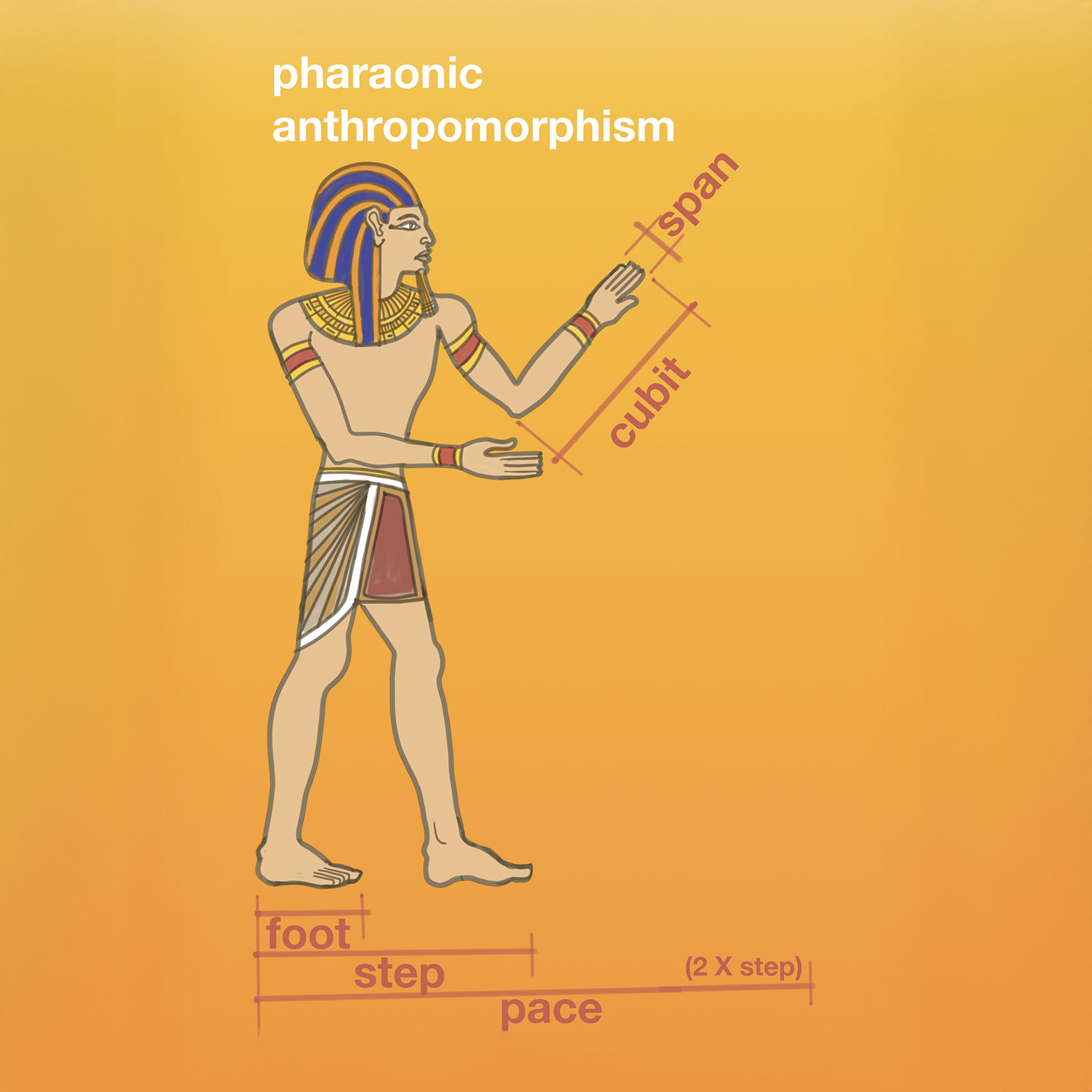
Consider the simple process of measuring from here to there, and it becomes clear that our need to make things fit has been passed down to us by careful craftspeople over millennia. Virtually all the units with which we measure our world are derived from…us. They’re anthropomorphic, the measure of man.
A grand pharaoh, perhaps Ramses II, the builder, probably fixed the basic units of Egyptian measurement: the cubit (fingertip to elbow); the palm (breadth of palm); the foot (one dog). We know these measures were fixed because we’ve found masons’ and carpenters’ rulers 3,000 years old, and because the pyramids were constructed with bewilderingly precise cubit dimensions that delight mathematicians and numerologists with their cabalistic implications and harmonies.
Consistency across distance brings up a historical point: Did it matter that the pharaonic cubit in Aswan was identical to the cubit in Thebes? If engineering accuracy demanded common measures, those lengths became strict official standards—often iron bars approved by authorities. Roman engineers depended on consistency across a kingdom and produced official copies of the regula—a wooden stick about 11.625″ long, divided into 12 unciae (hence, our “inch”), and digiti, or finger widths.