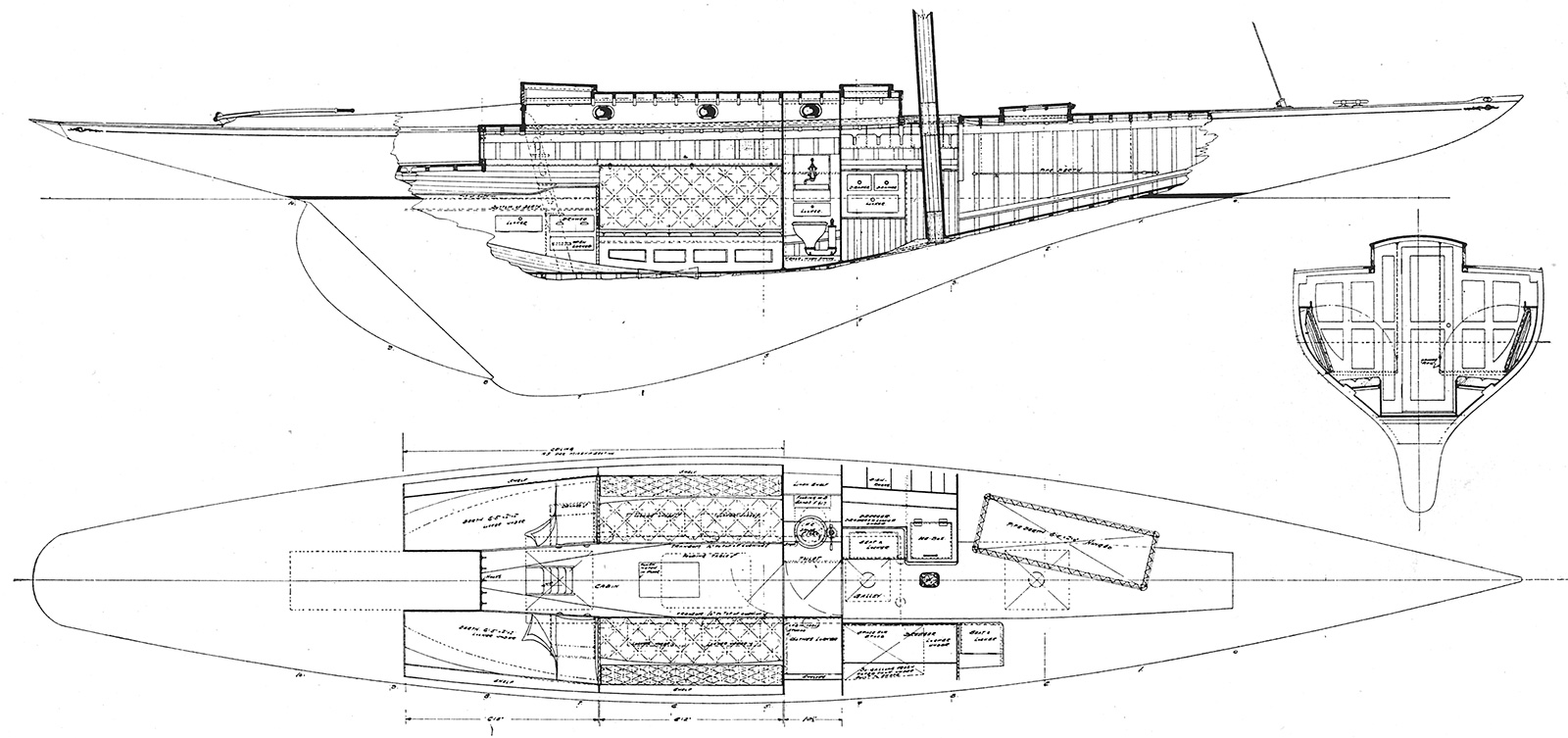
Yachting, January 1930 / Mit MuseumLong and very lean, HOPE was built at Hodgdon Brothers in 1929 for John G. Alden’s use. As a Q-class racing yacht, she had spartan accommodations.
The Great Depression began at the end of HOPE’s first racing season, and the Universal Rule that created the “letter class” racers such as Q-boats would eventually be abandoned in favor of the International Rule, which spawned the 6-, 8-, 10-, and 12-Meter sloops. HOPE was among the last of the Q-boats built. She and other letter-class yachts soon became obsolete in New England, and many of them migrated to the Great Lakes.
HOPE went first to Chicago and then, after World War II, to Milwaukee, Wisconsin. The Register of Wooden Boats shows that she reappeared in Chicago in 1996 and then Detroit, Michigan, before she returned to the East Coast, coming to Rye, New York, only a few years ago. Rather than sell her “down,” that owner transferred her to Steve White at Brooklin Boat Yard here in Maine in 2020, and she arrived by trailer. Steve immediately launched her and tried her out under sail. Soon afterward, he put her away to await a suitable opportunity. I’m hoping this page will help find one.
Mit MuseumA young K. Aage Nielsen, then working for Alden, drew HOPE’s plans, including this one of her fractional sloop rig.
HOPE was built for and campaigned by John G. Alden himself, who was the designer of record. But the plans were actually drawn by K. Aage Nielsen, who had recently joined the Alden office as a Danish immigrant and who would later become widely known as a designer in his own right. Nielsen’s drafting is impeccable, and it shows in the few plans of HOPE that have been published. All of them reside within the Alden collection at MIT.
As to the boat herself, she’s a long and skinny string bean, but with full headroom, a small galley, and four berths. (We once owned a similar but smaller R-boat, which we lived aboard for a bit, but we were forever wishing she were a “roomy” Q-boat such as HOPE.) At some point, HOPE got auxiliary power, and between 1960 and 1996 her mast was changed to aluminum and moved aft. Her boom was shortened for a permanent backstay, and her stern was cut off. Low bulwarks were installed for surer footing, but they raised her sheerline in a way that compromised her sleek appearance.
Maynard BrayHOPE is in remarkably original condition but would need a full restoration to make her suitable for the classic-yacht-racing circuit.
Despite these visually obvious alterations, much of HOPE remains as built: the joinerwork belowdeck, the deckhouse, the deck itself, and the frames, deckbeams, and planking. Here and there, she’s been strengthened by sister frames, new chainplates, and other structure—but there’s been surprisingly little of such work, given her age. The tiny Atomic Four gas engine has even survived.
With not a great amount of work, HOPE could be made to look as she did when new and could be safely sailed if used gently. But to race her—and that’s where her appeal probably lies—a full restoration awaits, and according to Steve, that will have to be carried out by Brooklin Boat Yard. Perhaps afterward, she’ll be shipped to Europe, where racing is hottest for such a craft. But even if she leaves these shores, I hope that HOPE will return, at least for a visit, just as other classics occasionally do. ![]()
To inspect the boat or learn more, contact Steve White at 207–359–2236. The boat is stored inside at Bill’s Boat Storage in Sedgwick, Maine.
Maynard Bray is the technical editor for WoodenBoat.