New intro coming from Matt
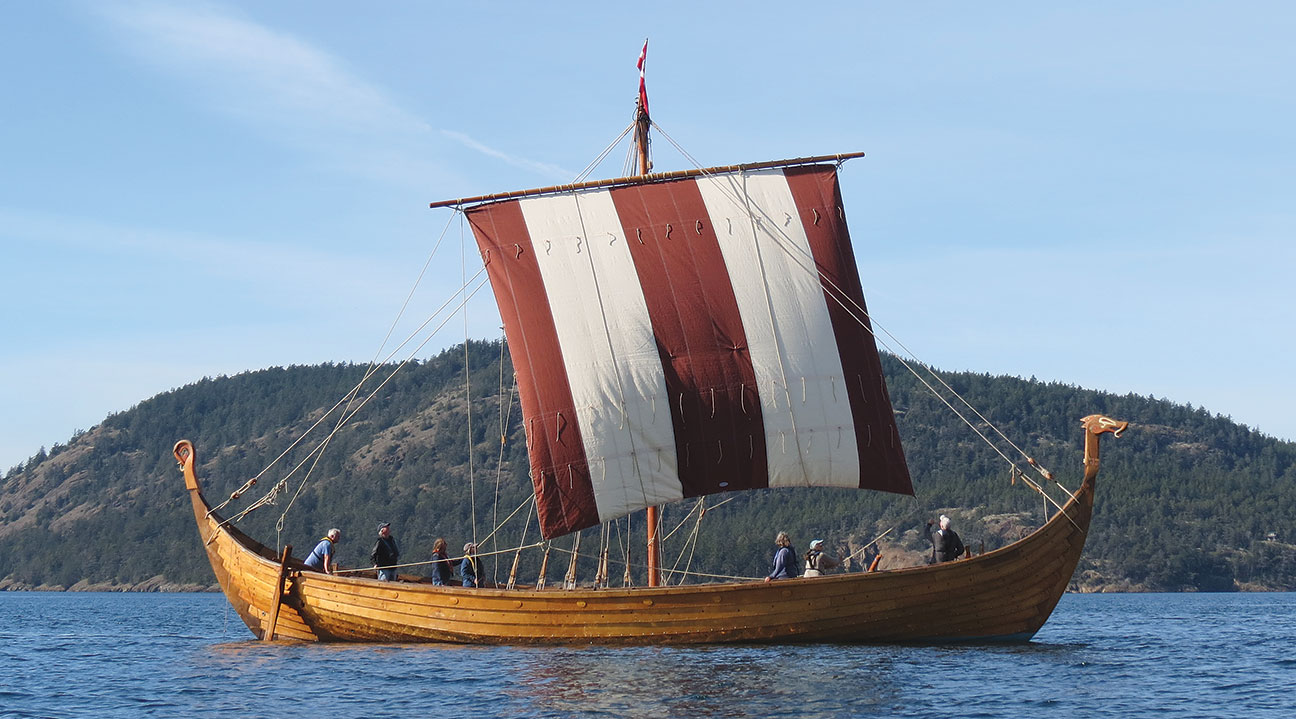
The 56′ VALKYRIE
Photos by Jay Smith
The 56′ VALKYRIE, built by F. Jay Smith of Anacortes, Washington, was launched in March 2024. Commissioned by David Knudson to fulfill a promise to his Danish-born father to build a Viking ship, the project spanned 16 years.

The hull is planked with Alaska yellow cedar and the keel, carved stems, and frames are of Oregon white oak, with many of the curved pieces harvested from the crooks of standing trees.

The construction was done with traditional methods right down to using hand-forged iron rivets. VALKYRIE, the culmination of Smith’s four decades of research of Viking ships, sails the Pacific Northwest’s Salish Sea.
RUTHIE
Photo by Derick Davis
After his 40th birthday, when Derick Davis of Charlottesville, Virginia, was given tuition to attend WoodenBoat School in Brooklin, Maine, he and his best friend, Seth Noble, enrolled in John Karbott’s Introduction to Boatbuilding class. During the weeklong class, the two, along with classmate Tony Turmel, did much of the work on a Karbott-designed 12′ semi-dory. The construction was completed by the end of the week, and Derick brought the boat home. His plan to finish the boat with paint and varnish was delayed by two years until he and Seth reunited to get the semi-dory ready for the water. In May 2024, Derick launched RUTHIE at Piper Pond in Abbott, Maine, where he has a camp and is introducing his two sons to the pleasures of a wooden boat.
MUNCHKIN
Photo by Jim Cox
Jim Cox of East Aurora, New York, built two 11′ Solo canoes designed by Hillary Russell, and enjoyed them so much that he decided to build a smaller version for his young family members. He scaled the plans down for an 8′ version with a beam of 22″. The weight of the finished kids’ canoe was just 15 lbs, easily managed by even the youngest. MUNCHKIN was launched in summer 2024 at a pond at Jim’s brother’s home in nearby Colden, where his grandchildren were waiting to take the first outings. Later that summer, Jim took the canoe to Chandos Lake, Ontario, for more kid testing. While the youngsters in the family have taken well to MUNCHKIN after getting used to its nimble feel, they’ll soon grow out of her and Jim plans to design and build the next size up.
François Vivier–designed Kernic
Photos by Eric Bridgford
Students at the Santa Barbara (California) Middle School built a François Vivier–designed Kernic from a kit supplied by Chase Small Craft of Maine. The project was a weekly yearlong drop-in elective class for the sixth to ninth graders, who worked under the direction of Eric Bridgford of Carpinteria Boat Works. The 18′8″ boat was launched in late September 2024 and will become part of the school’s outdoor program. Plans are afoot for an exploratory trek to San Francisco Bay. The boat awaits a name, likely to be bestowed by student cruisers.
THE ENGLISH BULLY
Photos by Ted Dillard
The Brickyard Collaborative is a well-equipped “makerspace” serving the community in and around Lynn, Massachusetts. Among the opportunities offered in 2024 was a boatbuilding program for students at Lynn English High School. The five participants built a Periwinkle Junior, designer Nat Benjamin’s 10′ interpretation of the classic New England flat-bottomed skiff. The boat, built with a ⅜″ plywood bottom and two topside strakes of ½″ pine, was launched in June 2024 and christened THE ENGLISH BULLY, a reference to the school’s bulldog mascot. She was donated to a nonprofit organization, Kayak and Sail Lynn, for use by students and military veterans.
FAFAFINA
Photos by Fani Skoulikidi Boukouvala
After Ioanna Moutousidi and Giannis Bormpantonakis both completed boatbuilding apprenticeships, they set up shop on Syros, a Greek island in the Aegean Sea halfway between Greece and Turkey. In April 2024, they finished work on a Spitfire, Paul Gartside’s design No. 177.

Their 10′ lapstrake pram for oar and sail is traditionally built of pine, spruce, oak, and elm, with planks copper-riveted to steam-bent oak frames. The couple christened the pram FAFAFINA, and while they enjoy rowing and sailing her, she’ll be a fixture at their shop as an example of the fine work they do.
MARLEY
Photo by Stephen Fink
In June 2024, boatbuilder Elijah Davis of Portland, Maine, launched a Point Comfort 18. The 18′3″ × 5′5″ outboard-powered skiff was designed by Doug Hylan, who drew inspiration from Chesapeake deadrise workboats whose bottoms were cross-planked to take the twist between the keel and chines at the forward end. The forward portion of the Point Comfort’s bottom is cold-molded and the rest of the hull is planked with okoume plywood. To better accommodate passengers and clear a path amidships, Elijah eliminated the design’s central thwart and instead installed side benches that run the length of the cockpit. He had intended to sell the Point Comfort upon finishing it but took such a liking to the boat that he decided to keep it. He christened her MARLEY and cruises her in his home waters of Casco Bay as well as farther east on Penobscot Bay.
WHITUPAU
Photo by Heidi Mathisen, detail photo below by Klaus Brauer
A western red cedar had been leaning over Klaus Brauer’s driveway on San Juan Island, Washington. When the time came for it to be taken down, he decided to take the log cut from its trunk and put it to good use. He carved it into the 18′ main hull—hiwi—of a Micronesian proa. For the outrigger, he shaped a driftwood log, split it in half, hollowed it out, reassembled it, and filled it with expanding foam to assure its buoyancy. While the spars for the Oceanic spritsail are traditional bamboo, the beams—kiato—connecting the hulls are, for safety’s sake, foam-filled aluminum tubes.
Klaus launched WHITUPAU in August 2024 and now day sails the waters of the San Juan Islands with an eye to cruising north into Canada’s Gulf Islands.
XAADAS TLUUWÁAY
Photos above by Jodie Garrison, photo below by Stephanie Hamar

It took Gitijang “Stormy” Hamar of Kasaan, on Prince of Wales Island, Alaska, two years to carve a western red cedar log into a Haida-style canoe. As a child, Hamar paddled a dugout canoe to school, and he later served as an apprentice to the late Stan Marsden, a Tsimshian master carver and fellow islander. Hamar is a founder of the Haida Canoe Revitalization Group, and his newly launched canoe is the fourth he has carved. With a length of 30′ and a beam of 4′1″—achieved by heating water in the canoe to allow the sides to be bent outward—it carries a crew of 10 paddlers with a helmsman. XAADAS TLUUWÁAY, meaning “the people’s canoe,” was launched in May 2024 and has her home waters in Kasaan Bay, 30 miles northwest of Ketchikan.
BARBARA SUE
Photos by Amy And Ethan Luft
BARBARA SUE is a 1955, 15′ Tollycraft Roustabout that had been stored on a trailer in an Idaho barn for more than 30 years. Barbara Sue Adams of Moscow, Idaho, bought her for her husband, David, to restore. David stripped everything back to bare wood, replaced damaged planks, patched leaks, and filled seams with epoxy resin. He also rewired the lights and refinished all the wood. BARBARA SUE was relaunched in 2020. Almost immediately, it became obvious that more work was needed.

Over the decades of sitting on the trailer, the hull had distorted and developed tiny leaks that David didn’t identify until BARBARA SUE went back in the water. The second stage of the restoration included refairing the hull and addressing the leaks. BARBARA SUE, powered by her original Evinrude 30-hp outboard motor, was relaunched in June 2024 in Lucky Peak Reservoir, Ada County, Idaho.
PARNASSIUS
Photos by Thierry Copie
PARNASSIUS is an 18′ sailing dory based on the 1936 Sam Crocker–designed Compass class. She was built as ALICE in 2007 by Ray Heus in the Cape Cod town of Orleans, Massachusetts. In 2023, she was bought by Thierry Copie, also of Orleans. She had been out of the water for about five years, stored on blocks in Ray’s barn. Thierry says she was in good shape but in need of some attention. Penn Colbert of East Orleans recaulked, reprimed, and repainted the hull—in a custom color Thierry calls “Cape Cod Sunset Red”—and refinished her canvas deck and all of her brightwork. Penn also fitted an auomatic bilge pump and an electric motor. PARNASSIUS was relaunched in June 2024; her homeport is Kescayogansett Pond, Orleans. At the 2024 Arey’s Pond Boat Yard Cat Gathering on Pleasant Bay, PARNASSIUS received the Special Restored Boat award and Thierry and Penn sailed her to a fourth-place finish in the Traditional Class.
Wooden Currach
Photo by Ian Mac Donnacha
The origins of the currach that Cian Mac Donnacha restored aren’t clear, but it’s likely it was built in the early 1900s by Paddy and Joe Casey, two brothers who built boats on Mweenish Island just off the central west coast of Ireland. While canvas-covered currachs are more common, this boat—in Irish called a currach adhmaid, or wooden currach—is carvel-planked. With a length of 18′ and a generous beam of 5′, it would have been built as a workboat for fishing and seaweed harvesting on the Atlantic coastal waters surrounding the island. Cian rebuilt the boat during winter 2023, replacing all the sawn-oak frames and refastening the larch planking with galvanized boat nails. The currach was relaunched in summer 2024.
These pages, along with the Boat Launchings section of www.woodenboat.com, are dedicated to sharing recently launched wooden boats built or restored by our readers. If you’ve launched a boat within the past year, please email us at launchings@woodenboat.com, or write us at Launchings, WoodenBoat, P.O. Box 78, Brooklin, ME 04616.
Please include the following information:
- The boat’s length and beam;
- The name of its design class or type;
- The names of the designer, builder, owner, and photographer;
- Your mailing address along with an email address or phone number;
- The port or place of intended use;
- Date of launching; and
- A few sentences describing the construction or restoration. Send no more than five photographs (jpg images at 300 dpi) and enclose a SASE if you want anything returned.
Hints for taking good photos of your boat
- Set your camera for high-resolution images. We prefer jpg format, at 300 dpi minimum.
- Stow fenders and extraneous gear out of the camera’s view. Ensure the deck is clean and uncluttered.
- Take your photographs in mid-angle sunlight for best results. Mid-morning or mid-afternoon usually work well.
- Keep the horizon level and the background simple and scenic so your boat stands out from its surroundings.
- Take some pictures of the boat underway and some at rest. Often a vertical format works well for sailboats. Shoot a lot of images, then send us your five favorites.
We enjoy learning of your work—it affirms the vitality of the wooden boat community. We receive so many submissions that there is not room in the magazine for all of them to be published. Launchings not printed in the magazine can be seen at www.woodenboat.com/boat-launchings. ![]()


