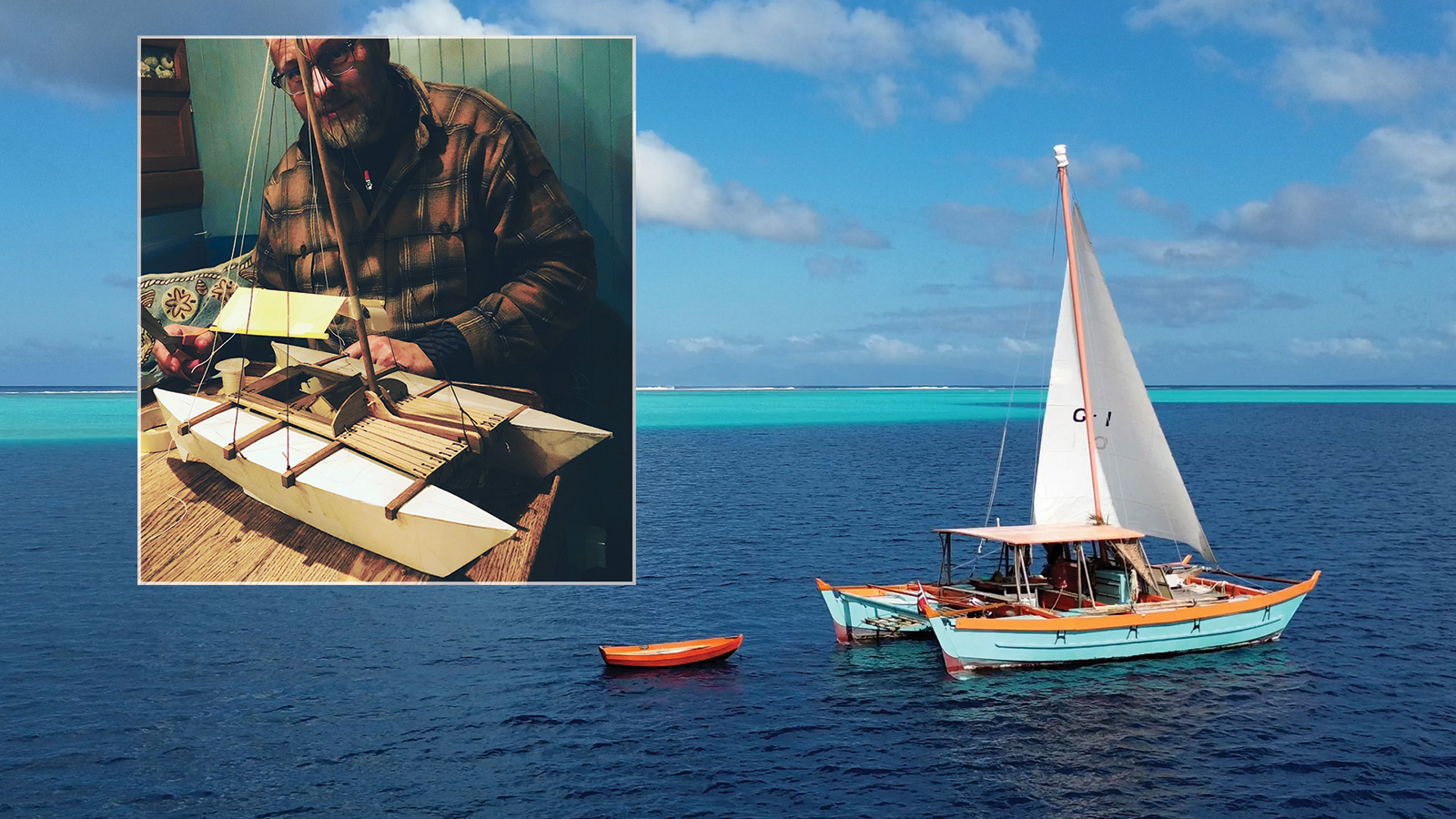
While weather-bound for nearly a week in Cape Verde aboard their 43′ jakt, DVINA, author Anne Nygren and her husband, Leif Erik, devised a plan to return to their home in Norway, build a cruising catamaran, and ship it to the South Pacific. Leif Erik modeled an early version of the boat aboard DVINA. The plan came to fruition in 2019 with BAREBARE’s arrival in Tahiti.
In February 2015, my husband, Leif Erik Irgens Ellingsen, and I were weather-bound in Cape Verde in our little ship, DVINA, a traditional gaff-rigged 43′ jakt anchored by the barren island Sao Nicolau. It had been blowing a gale for almost a week. One of our three anchors had failed, and we did not dare go ashore. It had, in fact, been almost a week since we had last left DVINA, and life on board was getting dull. We were halfway into a yearlong cruise and having a fantastic time. The trip was fun, hard work, and full of adventures. We had met like-minded people and had fascinating experiences.
I was engrossed in a very exciting book, sitting in the corner of the settee, and Leif Erik was at the other end of the table working on a project. I glanced up from my book now and then and saw cardboard, paper, pieces of wood, and glue slowly filling the table. After a while I looked up from my book. He looked back at me. “What are you making?” I asked.
“I really want to go to Tahiti,” he said. “Everyone says it’s so beautiful. “But it is so far away from Norway—halfway around the world.” Indeed, sailing there, and continuing on around the world in DVINA would take a long time—at least three years. “Let’s build a boat, in Norway, put her in a container, and send her to Tahiti,” he said. “We can then start sailing in Paradise.”
“What a crazy idea,” I said. “Let’s do it!”
In late August we returned to our home port of Fredrikstad, Norway, with the new-boat project at the forefront of our minds. We proceeded to muster a crew of skilled, like-minded friends to help us—and to join us for sailing in Tahiti. We decided on a James Wharram design. He had designed and built the first British oceangoing catamaran in the late 1950s and has been a legend in the catamaran community for more than five decades. His boat philosophy was a good fit for us, and his design style was rooted in the South Pacific.
We were drawn to his Tama Moana design, a 37-footer built of strip planking over plywood bulkheads, but it would be far too small for our tribe. And so we settled on the Tiki 38, which has accommodations for six in two double cabins and two single cabins. Our version did not have a shower, and we chose to have the galley on deck, outdoors. She’s designed with a deck pod with a berth for the off-watch crew, but we chose to make her flush-decked so she would fit in a 40′ high-cube container, which is 1′ taller than a standard container. This would yield less interior space, but because we were to sail in the tropics, we planned to spend most of our time outside anyway.
Our gang of builder-sailors from our traditional-boat community included Jan Sigurd Krogh, a carpenter with about a half-dozen employees and a big workshop. He had, together with friends, built a Viking ship, HAVØRN, and sailed her to the Shetland Islands where she capsized in heavy winds. His team rebuilt her and later sailed and rowed her all the way to Istanbul. Jan was thus well disposed to join us and was immediately taken with our project and signed on. The rest of the crew of seven included Oddvar Brekke; my brother, Aslak Nygren, and his girlfriend, Itta Helland-Hansen; and Sofie Holt Rudshaug, a carpenter’s apprentice.
We began preparing for building in January 2016, and actual construction commenced in July of that year. The following photos and captions describe the journey of building the boat, getting her to Tahiti, and sailing her in paradise.

1–3. In this age of computer-design and -cutting, our approach to the project was simple and old-school: We enlarged the drawings on a copy machine, transferred their shapes to plywood, and cut out the boat’s structural pieces with electric jigsaws and routers. We gave each of the frame’s pieces two coats of epoxy.
We spent Saturdays that winter in Jan’s workshop in Oslo. That’s where we made all the pieces for the two hulls. Leif Erik was the project manager; at the end of each week, he planned the following week’s work.

4. As warm weather approached, we moved the project out of Jan’s shop. Aslak and Itta had a big house, and they offered us its equally big garden for our work over the summer. Our first task there was to erect DVINA’s winter house—a wood-framed, plastic-covered tent—and convert it to a summer workshop. Our initial plan was to build one hull at a time inside that shop, but we soon realized it would be much more efficient to build both hulls at the same time. So, we bought a large party tent to shelter one of the hulls, and proceeded to build both simultaneously, one in each tent.
We had set aside the whole month of July to build the two hulls. We were seven people, but some days it was only Leif Erik and me working on the hulls, as summer was a busy time for everyone. We built the lower portions of the hulls upside down, bulkhead-and-stringer fashion, planked the framework in precut plywood, and sheathed it all in fiberglass and epoxy.
We worked long, hot days that July. After a late dinner, Leif Erik and I would bicycle back to DVINA on a small road through the woods, smelling the flowers and trees and sometimes seeing deer. It would still be light out, as Norwegian summers are light through almost the whole night. Nevertheless, I would pass out as soon as I hit the pillow and sleep like a baby, only to wake up to the alarm at 7 a.m. to return to our crazy project.

5. We began building the interior after turning over the lower hulls. Upper bulkheads were mounted, as well as berths, bench seating, ladders, and heads. This was a very smart and easy way to build—especially doing the interior before gluing the plywood to the upper sides of the boat.

6–8. The interior design was simple. Each hull was to have a small cabin forward, with a small seat that could be used as a table when one is lying down in the berth. There would be a larger cabin aft of this, in each hull, with a table, chair, and small bookshelf.
We decided to install two heads. Toilets easily break, and with four to five people on board we could have one for each couple or one for the ladies and one for the men. One could also serve as a workshop while the other could contain snorkeling and fishing equipment.
Each cabin had a hatch. The big cabins had two hatches, a small one to be used when sailing and a larger removable one for the tropics. We also built a galley.
By the end of July and after one hard month of work, we had two complete hulls. I was completely exhausted and took off to see a friend in France, but could hardly walk up the stairs when I arrived.

9. In late November we trailered the two hulls to the Bygdøy peninsula in Olso, home to a cluster of maritime museums—the Norwegian Maritime Museum, the Fram Museum, and the Kon-Tiki Museum. The hulls were covered up to spend the winter close to a collection of small traditional boats from along the coast of Norway, as well as a newly built replica of a Renaissance boat called VAAGHALS.

10. The following winter, we built the rest of the boat’s pieces in Jan’s shop, including her beams, spars, and rudders.


11–13. During the Easter holiday, we worked hard to assemble the two hulls, receiving help from our traditional sailing association, as well as from people walking by, when lifting the heavy beams aboard. It was cold work, and we would make a little fire on the beach to enjoy the cold, but a beautiful spring was coming.

Four crossbeams, called amas, would hold the two hulls together. They are made of 18mm plywood, Norwegian pine, and epoxy. They are long and heavy, the longest being close to 6m (19′9″) and weighing more than 100kg (220 lbs). They could be fastened in a variety of different ways, but we followed Wharram’s specifications and lashed them to the hulls.

14. BAREBARE’s mast (see photo, page 30) had to fit inside the 40′ container, so we decided to make it 11.37m (about 37′), a bit shorter than the container. We wanted to make it as light as possible so we could hoist it by ourselves using ropes. Leif Erik had built DVINA’s mast hollow to make it light, using the popular “bird’s-mouth” method (see WB No. 149); he also used this method for BAREBARE’s mast. We cut the joints quickly and efficiently on the machines in Jan’s workshop. What happened next was close to magic—mixing buckets and buckets of epoxy and gluing all the pieces together. After the glue cured, we shaped the spar from octagonal to round.

15. The rudders are made of two layers of 18mm plywood—with an additional layer at the rudderhead, for strength. We tapered the trailing edges to be hydrodynamic, and each piece was coated with epoxy on both sides and then glued together and the entire assemblies were sheathed in fiberglass set in epoxy. I added my own design on the top of each rudder: carved bird heads inspired by Norwegian woodcutting tradition.

16. The original Tiki design is schooner-rigged, with the foremast well forward. We chose to have only one mast and made some other modifications to suit our needs. The maststep is a long, longitudinal box, and has several functions beyond fixing the mast heel: it also serves as an anchor-chain locker, anchor roller, and windlass mount. The box also provides storage for mooring gear. This assembly was a very important piece of the boat’s construction and functionality.

17. When I heard that a big crane was coming to lift VAAGHALS, I quickly contacted the museum and asked if I could pay for one extra hour to get our boat out. I knew that just getting the crane to come to the museum area would be very expensive. They agreed and we were all ready when the crane arrived. It took less than 15 minutes to get the boat out. I tried jokingly to haggle for a lower price, because we were constantly on a tight budget.

18. With four long oars, we easily rowed the boat the few hundred meters to where she was to stay on a mooring that summer. And that summer was wonderful. Being a very different-looking wooden boat, she quickly became an attraction. Even the tourist boats would pass by and the guides would tell the story about the crazy “Vikings” building a Polynesian double canoe and shipping her to Tahiti!

19–20. Later that summer, five of us went sailing for a week, testing how BAREBARE would sail. I had bought a Sailrite sewing machine (see Review, WB No. 240) to modify a Bermudan sail for gaff rig. The weather was terribly windy and rainy, which provided a good test of the boat. As we beat our way out of the narrow Oslo fjord in a heavy breeze and into a strong current, we learned to tack the boat in challenging conditions. We enjoyed mackerel and foraged beach cabbage for dinner—a simple, wonderful meal with potatoes, melted butter, and of course a beer.
The name of our boat, BAREBARE, requires some explanation for non-Norwegian speakers: “Ikke bare bare” is a Norwegian expression that might be loosely translated to the English expression “Not just a walk in the park.” It emphasizes that something is challenging or complex, requiring effort or work. If you remove “Ikke” from “Ikke bare bare,” it becomes “Just a walk in the park”—an ironic twist on the original phrase, used to suggest that something is not as easy or simple as it may seem at first glance. Like building a 40′ catamaran, placing it in a container, and shipping it to the South Pacific.

21–22. Later that fall, we started dismantling BAREBARE. Leif Erik had thought of a clever way to do this, using lots of straps and the truck on the slipway. We stored the hulls and all the pieces in a warehouse a few minutes away, having still not finished all the little bits and pieces we need for our South Pacific adventure. We had also bought two secondhand outboards—a small 2-hp Evinrude from the late 1970s for the dinghy and a 10-hp Mercury for BAREBARE.

Early in the new year, we bought a shipping container in Norway to transport BAREBARE to Tahiti. Our plan was to sell the container in Tahiti, after the boat’s arrival, without having any idea how difficult that might be. Such “we will find a way” thinking, however, was what propelled us through this project.
We pushed BAREBARE into the container and secured her with chain and a big lock. That was a milestone. I booked the transport aboard a containership, and in February 2019 BAREBARE began her two-and-a-half-month journey from Norway to Tahiti.

23–26. On an early morning in late April 2019, five of us—Leif Erik, Jan, Oddvar, Sofie, and I—flew to Tahiti via Paris and San Francisco. We rented a car and drove across Tahiti to Taravao, where the container was scheduled to arrive a week later. We had rented two small bungalows in anticipation of this. There was still administrative work to be done: we needed to sort out customs, and we had to pay a heavy tax because the boat arrived in a container—though a few years later, when we sold the boat in Tahiti, this vastly eased the process of allowing it to stay in French Polynesia.
We also had to dispose of the container when it arrived and had no good plan for that. But luck intervened in the form of a two-way bidding contest. We ended up selling it to the shipyard that received and launched BAREBARE—a convenient transaction, because once it was empty, we would not have to think about moving that big steel box again.
One week later than scheduled, and minutes before the shipyard closed for the day, the container arrived. It was a Wednesday, and we had booked launching for the following Friday morning at 8 a.m. We opened the container, realizing customs had not even been inside, and slowly began removing things. We pulled out one hull, then rolled over the other inside of the container and pulled that one out, as well.
The next day we assembled the boat by lifting the heavy beams and lashing them to the hulls. We worked until the final minutes before launching and painted the bottom while the boat was in the Travelift. By 8:15 a.m. on that Friday, BAREBARE was floating in the Pacific Ocean. We spent about a week getting her ready before setting sail. We did everything by hand—even raising the 11m (37′) mast.
Jan and Sofie had five weeks of vacation and managed to have one week of sailing. Oddvar had two months. Leif Erik and I spent four months altogether in French Polynesia, then flew home to Norway just in time to greet our first grandson. We left BAREBARE in the care of a local couple, Teiki and Tea.
Our sailing in French Polynesia took us from Tahiti to Moorea, and then from Moorea to Huahine. We fell in love with Huahine and ended up staying there for a long period of time. It was the wonderful paradise we had sought: crystal-clear turquoise water, exotic fish, palm trees, friendly people. And the best mangos ever. ![]()
Anne Nygren is a graphic designer who operates a boutique publishing house, Flyt, dedicated to maritime books. She also works at a sail loft, does leatherwork, and makes signs. Together with her husband, Leif Erik, she maintains the YouTube site BareBare to BoraBora.


