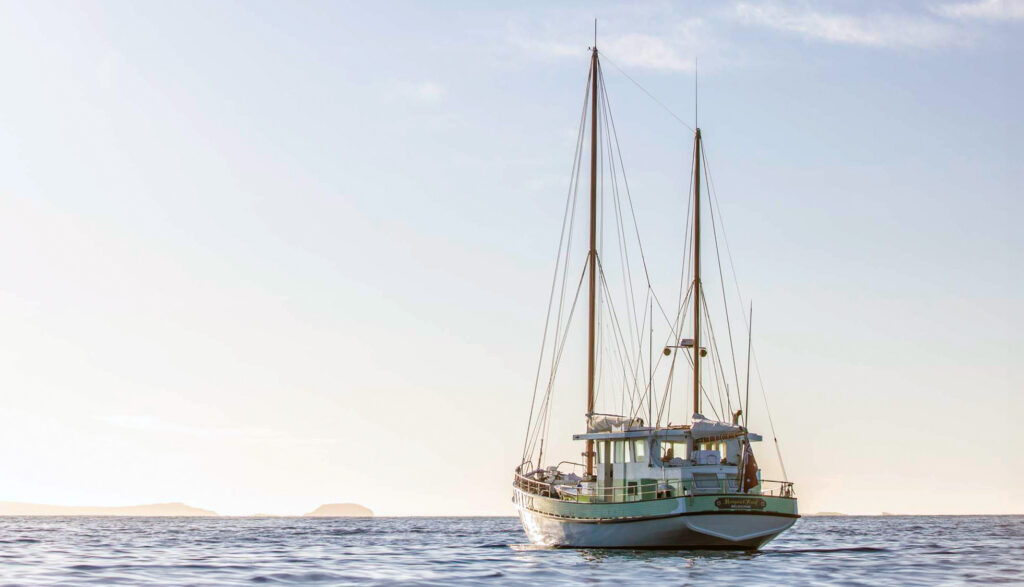
Mark Chew/Southern Wooden Boat SailingThe 56′ MARGARET PEARL, a commercial crayfishing vessel designed and built in the Australian island state of Tasmania, was restored between 2015 and 2020 and in the process converted for adventure-cruising.
When Tim Phillips called Jim Woods one day in 2015 to alert him to the plight of an old crayfishing boat, Jim’s interest was piqued: “Tim told me that he wanted to save the boat, but what he really meant was that he wanted me to do so!” The boat in question was MARGARET PEARL, designed by R.H. (Dick) Thompson and built by Jack Behrens at Battery Point in Hobart, capital of the Australian island state of Tasmania, in 1958. She had a small gasoline engine and a single mast on which to set auxiliary and steadying sails. And she was a mess.
MARGARET PEARL had suffered a number of mishaps over the years, but somehow survived them. In the late 1990s, she grounded on rocks that stove a hole in the port side big enough to drive a small car through. Her crew somehow managed to beach her and roll her over to her starboard side to make temporary repairs, and then motored her home while listing her to starboard, to keep the repaired area clear the water. “They used these boats very hard,” Jim said, “and while they loved them, the money was more important than the boats. Repairs and maintenance weren’t necessarily carried out to a particularly high standard.”
Thompson, the designer, was a commercial mariner and a sometimes-harbormaster of Devonport who designed hundreds of Tasmanian fishing vessels, both commercial and recreational; Behrens was a very successful fisherman, and a well-respected boatbuilder. This duo created MARGARET PEARL for Cyril “Dodger” Long, who had been a gunner in Lancaster bombers during World War II, then an auctioneer, and then a crayfisherman based at Stanley on Tasmania’s north coast. Long fished MARGARET PEARL for 23 years before selling her in 1977 to Keith Ford, who for two years continued her career pursuing crayfish and went longline shark fishing in the off-season.
Courtesy Of Southern Wooden Boat Sailing (both)Left—MARGARET PEARL was launched for Cyril “Dodger” Long in 1958; he used her for crayfishing for 23 years. Under subsequent ownership, she was also used for shark fishing and scalloping. Right—She declined precipitously after 2010 and was in danger of being broken up when acquired by Jim Woods, who restored and converted her.
A succession of owners followed after 1979, and MARGARET PEARL was variously used for shark fishing and scalloping—as well as crayfishing. She was truly an industrial vessel: when one of her owners, Greg Rainbird, had her, he drove a tractor onto the foredeck and removed its tires so that the wheel drums could be used to haul the scallop dredges. Her most recent former owner, Peter Kelly, died in 2010, and this resulted in MARGARET PEARL’s precipitous decline; five years later, the harbormaster in Portland, Victoria, about 170 miles west of the mainland city of Melbourne, had to dispose of her.
After traveling to Portland and “spending a weekend poking and prodding at her,” Jim bought MARGARET PEARL for one Australian dollar. “Which,” he said “turned out to be probably many hundreds of thousands of dollars too much. Tim is an expert at having a vision and then inspiring someone else to fulfill it.” He then acknowledged his own weakness in the transaction: “But he didn’t have to work all that hard on me.”
Jim Woods has been involved in wooden boats since he was a teenager. In the early years he helped restore, maintain, and sail his friend Ric Lansell’s Couta boat, WEEROONA. Couta boats are sloops with 19th-century origins, used to fish for barracouta in Port Phillip Bay and Bass Strait (see WB No. 137) WEEROONA’s crew cruised her around Port Phillip Bay and Bass Strait, and even took her to Whitsunday Islands in Queensland, “living under the foredeck for a couple of months.” These outings gave him a firm foundation in the suitability of old fishing boats for sensitive conversion to pleasure craft.
The first boat he owned was RON OF ARGYLL, a 50′ canoe-sterned gaff ketch built in 1928 by Alexander Robertson & Sons of Sandbank, England. This was “a bit of an impulse buy,” Jim said. She was in poor condition and so he took her to Tim Phillips, his friend and the proprietor of the Wooden Boatshop at Sorrento, near Melbourne. Tim had been largely responsible for a much-touted Couta boat revival in Australia. “[RON OF ARGYLL] was one of his first forays out of the Couta boats with a bigger boat restoration,” Jim said. “It was a bit of an eye-opener and a learning experience for both of us, I think.” Jim and his friends then had “a lot of adventures in her,” including chartering her in the Whitsundays for about seven years and making a number of trips up and down Australia’s east coast. “I think we were a bit of a wild crew,” Jim said. “I was between wives at that time….”
Mark Chew/Southern Wooden Boat SailingSeen here in her home waters near Melbourne, Australia, MARGARET PEARL is an ideal vessel in which to access remote places.
His next boat was the 44′ WINDWARD II, built in Hobart in 1929 and more of a racing boat. With a low freeboard, no lifelines, and “a huge rig,” she didn’t really suit his workboat-cruising mentality but was “good for the boys for a bit of fun.” One particular memory that has stuck with him was taking her back to Hobart, her first return to the place of her build since she was almost new, and where a number of people who remembered her came aboard and showed him their old photographs. “One of the things I like about wooden boats is the connection with the past custodians,” he said. “That is what it is all about.”
Even when he had his own boats, Jim often cruised with friends on their crayfishing boats, in particular with Tim Phillips in his 1925 54′ gaff cutter STORM BAY, and with Gary Kerr in his 1981 49′ ketch JANE KERR, both of which had fished for cray commercially but now did so only for fun. In the early 20th century, there were hundreds of boats harvesting crayfish around the Tasmanian coast—“the southern rock lobster capital of the world,” according to Jim. They evolved from sailing boats to motorsailers and then to pure motorboats, which are either fast day boats that return to port each night or large steel vessels that stay at sea for a week or more. Both STORM BAY and JANE KERR, with their long keels and heavy displacement, are of the type; they were designed and built for “getting people out, being safe to work on, and getting them back” in all weather. Jim has fond memories of cruising with Tim and Gary, both of whom have covered many miles in their crayfishing boats—often in company and both offshore and on rivers stretching far into the Tasmanian wilderness.
Nigel SharpThe new wheelhouse is built of ½″ and ¾″ plywood, sheathed on the exterior with fiberglass cloth set in epoxy. The structure is larger than that of a traditional crayfishing boat to allow space for passenger seating.
Jim was thus primed for a crayfishing boat of his own.
im intended to restore MARGARET PEARL in Queenscliff, near his home in Melbourne, but first he needed to get her there from Portland, a sea voyage of approximately 200 miles. The hull had opened up significantly above the waterline and so “thousands of dollars were spent on caulking compound, which was liberally applied in the seams.” The GM 6-71 diesel engine was made operational (albeit without affording any great confidence) and several electric bilge pumps were temporarily installed along with a portable gasoline generator to power them. As it happened, the voyage to Queenscliff—accompanied by JANE KERR—went off almost without incident, although at one stage Jim forgot to activate the bilge pumps until his crew told him they were knee deep in water in the forecastle.
MARGARET PEARL was hauled at Queenscliff marina and lightened by the removal of the wheelhouse and various other items; she was then transported to Queenscliff Maritime Museum, which had agreed to provide space ashore. It may have seemed more obvious to have asked Tim Phillips to restore MARGARET PEARL at his yard at Sorrento, “but he said to me, ‘You can’t afford three of my guys for four years doing this job’,” Jim said, “and he was quite right.” So he managed the project himself for most of the time, with his friend Greg Phelan taking over in the latter stages. Jim engaged one of Tim’s most experienced shipwrights and frequently had the benefit of input from Tim himself, but most of the work was carried out by three local house carpenters.
One of the first jobs was to remove the concrete ballast, which was about a month’s work for a couple of temporary workers. The timber keel was retained, but the stem and sternpost were partially replaced with new ones shaped from makore, a West African hardwood. About 70 percent of the 2″-thick blue-gum planking was saved, but the rest—including the garboards and a few planks around the stem—was replaced with makore. All but five of the frames were renewed; the replacements were laminated (but through-fastened with ⁵⁄₁₆″ bronze bolts, and not glued) from three pieces of 1″ × 3″ wood—Queensland blackbutt, at first, until that was found to be too brittle and prone to breaking despite steaming, and American white oak for the remainder. The floor timbers, beam shelves, stringers, and laminated deckbeams were all renewed in Victorian mountain ash.
In the early stages, it became clear that the project required significantly more work than initially anticipated, and Jim decided to “bite the bullet” and make sure it was all done thoroughly. “If we didn’t start with a structurally sound hull,” he said, “we would be continually removing joinery and systems so we could fix bits.”
MARGARET PEARL has no external ballast, but 7 tons of lead was installed in the bilges. “Tim told us it had to be packed in a certain way, sitting on bearers on the frames and with angle iron to hold it in place,” Jim said. “It was loaded into the boat by my son, Tim, and his mates. They got very competitive about it to see how much they could pick up at a time. They were going like stink. Tim, bless his cotton socks, placed the entire 7 tons in position himself.”
After a ¾″-thick plywood subdeck was fitted, ¾″ iroko planks were straight-laid on top of it. Below the plywood and between the deckbeams, short lengths of non-structural western red cedar were fitted to give the appearance of laid decking to the overhead.
A new wheelhouse was built from ½″ and ¾″ plywood, and then sheathed on the outside with fiberglass and epoxy. This structure, with design input from Tim Phillips, is larger than that of a traditional crayfishing boat to allow space for seating aft. With childhood memories of traveling on the wooden ferries from Sorrento to Queenscliff and admiring their clearview screens, with their rotating glass discs to shed spray and rain, Jim had always wanted one himself, and so it was now an easy decision to fit one in the central window of his new wheelhouse.
Along with other boats of her type, MARGARET PEARL always had a substantial wet well amidships to keep crayfish alive until the catch could be offloaded. Jim and Tim had “some philosophical differences” with regard to this; Tim passionately believes it should have been retained, even if small, just as it has been on both STORM BAY and JANE KERR. Jim’s decision to dispense with it, however, freed up space for a very comfortable saloon and galley, deep amidships where the boat’s motion is least noticeable. “He has opted to live out of the freezer rather than the wet well, which is a shame,” said Tim. “But when people who love classic boats like Jim come along and put their money where their mouth is, you can’t beat them up too much, otherwise you will either get the sack or they will be unhappy with it. You have got to gently take them on the journey.”
Nigel SharpThe space of the original vessel’s large wet well amidships has been given over to a comfortable saloon and galley deep amidships, where motion is least noticeable. Forward of this space is a large forecastle with about 8′ of headroom.
Forward of the saloon and galley is a huge forecastle with about 8′ headroom, which Jim describes as “multifunctional” and “determined by my time on STORM BAY.” It includes a double berth forward (under which is the freezer) and four single berths aft of that, providing accommodation for “a couple with kids or four blokes going on a fishing trip.”
Also in the forward accommodation is a head and shower compartment, while aft of the wheelhouse is a comfortable double cabin with en suite heads used by Jim and his wife, Sam. The key here, says Jim, is to “have a comfortable and private space for the skipper and his missus both to encourage ongoing use and justify the expenditure.”
The engineroom is below the wheelhouse, with access from the aft cabin. MARGARET PEARL now has a new 350-hp Yanmar diesel engine, while outboard of the saloon is a pair of 1,000-liter (264-gallon) fuel tanks. Her systems also include air conditioning (“we haven’t used it yet but we will when we go north”), and a desalinator feeding a 900-liter (238-gallon) freshwater tank. A hydraulic system runs the steering system and the anchor winch, which came with the boat and was refurbished “although it would probably have been cheaper to get a new one.” The boat has no generator, but power requirements are adequately met by a 250-amp alternator; 6,000W inverter; 600aH, 24V, lithium batteries; and 900W solar panels on the wheelhouse roof. “She has the most complex conglomeration of systems and machinery I have ever been involved in,” Jim said. Much of the engineering work was installed by two Teds—Ted Banks and Ted Harold—in whom Jim had complete faith in terms of everything working, while also needing them to understand that “everything also needed to look nice.”
Nigel SharpAlthough now laid out as a pleasure boat, MARGARET PEARL still goes crayfishing: here, her foredeck is lined with crayfish pots, and a custom-built hydraulic pot hauler is partially visible on the starboard side.
Soon after the restoration began, Jim decided he wanted the boat to comply with Australia’s Uniform Shipping Laws code for commercial craft. This “added another layer of serious complexity” to the project, mainly because the regulatory administration for the code was in transition from the state government to the federal government. Furthermore, said Tim, “the knowledge of this sort of boat has greatly diminished over the years, as they haven’t been built commercially for so long, so it is very hard to get a surveyor who has got an appreciation of them and how they are put together.” One consequence of the code is that the boat now has three watertight compartments with watertight doors between them; one of these compartments can flood without the boat sinking. “The coding was a huge task,” Jim said, “but in the end, the surveyors were pretty good.”
MARGARET PEARL originally had a single mast. She is now ketch-rigged. The rig was designed by Tim Phillips and the Wooden Boatshop’s general manager, Wayne Parr, and is based on JANE KERR’s rig. The Wooden Boatshop also made the spars of Douglas-fir and the standing rigging of Dyneema. The rig was designed to be easily manageable, which is why it is small, has fully battened main and mizzen sails for ease of stowage in conjunction with lazyjacks and stack pack bags, and a self-tacking jib. The main boom is short enough to allow the wheelhouse roof to accommodate a RIB, which is launched and recovered by extending the boom with a stainless-steel tube and then using it as a derrick.
Mark Chew/Southern Wooden Boat SailingJim Woods held childhood memories of riding ferries with clearview screens—rotating discs that shed water—mounted in their wheelhouse windows. It was an easy decision to fit one in MARGARET PEARL’s central wheelhouse window.
After five long years of work, MARGARET PEARL was eventually relaunched in October 2020. Since then, Jim and his friends and family have cruised around the Bass Strait and the Tasmanian coast. He particularly likes adventure cruising, to get away to places that are hard to reach otherwise, and is greatly enjoying the fact that he can now do so “in reasonable comfort.”
Although Jim rejected the wet-well idea, MARGARET PEARL does retain the ability to indulge in some crayfishing. A recirculating tank under the bench across the front of the wheelhouse allows live crayfish to be stored, and they are brought aboard by means of a custom-made, hydraulically driven pot hauler amidships on the starboard side. “It works beautifully and looks the part,” Jim said.
Under power, with the engine turning at 1,200 rpm, MARGARET PEARL makes about 7.5 knots; increasing the rpm to 1,300 yields about 8.1 knots. She spins a 40″, 4-bladed propeller and tops out at 10 knots; her range at 7.5 to 8 knots is 1,400 miles. Although the rig is primarily intended for steadying, in 20 knots of wind it can provide enough drive to sail the boat at 4 to 5 knots; under the big genoa alone it makes about 4 knots. “If we want to turn the engine off for an hour to enjoy a beer as the sun goes down, it’s good to set the sails,” Jim said. “It’s very pleasant and makes us feel like we really are sailing.” The wheelhouse, in particular, seems to have come into its own. “There are very few days in this part of the world when you can just stay outside all day,” he said. “It is either rainy and cold or sunny and too hot. But we can just sit inside and have a beer, watching the spray hit the clearview and enjoying the views.” Jim is also using MARGARET PEARL for occasional charter work in the Melbourne area—about 10 day trips per year.
Mark Chew/Southern Wooden Boat SailingMARGARET PEARL cruises in calm water at about 7.5 knots with the engine turning at 1,200 rpm. The rig is meant mostly for steadying, but in 20 knots of breeze she’ll make up to 5 knots under sail alone.
As with his earlier boats, Jim enjoys meeting people with connections to MARGARET PEARL. For instance, Keith Ford visited the nearly complete boat just before he died in 2020 and “expressed delight” that MARGARET PEARL would have a second life; Dick Thompson’s grandson Andrew came aboard in 2021 and had evidence that the steering wheel had been made by Dick himself; and when Jim took MARGARET PEARL to the Australian Wooden Boat Festival in Hobart in February 2023, “a large number with quite intimate connections to the boat came aboard.” These included Jack Behrens’s 80-year-old daughter, Kay Richardson; several descendants of Cyril “Dodger” Long, including his great nephew and a nephew who remembered fishing with Cyril as a teenager; and a number of crew who worked on MARGARET PEARL out of Stanley and other parts of Tasmania.
“There were also quite a lot of people with big reputations who came on board and said nice things about the restoration,” Jim said. “It just brings home how connected people are with timber vessels, and I don’t think that happens with boats built of other materials. It was worth the trip.” ![]()
Nigel Sharp is a lifelong sailor who worked for 35 years in the British boatbuilding industry before leaving in 2010 to work as a freelance marine writer and photographer; for more of his work, see www.nigel sharp.co.uk.