
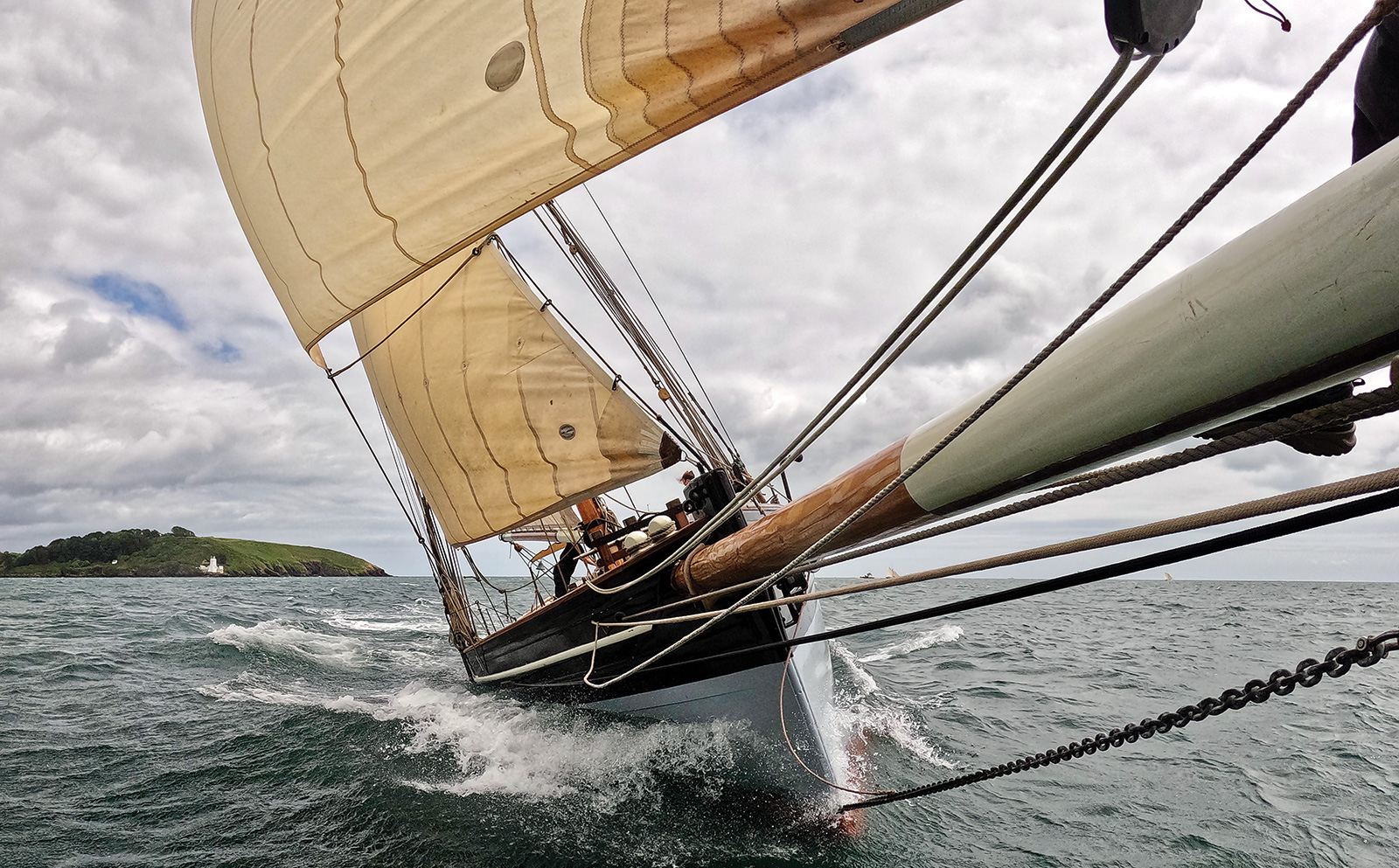
ALPHA—one of nine pilot cutters racing in the Pilot Cutter Review off Cornwall, England, in 2025—was built in 1904 in Lancashire in North West England. Her cutaway-forefoot keel profile is very different from that of most pilot cutters built for working on the Bristol Channel.
It was a cloudy day with gusts of up to 28 knots for the last leg of the Pilot Cutter Review in St. Mawes, Cornwall, England, in May 2025—more like a chilly autumn morning than late spring day. Racing would have been canceled had this been an AMERICA’s Cup challenge, but of course pilot cutters are famously hardy boats, designed to be sailed by “one man and a boy” in any weather. The Pilot Cutter Review would go ahead come what may.
My ride for the day was the 1904 Bristol Channel pilot cutter ALPHA, looking stunning after her recent restoration by Ben Hopper Traditional Boats in Falmouth. Although one of the heaviest boats there, she had a secret weapon: her cutaway forefoot, which is unusual for a traditional Bristol Channel pilot cutter. In theory, this makes her more nimble than her contemporaries, and her heavy displacement means she can stand up to a strong blow.
ALPHA had done well on the 23-mile passage race from Fowey to Falmouth two days before, finishing second, but not so well in the two Saturday races (finishing seventh and fourth), so the pressure was on to do better on the Sunday race, known as “the long one,” the last race of the series. After checking the forecast and consulting with ALPHA’s owner, Willem Scholtes, Ben briefed the crew on the race ahead. “We’ll fly the medium topsail, which has a topsail yard but no jackyard, and full mainsail,” he said. “If the wind increases any more, we’ll take a roll in the main and fly the medium topsail over a reefed main, rather than try to change the topsail. Let’s focus on trim, sailing the boat fast, and making perfect maneuvers rather than lots of sail changes and any mishaps.” Given the strength of the wind, the strategy seemed a good one to me.