
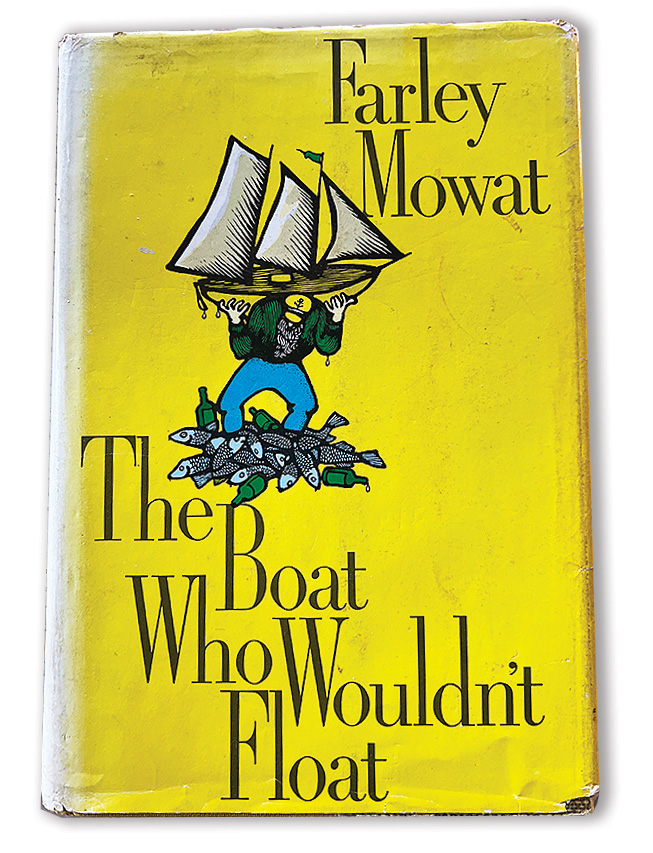
The Boat Who Wouldn’t Float, by Farley Mowat. First American edition by Atlantic–Little Brown, New York, 1969. 241 pp. Hardcover. Available now in libraries or pre-owned soft- or hard-cover editions at prices ranging from $6 to $34.95.
Let’s start this book review with a little quiz.
What special property of some Newfoundland-grown spruce makes it both perfect yet problematic as a timber for masts?
Can a wooden hull that has had its seams reefed out and caulked, covered with canvas set in epoxy, then double-planked with an outer layer of 1″-thick pine, also expertly caulked, leak?
Just how badly can you screw up leaving your mooring?
What’s the only practical way to take an auxiliary sailboat up the St. Lawrence River against the prevailing wind and current?
Answers to these questions and many others will be found in Farley Mowat’s The Boat Who Wouldn’t Float. The whole tale hinges on the answer to another question: What happens when you buy a boat in the dark of a gale-lashed night in Muddy Hole, Newfoundland, when the seller has gotten you blind drunk on a lethal alcohol known as Screech?
The deliberate use of the pronoun “who” in the book’s title is a grammatical clue regarding how Mowat viewed his vessel. She was known for a brief period as ITCHY ASS SALLY but more usually as HAPPY ADVENTURE. This was a sailboat with a very real personality. HAPPY ADVENTURE could sometimes be compliant. However, particularly if she sensed that her course was westerly and away from her fog-enshrouded home, the boat could turn stubborn and dangerously malevolent. Those are worrisome traits given the cold, reef- and sunker-strewn waters in which Mowat sailed.
This tale begins with one of those ideas that seems to make perfect sense at the time. Over drinks in a Toronto bar, Mowat and his Canadian publisher and friend, Jack McClelland, committed “to buying ourselves an oceangoing vessel in which to roam the salt seas over.” The pair decided they would do things “the old-fashioned way…and this meant buying an old-fashioned boat, the kind of wooden boat that once was sailed by iron men. The only place we knew where such a boat might be procured was in the remote and foggy island of Newfoundland.”
It was Mowat’s job to actually go and find a boat. But it was not until two days after he made the purchase that Mowat, by then sober, returned to Muddy Hole with the broker and beheld his new craft in daylight. From a distance, the boat looked like “a pretty little thing, despite her nauseous [light green] color.” She was a flush-decked 31′ schooner with three fishing wells in which a man could stand and jig for cod. There were two odiferous fish holds, a tiny accommodation forward, masts like walking sticks stayed with “lengths of telephone wire and cod line,” a bowsprit that looked like little more than a mop handle, and ancient, patched sails. In the engineroom “lurked…a single-cylinder, make-and-break (but mostly broke) gasoline engine.” Such vessels were known locally as a “jack boats” or “Southern Shore bummers.”
Like her sisters, this boat had been constructed of unseasoned green wood. The builder Mowat hired to fix up HAPPY ADVENTURE and install a cabin house reported: “Southern Shore boats all leaks a drop when they first [sic] off…. But once they’ve been afloat a day or two, why they takes up.” The problem with this particular bummer was that she never really did reliably “take up.”
Among the many surprising aspects of this whole story is that when McClelland arrived in Muddy Hole to view the boat, he did not head right back to Toronto. Instead, he and Mowat began scrounging all the needed equipment such as blocks, shackles, portlights, and a propeller. Meanwhile, boatbuilder Enos Coffin constructed a long, raised house and an interior whose berths were contrived to eliminate any chance of comfort. There was a gasoline stove but no toilet. New spars were built from select black-spruce trees offered by the owner of an island forest.
Mowat bought the boat in May 1960, and he, Jack, and Enos labored over her until July. HAPPY ADVENTURE’s maiden voyage went something like this: As the little schooner beat toward the narrow harbor’s entrance, she balked at the first effort to tack and “fell off again and…resumed her original course.” As HAPPY ADVENTURE bore down on a fleet of moored boats and rocks, McClelland got the one-lunger started. There was a momentary feeling of relief until it was discovered that the engine was running in reverse. And so, as all the residents of Muddy Hole watched in amazement, HAPPY ADVENTURE backed out of the harbor with all sails raised.
The book’s 23 chapters tell the whole tale. When the original goal of sailing to some far-off place was accepted as unrealistic, a new destination was selected: the nearby French islands of St. Pierre and Miquelon. Mowat had many adventures there, including one aboard a real St. Pierre dory with its pull-up propeller shaft for ultra-shallow water. HAPPY ADVENTURE’s stay in St. Pierre ended after she became a pawn in the dangerous game between local bootleggers and the Royal Canadian Mounted Police. After that, Mowat, whose crew now included Claire, the young woman who would become his second wife (he was married at the time), ranged the little outports of Newfoundland, settling in with the locals and battling his schooner’s willfulness and efforts to sink herself. Eventually, with a seasoned skipper to help him, Mowat barely survived an incredibly rough crossing of the Cabot Strait on the voyage that would take HAPPY ADVENTURE to Québec and Montréal’s Expo 67. There, the boat was welcomed as an authentic artifact of her island home.
This book was first published in 1969, by which time Mowat (1921–2014) was recognized as Canada’s most widely read and influential nonfiction writer, and he was far from done. His great themes, which included the plight of Canada’s native peoples and wildlife, Newfoundland, and war (based on his own devasting experiences in a Canadian infantry regiment), earned him a worldwide reputation despite some controversy regarding accuracy or exaggeration. The Boat Who Wouldn’t Float is a sobering book in some ways, possibly over-dramatized in places, and laugh-out-loud funny.
As for those questions posed at the outset of this review, you’ll find the answers and much, much more if you get the book from your local library or buy yourself a copy.
—SG