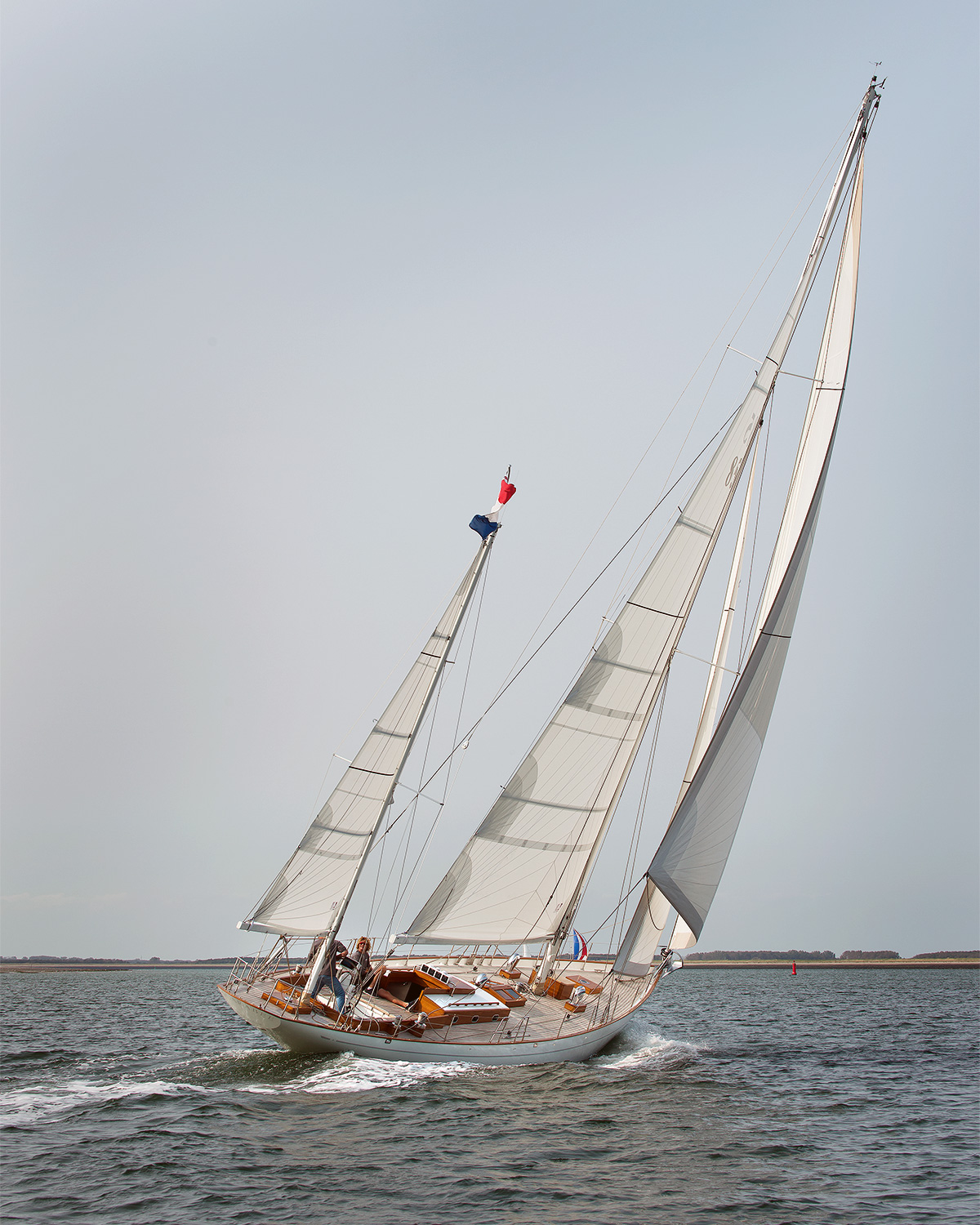
Pieter van der Aa built the 55′8″ yawl SCARABEE singlehandedly at his shop in The Nertherlands. The yacht is a re-creation of the Sparkman & Stephens yawl AVANTI.
Particulars
- LOA 55′8″
- LWL 40′
- Beam 12′5″
- Draft 7′9″
- Sail area 1,354 sq ft
Pieter van der Aa has a seemingly genetic passion for wood. His great-grandfather, grandfather, and father all worked with the material. As a young boy he spent much time with his father at his factory, which built wooden doors and other components for houses. He also spent time at the small boatyard operated by his uncles, who built lifeboats.
In 1980, when he was 17, Pieter brought this experience together and built his first boat, a plywood canoe. Two years later, he restored a teak sloop under the guidance of his uncles’ yard. Soon afterward he restored a classic 28′ Alan Buchanan–designed East Anglian 28 built in 1963. Through these projects, he developed both skill and a deep understanding of hardwoods. He parlayed all of this into his own business, importing oak from France—mainly in special long sizes commonly used in industrial flooring. After a very successful period, he sold his company in 2009.
By then, he had succumbed to the urge to combine his twin passions for boats and wood—but in a very large way. Rather than continue to turn out, say, a series of small boats or even a modest-sized pocket cruiser, he took on the complete construction, alone, of two significant bluewater yachts designed by the legendary American firm of Sparkman & Stephens (S&S).

Pieter van der Aa (on the helm) sails SCARABEE with rigger Rogier van Overveld in September 2022.
From 2004 to 2010, Pieter singlehandedly built the S&S–designed 45′ New York 32-class sloop MASQUERADE. For many years, Pieter had dreamed of building his own sailing yacht. Upon discovering the S&S drawings of the New York 32, from which 20 had been built during the winter of 1935–36, he was determined to build one.
The New York 32 originated in 1935 when the New York Yacht Club sought to replace its aging one-design fleet of Herreshoff New York 30s with a fast, graceful bluewater racer-cruiser. S&S won the contract with its New York 32 design, and the Henry B. Nevins yard of City Island, New York, built the entire 20-boat fleet over the subsequent winter. Incredibly, one-third of that fleet is still in commission and sailing; several of the boats have competed recently in ocean races, including the Newport Bermuda Race and the Marblehead to Halifax Race. Others have disappeared or await restoration.
Before embarking on his six-year New York 32 project, Pieter contacted the yacht’s designer, Olin Stephens, who was then 97, about cold-molding the hull over a strip-planked core. Olin sanctioned this construction method, and resolutely declared her a true New York 32 on which the sail number 21 would be officially bestowed. During the boat’s lofting, Pieter searched for an original New York 32 beyond reasonable restoration, from which he could salvage and reuse the lead ballast keel and bronze hardware. He located hull No. 13, then called MUSIC, in Port Townsend, Washington.
MUSIC, which had been launched as BIQUETTE and gone through a succession of other names, had had an illustrious racing and cruising career on the East Coast before moving to the Seattle area, where for a period of time she was well maintained. Eventually, however, she would languish for many years, uncovered. A 2002 survey report described what was likely the original deck, built in the conventional Nevins style of square-sectioned pine strips edge-fastened with galvanized-steel nails and covered in canvas. Several potential buyers had walked away from the boat by the time Pieter arrived to inspect her, and he concluded that her condition was very poor. A recent survey had put her replacement value at $1 million, and her fair market value, upon restoration, at $100,000 to $350,000. These figures illustrated both the economic challenge of the restoration and the enormity of Peter’s new-construction project. He purchased the hulk, which included spars, an assortment of hardware, and the ballast keel, and had it shipped to The Netherlands.

From 2004-2010, Pieter built No. 21 of the S&S designed New York 32 class. He named the boat MASQUERADE.
In 2006, about midway through the new boat’s construction, New York 32 hull No. 21 was placed atop the ballast keel of New York 32 hull No. 13. Pieter named the new boat MASQUERADE—a nod to a festive gathering of people who hide their true identities by wearing masks—because despite MASQUERADE’s classic appearance, he reasoned that she was a new yacht built with current-day construction methods.
Pieter is a perfectionist. He lofted the hull and built every single part of MASQUERADE himself, including the hull, interior, deckhouses, deck, hatches, mast, and boom. He also accomplished all of the finishwork. The boat, launched in 2010, is an extraordinary achievement.
Pieter sold MASQUERADE in 2013, wishing to build an even larger yacht that he could possibly live aboard. “I accurately studied the books and drawings of Olin Stephens’s designs,” he said. With each of his forays into the S&S archives, he said, “the beauty of the yawl rig caught my eye. One day, I sailed with the Dutch owner of the 52′ 1953 S&S yawl BACCARAT…. She is beautifully preserved.” For Pieter, it was love at first sight for the yawl. He determined that his next boat would be so rigged.
In 2013, Pieter asked Bruce Johnson, who was then the head designer at S&S, for his perspective on a new project. He wanted a boat bigger than MASQUERADE—up to 60′, with a yawl rig. It would be suitable for trips abroad and offshore sailing with his wife and three daughters. And every now and then it would compete in a regatta.
Bruce came up with AVANTI. This 55′8″ yawl had been commissioned by Walter N. Rothschild and was built by the Herreshoff Mfg. Co. in Bristol, Rhode Island, in 1935. The yacht was an immediate success, winning many 475-nautical-mile Gibson Island Races from New London, Connecticut, to Gibson Island, Maryland. The New York Times reported on AVANTI’s first victory in this contest on July 2, 1937, before the entire fleet had even finished: “…Avanti…took the J. Ruslon Miller Jr. Trophy for being first on corrected time in the fleet and also was confirmed as the Class A winner tonight, as all but three of the thirty five yachts that raced here from New London were either in or accounted for.” The Times called it a “Triumph for New Boats,” noting that the “gray-hulled Avanti, a short-rigged yacht,” was accompanied in victory by the freshly christened Phil Rhodes yawl GOLDEN EYE in Class B. The older S&S–designed EDLU finished second to AVANTI in class A, supporting Bruce Johnson’s observation that AVANTI was a refinement of EDLU, which was a refinement of Stephens’s winning yawl STORMY WEATHER, which was in turn a refinement of his breakthrough yawl DORADE. “She had a little more beam, a little less overhang” than her predecessors, Johnson said. Olin would later refer to AVANTI as the “parent form” for a number of his subsequent designs, including the legendary BLITZEN, which won both the Newport Bermuda Race and the Transpac.
AVANTI had a rich history beyond the racecourse. In spring 1942, she was requisitioned by the U.S. government to join other private sailing yachts and fishing boats in World War II coastal-patrol service searching for German submarines that were attacking commercial shipping between the United States and Europe. AVANTI’s wartime conversion included the installation of a radiotelephone, electrical-generating equipment, life rails, recognition lights, and large-caliber guns on the foredeck. She was painted in drab gray and bore the registration number CG R-3042. With a crew of six, she made her first patrol on October 15 and continued daily patrols for months to come. She reported several encounters with enemy submarines, and on one occasion missed a just-surfaced U-boat by only a few yards.
New Bedford Whaling Museum/Norman Fortier, Inset: Wikimedia CommonsAVANTI was wrecked in 1954 when her mooring parted and she was cast onto a breakwater in Padanaram, Massachusetts. Inset—Her wheel was donated to the United States Naval Academy, where it serves as a still-contested perpetual trophy.
After the war’s end, she was returned to her yacht trim and resumed her winning ways. In 1954, Rothschild donated AVANTI to the United States Naval Academy in Annapolis, Maryland. However, while she was in Padanaram, Massachusetts, awaiting delivery, Hurricane Carol, which had intensified quickly in the Bahamas, made landfall in Newport, Rhode Island, on August 31, and proceeded to rake the New England coast. The storm surge in nearby New Bedford, Massachusetts, was a record 20′; 60 miles to the north, in Boston, the steeple was blown off the Old North Church. AVANTI, moored just three miles south of New Bedford, was thrown onto the town’s breakwater, and like so many yachts in that storm was declared a total loss. Rothschild salvaged the yacht’s distinctive wheel—which has but a single grip—and donated it to the Naval Academy, where it is a still-contested perpetual trophy.
Pieter, who wished to build a historic S&S yacht that no longer existed, studied and then purchased AVANTI’s original drawings. The choice was clear. He began building in Heukelum, The Netherlands, in 2013, and resolved during construction that he would name the boat SCARABEE after a sacred beetle of ancient Egyptian mythology—a symbol of the sun god, Re. This beetle laid eggs in camel-dung, and ancient Egyptians thought that its young spontaneously arose from dung, triggered by the rebirth of the sun every day.

SCARABE was strip-planked in western red cedar, and fiberglass-sheathed inside and out.
AVANTI was built of mahogany planks on steam-bent oak frames. SCARABEE, on the other hand, is strip-planked in western red cedar and sheathed inside and out with fiberglass and epoxy. While SCARABEE is of contemporary wood-composite construction, Pieter wanted to respect the original AVANTI’s design and sail plan. He developed the new boat’s scantlings himself and began construction by lofting the boat full-size, by hand, in four different views—working very accurately to the nearest millimeter. From these drawings he developed a construction jig of temporary molds spaced 2′ apart over which he laid 30mm strip planking of western red cedar. After smoothing the finished planking, he sheathed it outside with three layers of 600gsm (about 17-oz) fiberglass cloth and a further layer of 200gsm (about 6-oz) cloth. Upon turning the boat upright, he replaced the molds with 18mm permanent plywood bulkheads that define the owner’s cabin, head, saloon, galley, navigation station, and cockpit. He then sheathed the inner planking with three layers of 600gsm cloth. The bulkheads have 10mm mahogany glued to each of their faces. The result is a strong, dry, monocoque structure. “The magic moment,” said Pieter, “was when the hull was turned upright and suddenly a real boat came alive.”

SCARABEE’s hull was built upside down and then turned over for completion. The support of the temporary molds was replaced by bulkheads, which define the interior spaces.
Pieter strayed from the original AVANTI’s interior plans to create a modern layout. There is an owner’s cabin forward with an adjacent head. Amidships are two comfortable settees with a folding table that seats eight people. Aft of this, the galley is to port and the navigation station to starboard. Two additional cabins, port and starboard, extend under the cockpit. The new layout is an efficient use of living and storage space.
The sole is of varnished Douglas-fir, and the overhead consists of bright-finished oak deckbeams contrasting with a white-painted, V-matched inner layer of sipo-mahogany deck planking. On top of this is a layer of 10mm plywood covered with fiberglass and epoxy, and then a 12mm layer of glued-down teak for a classic appearance. In total the deck is 41mm (about 11⁄2″) thick. The hatches and skylights are also teak. The cabin trunk sides are built in two 14mm (about ½″) layers, using teak on the exterior, and mahogany on the interior. “I do not like veneer,” Pieter said. He forecasts that his construction method “will last for many generations.”
The auxiliary engine is a 75-hp Beta diesel spinning a two-bladed propeller. Fuel capacity is 320 liters (84 gallons), and water capacity is 400 liters (about 105 gallons). The new boat also has a bow thruster—a necessary item these days in sometimes-crowded marinas.
Simon den Boer made the laminate sails, which have caramel-colored accents and sail number 85—the same as AVANTI. Rigger Rogier van Overveld worked closely with Pieter to build an easy-to-handle rig. The deck fittings are chrome and stainless steel, and the genoa tracks are of anodized aluminum. Pieter chose an aluminum mast for ease of maintenance. He considered but decided against Sitka-spruce masts but did use that wood for the hollow booms, which he sheathed inside and out with fiberglass and epoxy; the resulting spars are lighter, stronger, and lower-maintenance than conventional wooden ones. SCARABEE was launched on June 26, 2022, after four years of construction; the masts were stepped one week later.

SCARABEE was launched in June 2022 after four years of construction. Her home waters are in the southwest of The Netherlands.
I sailed aboard SCARABEE with Pieter on a sunny day in mid-September 2022. As we got under sail, the wind blew away all the small wrinkles from the new sails. The breeze was light at first, but picked up to Force 4 (11–16 knots). She effortlessly reached 8 knots, and the helm balance was astonishingly light and steady. Rogier van Overveld, the rigger, was aboard to check and fine-tune his work. The sheet leads and standing rigging are all according to AVANTI’s original drawings; Pieter could find nothing that required improvement. The yacht is easily managed by two people and has accommodations for eight.

Although SCARABEE’s hull and deck follow the original AVANTI’s plans, her interior has been reimagined to optimize living and storage space. She has an owner’s cabin forward; a galley aft, to port; and two more cabins aft, port and starboard.
SCARABEE’s homeport is Marina Colijnsplaat, which is on the south banks of the Oosterschelde—or Eastern Scheldt—an exceptionally well-protected sailing area in the southwest of The Netherlands. In summer 2023, Pieter sailed SCARABEE from there to the west coast of France and the south coast of England. He spent several weeks aboard the boat, and she exceeded his expectations—balancing beautifully under just mizzen and staysail in winds of 35 to 40 knots. A crew of two, in addition to Pieter, was sufficient to handle her.
Pieter expresses awe for Olin and the other talented designers at S&S who, nearly 80 years ago, created yachts such as AVANTI without the aid of computers. “It is a great feeling to sail her,” he said, “to cherish and to maintain this beauty.” He is already planning the 2024 season, with his sights set on Finland and the rest of Scandinavia.
Will he build another boat? “Should a paid commission cross my path, I may accept it,” he said. But he wouldn’t do it alone; he’d hire skilled shipwrights to shorten the building time. “To maintain the profession of skilled wooden boatbuilding, I would like to educate young enthusiastic apprentices.” At the moment, he is consulting on two restoration projects: the steel-hulled 176′ Herreshoff schooner INGOMAR, and the 1932 Camper-Nicholson tender FIONA MARY. For INGOMAR, he has built deckhouses, skylights, and hatches. He is currently completing the refit of FIONA MARY.
“I worked hard on this cherished dream of building my own yacht and now strive for a well-deserved work-leisure balance in the years to come,” he said. ![]()
Kees Stuip has been a yachting writer and photographer, with a special interest in Sparkman & Stephens designs, for more than 25 years. He met Pieter van der Aa at the right moment during SCARABEE’s construction to follow the project up to and including the launching and sea trials. He will present his coverage at the next annual gathering of the Sparkman & Stephens Association, to be held in The Netherlands in June 2024. For details, visit www.sparkmanstephens.org.