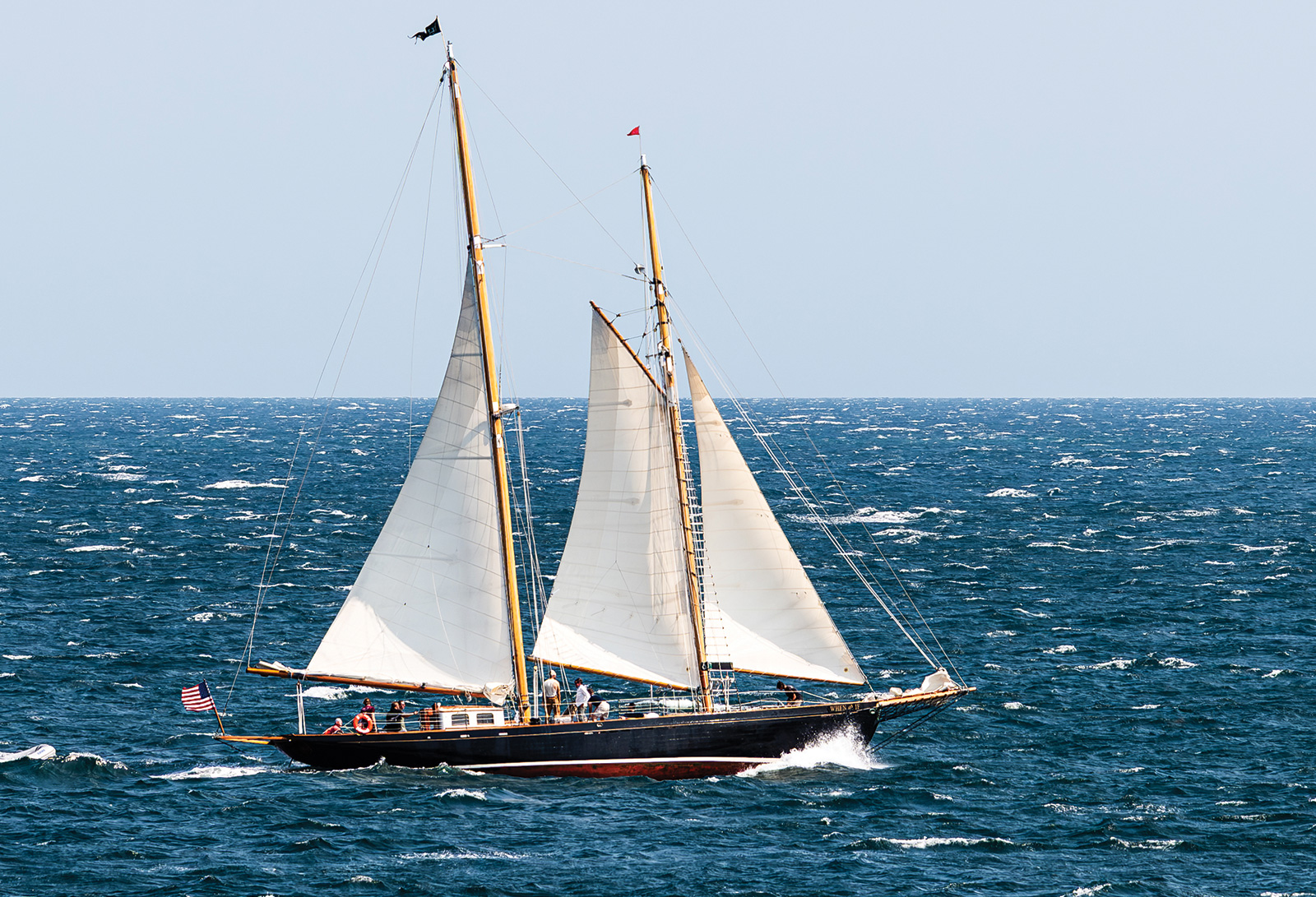
WHEN AND IF nears completion in the F.F. Pendleton boatyard in Wiscasset, Maine.Tyler Fields

WHEN AND IF, which takes the breezes of Buzzards Bay and Vineyard Sound in stride, is a 63′5″ LOD schooner designed by John G. Alden for ocean passages envisioned by George Patton before he achieved fame as a four-star general during World War II. She was launched in 1939. WHEN AND IF nears completion in the F.F. Pendleton boatyard in Wiscasset, Maine, where the future general George Patton closely supervised her construction and launching in 1939

There is a small, faded photograph tacked to the wall at Ballentine’s Boat Shop in Cataumet, Massachusetts, on the Buzzards Bay shore of Cape Cod. It is covered with layers of wood dust, and the edges are a bit torn. The photo—small, grainy, and black-and-white, as if from an old postcard—captured a white-hulled schooner in light air, flying every sail she could without much to show for it. The photo is easy to overlook amid the maybe 75 on the wall. For more than a decade, I walked past the image daily—often more than once. But something about that schooner kept me looking again. Finally, my curiosity grew enough to dig out a magnifying glass with which I could barely make out her nameboard: WHEN AND IF.

The schooner, commissioned in 1939, had been the pride of George Patton Jr., the career U.S. Army officer who achieved fame as a World War II full general. He died after a motor-vehicle collision in Germany shortly after the war’s end without achieving his longtime dream of sailing around the world with his wife, Beatrice, and family. Before the war, Patton had made clear his wishes for the cherished schooner should he not survive the war: The family could keep her, donate her for educational purposes, or scuttle her. Beatrice chose to keep the schooner and sailed her extensively. After she died in 1953, the yacht passed to her brother, Fred Ayer, and later to his son, Fred Ayer Jr.

WHEN AND IF nears completion (left), George and his wife, Beatrice (right).Wenham Museum/Patton Family Archives (both)

Above left—WHEN AND IF nears completion in the F.F. Pendleton boatyard in Wiscasset, Maine, where the future general George Patton closely supervised her construction and launching in 1939. Above right—George and is wife, Beatrice, cherished their Alden schooner ARCTURUS and sailed her extensively before World War II. Patton died before realizing his dream of ocean voyaging aboard WHEN AND IF.

By the 1970s, the Ayer family was ready to find a new home for the schooner. Honoring the general’s wishes, they donated her in 1973 to Landmark School in Beverly, Massachusetts. The school, founded by Dr. Charles Drake two years earlier, provides students who have dyslexia and other language-based learning disabilities an academic approach tailored to their style of learning. The donation was a nod to Patton’s own history with the disorder. The school established a seamanship and character-building program built around the schooner. The costs of upkeep for WHEN AND IF and a second schooner acquired later eventually proved too burdensome, so the school ended its so-called Watermark Program in 1989. WHEN AND IF was again looking for a steward.

In 1990, Jim Mairs, an editor with W.W. Norton & Company, the New York–based publisher, approached Landmark about buying WHEN AND IF. Just after the school’s board approved the idea, the 60-mph gusts of a November gale howled through the harbor at Manchester-by-the-Sea, where WHEN AND IF was lying. Her mooring parted, and she slammed ashore, coming to rest on her port side. For hours, her double-planked hull ground into the rocks, wearing through the two layers of mahogany and cedar. The hull flooded, and it remained on those rocks for more than a week before Bay State Towing could bring in a salvage crane and tugboats. The crews first removed the masts and rigging and then lifted the hull onto a barge for a tow to Fred J. Dion Yacht Yard in the nearby city of Salem.

Landmark School was facing repairs estimated at $250,000. An insurance company declared her a total loss. With options waning, a chainsaw fate looked likely. But Mairs and his wife, Gina Webster, remained committed to the boat and kept their ownership hopes alive. Even before the gale, Mairs had approached Nat Benjamin and Ross Gannon at Gannon & Benjamin Marine Railway on Martha’s Vineyard, Massachusetts, about addressing the schooner’s needs. Instead of contemplating a straightforward refit, Nat and Ross traveled to Dion’s to see if she could be saved at all.

WHEN AND IF was set on the hard at the Fred J. Dion Yacht Yard.Gannon & Benjamin Marine Railway

Once lifted free of the rocky shore on which she grounded in a November gale in 1990, WHEN AND IF was set on the hard at the Fred J. Dion Yacht Yard in Salem, Massachusetts. Her port-side’s severe damage is clearly evident.

The damage was extensive but mostly confined to the port side: The hole in her topsides was big enough to drive a small car through. Not only was the damage to the planking extensive but also numerous frames were destroyed. Her rudder was broken, her keel was scarred, and the cast-bronze floors were mangled. However, her starboard side was spared; “The paint was hardly cracked on that side of the boat,” Nat said. And nearly everything above the deck was intact. Belowdeck, the boat remained dry forward of the galley, and the head and staterooms aft survived. Her interior amidships had long since been modified to accommodate student bunks, but the plywood of that refit was waterlogged and unsalvageable.

Nat and Ross were confident she could be saved—and, more important, she should be. They submitted their estimate to Mairs, a number much higher than the repair bill that Landmark had feared. Mairs called Nat with the somber news that the cost was beyond his means; he would be unable to fund the work alone. But minutes after that call ended, Nat heard the boatyard’s beachfront phone ring again. Mairs had an idea. The thought, further developed in the call, led to an agreement that Mairs would cover the cost of materials and Nat and Ross would cover the labor, and in exchange, all three would share ownership of WHEN AND IF. The boatbuilders immediately jumped at the opportunity.

Frame and planking repairs.Gannon & Benjamin Marine Railway

Before the frame and planking repairs could begin, damaged bronze floors were restored to shape.

Nat and Ross had already bought and restored the severely fire-damaged 72′ Italian yawl ZORRA, the subject of another insurance sale. Even so, they decided that one more project would be well worth the trade. The deal was concluded nearly two years after the storm that damaged WHEN AND IF. She was picked up by a Brownell Boat Transport hydraulic trailer, which was then taken aboard an R.M. Packer Company barge on a rising tide in Salem. The crew set 1″-thick steel plates on the breakwater and slowly drove the truck, trailer, and schooner forward. As the weight shifted to the barge, the truck paused for nearly an hour for the tide to rise enough for the truck to pull completely onto the barge. Loaded and secured, the barge was towed from the North Shore down Massachusetts Bay, through the Cape Cod Canal, then across Buzzards Bay and Vineyard Sound to Vineyard Haven. There, the loading process was repeated in reverse, and after being driven off, the truck offloaded the schooner in a grassy lot adjacent to Gannon & Benjamin’s beachfront shop.

For the next year, a crew led by Andy Lyons worked steadily on repairs, but then the rented lot was sold and the boatyard given 30 days to vacate. Over a two-week period, using planks, rollers, and an antique bulldozer loaned by a friend, the yard crew painstakingly jacked up the 42-ton schooner on the sandy soil and built a cradle underneath her. She was carefully rolled away, maneuvered between two buildings, and then taken into the parking lot in front of the marine railway. Space was tight, and the bow overhung the railway’s small winch shed. Work resumed, and the project got back on schedule.

The unscathed starboard side was used to develop patterns for the new double-sawn frames of black locust that were shaped and installed for a 20′ length of the port side. The twisted bronze floors were heated and coaxed back into shape. New deckbeams, missing portions of the teak deck, and a new worm shoe were also fitted. New port-side tanks were made to replace the ones crushed in the grounding, and the original GM diesel engine was rebuilt.

The schooner’s restoration at Gannon & Benjamin.Gannon & Benjamin Marine Railway

During the schooner’s restoration at Gannon & Benjamin, the crew used the undamaged starboard side of the hull to pattern frame replacements along 20’ of her length to port.

Gannon & Benjamin’s timber merchant in England found a African mahogany tree in Nairobi, Kenya, which was harvested and shipped to London to be milled to order. The wood, enough to replank the entire outer layer of the port side closely matching the original Honduras mahogany, was containerized and shipped to the yard.

Nat and Ross designed a new accommodation with a U-shaped galley aft, a comfortable main saloon, and additional berths above the settees. The plywood bulkheads fitted during the Landmark years were removed and replaced with varnished cypress ones made of wood recycled from a Cape Cod farm’s decommissioned water tank, resawn into 1″-thick stock. The same wood was used throughout the interior.

The work continued steadily. On one bitterly cold day, Nat looked out the office window and noticed a gruff man in a long overcoat looking up at the schooner. Walking outside, Nat asked politely if he could help. In a curt response, the man said, “I’m Gen. Patton.” He was neither a reincarnation—though Patton himself believed in such things—nor a hallucination. He was the retired Maj. Gen. George Patton IV, the son of Patton Jr. of World War II fame (the sequence of numerals in the family is anomalous). Naturally, during their conversation, Nat asked whether Patton had ever sailed with his father aboard the yacht, hoping for a story for the scrapbook. The man’s response was as warm as the weather: “Yup. Worst experience of my life.”

Nat Benjamin, left, and Ross Gannon, right.Gannon & Benjamin Marine Railway

Nat Benjamin, left, and Ross Gannon, right, not only rebuilt the salvaged schooner but co-owned her and spent many years sailing her from Martha’s Vineyard north to Canada and south to the Caribbean.

In June 1994, the prized schooner was back to her former glory and ready for relaunching, with the island’s close-knit wooden-boat community gathered to celebrate. The marshal of ceremonies was the legendary network news anchor Walter Cronkite, who as a young war correspondent had covered troops on the front lines, including Patton’s advance on German Gen. Erwin Rommel’s army in North Africa; Cronkite lived on the island and was an avid sailor.

The years following WHEN AND IF’s relaunching were filled with family cruises and opportunities for island children to learn to sail aboard the historic schooner. Jim Lobdell, a close friend of Nat and Ross and a respected figure on the Vineyard Haven waterfront, was hired as a part-time captain. During his tenure, Lobdell served as captain when Mairs and his wife ventured to Maine and Nova Scotia. Both Nat and Ross cruised WHEN AND IF extensively. When not underway with one of the three partners, Lobdell would share his love of sailing by hosting island nonprofit organizations and taking young sailors offshore.

Heeled over in a breeze, WHEN AND IF’s crew attempts to stay dry on the high side.Seth Salzmann

Heeled over in a breeze, WHEN AND IF’s crew attempts to stay dry on the high side. Farther aft, sailors can shelter in the doghouse that Patton envisioned and demanded of Alden during their initial design talks.

By 2007, the partners were ready to sell. Nat and Ross had sold ZORRA a few years earlier, and the pair were eager for new adventures. The absence of response to brokerage ads for WHEN AND IF in Europe and the Caribbean was discouraging. More than a year went by. The next summer, Ross was in Maine with his partner, now wife, Kirsten. Nat was back in Vineyard Haven and working on the dock when a visitor asked if the schooner was still available. Nat, a little skeptical, confirmed that it was. In quick order, Paul Ruitenberg agreed to the asking price in late August, and a handshake sealed the deal.

Nat immediately called Ross in Maine with the news. Kirsten had always dreamed of a wedding aboard the schooner, so plans were hatched. Within days, the Benjamin family had hoisted WHEN AND IF’s sails and were headed for Maine. Without time to spare, Ross and Kirsten were married aboard on September 21. The next day, they sailed into Boothbay Harbor and traded the schooner for their own car, which Ruitenberg’s crew had driven up to meet them.

The Ruitenberg family continued the tradition of excellent care and love for the schooner. Between yearly family trips to and from the Caribbean, the schooner remained active with local nonprofits and youth sailing programs under the professional captain Emyl Hattingh. They continued to take the schooner to Gannon & Benjamin for work, including the installation of a new Lugger diesel. But sadly, after three years, circumstances forced the Ruitenbergs to place the schooner back on the market.

Racing off Martha’s Vineyard during the Pat West Gaff and Schooner Regatta.Tyler Fields

While an experienced sailor can manage the schooner shorthanded, a large crew is handy when racing, as seen here off Martha’s Vineyard during the Pat West Gaff and Schooner Regatta.

The next owner was Doug Hazlitt, a vintner from New York. A seasoned veteran of classic-yacht restorations, Hazlitt had earlier bought Alden’s MALABAR X in Greenport, New York, after she had been badly damaged in Hurricane Bob in 1991. He had that yacht trucked to Cayuga Wooden Boat Works in Ithaca, New York, for a two-year restoration led by shop owner Dennis Montgomery. Hazlitt, however, soon sold the boat, and her new owners took her to Spain. Now schoonerless, Hazlitt dealt with seller’s remorse in the most reasonable way possible; he asked his MALABAR X hired skipper, Seth Salzmann, to find him a new yacht. None of the prospects suited Hazlitt, and after each showing, Salzmann would boldly state, “Well, it’s not WHEN AND IF.”

Salzmann had encountered WHEN AND IF in Maine years earlier while captaining the GRACE BAILEY, an 1882, 82′ schooner of the Maine Windjammer fleet. It was a brief crossing of tacks, but WHEN AND IF made an enduring impression.

The restoration undertaken by Doug HazlittAlexander Solla

The restoration undertaken by Doug Hazlitt was thorough and dealt with areas untouched during Gannon & Benjamin’s efforts, namely the stern structure and deck. Cayuga Wooden Boat Works rebuilt the transom above.

Hazlitt and Salzmann had known the schooner was available but worried that the price was too high for a yacht that would likely soon need another overhaul. But after she had been on the market for two years, Ruitenberg’s broker called Hazlitt and encouraged him to make an offer. Even before Ruitenberg replied, Hazlitt called Salzmann to ask whether he would serve as captain. The following day, the offer was accepted. Salzmann caught up with the schooner in Rockport, Maine, in spring 2012 during a brief haulout at Rockport Marine. After she was relaunched, he raised sail, cast off the mooring, and headed into Penobscot Bay, sailing solo. An hour or two later, he sailed back into Rockport Harbor and picked up his mooring, all without thought of starting the Lugger. From that day on, he and the schooner have seemingly shared a mutual trust in each other.

Dennis Montgomery and the crew at Cayuga Wooden Boat Works had so impressed Hazlitt with their work on MALABAR X that Hazlitt also took WHEN AND IF there for her next refit. She sailed on her own bottom to the north end of Cayuga Lake, New York, where the yard had a second facility. She was hauled out and covered by a temporary building.

Cayuga Wooden Boat Works rebuilt the transom.Alexander Solla

Cayuga Wooden Boat Works rebuilt the transom framing. Some frames aft needed to be replaced before her deck was laid anew with sprung teak.

Hazlitt managed the project himself, along with shipwrights from the yard and a few additional hands. One of those hands was Justin Armstrong. During the restoration of MALABAR X, Justin, then just 16, had wandered into the Cayuga shop and approached Hazlitt and Montgomery for a job. The two older men assumed that sweeping the floors would be a good place to start. Armstrong felt differently and suggested he might be more helpful in lofting the schooner. After that confident introduction, Armstrong proved himself capable.

Hazlitt already knew WHEN AND IF’s stern needed attention. To guide the work, Armstrong lofted this hull, too. It became clear to him that something was missing. At some point during the Landmark years, issues with the transom were resolved by removing its structure altogether, cutting away compromised planking, and fitting the transom back into place; the procedure shortened the schooner by 6″.

The Cayuga team removed all compromised timber and planks, milled and installed a new horn timber, fitted all-new transom framing, and replaced the next three frames forward with copies made of alternating laminates of silverballi and angelique. To return the schooner to her original length, they replaced a total of 56 planks, covering 15′ from the main shrouds aft. While work progressed on the hull, the charthouse, cabin trunk, and foredeck hatch scuttle were removed. On deck, shipwright Ted Okie and Salzmann worked together to replace her aging structure and new sprung planks of Burma teak.

The classic Alden schooner still shines with richly oiled and varnished teakAlexander Solla

While designed and built for strength and safety, the classic Alden schooner still shines with richly oiled and varnished teak, which is no small task in a tropical climate.

Hazlitt had hoped to have the project completed in time to sail to the Caribbean for the winter of 2013–14. While the main structural work was finished, the schooner was not yet ready for blue-water cruising. With time running out before the lake’s locks closed for the season, the schooner’s shed was taken down and she was relaunched that October so that she could motor through the Cayuga–Seneca Canal and spend the winter at a dock in Watkins Glen, closer to the Hazlitt family vineyard.

Seth Salzmann.Tyler Fields

Seth Salzmann has owned the yacht since 2016, but his familiarity with her began much earlier.

Just as WHEN AND IF’s Caribbean travel plans were scrapped, Salzmann took a position as captain of ADVENTURESS, a recently restored 83′ William Fife–designed schooner. Hazlitt settled in for a few months of dockside projects, including wiring, finishing up the cockpit coamings and staving, and constructing the helm box.

In 2015, Hazlitt called Salzmann in Spain to tell him that he was putting the schooner back on the market. Still feeling regret at watching MALABAR X’s move overseas, Salzmann asked for a favor: “If you have to list the boat, set the price high and let me lease WHEN AND IF in the meantime,” with a right of first refusal. He offered to take over the crew costs, get the schooner a U.S. Coast Guard certification to carry passengers, and start chartering. Along with the usual daysails and sunsets cruises, WHEN AND IF would also join the classic-yacht-regatta circuit. “It will either help you sell it, or I’ll realize it would work as a charter business and I’ll buy it,” he reasoned.

WHEN AND IF ventures to Florida.Tyler Fields

Each fall, WHEN AND IF ventures to Florida to join owner Seth Salzmann’s charter boat fleet out of Key West.

Hazlitt agreed. Salzmann came back to the United States, and he and his wife, Jenny, whom he met while captaining ADVENTURESS, jumped into charter mode. One of their first trips was the June 2015 Tall Ships Festival in Philadelphia, Pennsylvania, followed by a summer of cocktail receptions and daysails throughout New England. In 2016, they took WHEN AND IF into the Great Lakes. Then, only 10 months after Salzmann’s lease began, Hazlitt received a cash offer for WHEN AND IF’s full asking price. By a stroke of luck, during the Great Lakes trip Salzmann had secured financing to make his first-refusal purchase possible. With a handshake between the two, Salzmann was in the schooner business.

During summers since then, WHEN AND IF has been based in Salem, Massachusetts, not far from her original home of Manchester-by-the-Sea. Each fall, Salzmann takes her to Key West, Florida, where she joins his fleet of daysailing charter boats.

Recalling the photograph of WHEN AND IF on Ballentine’s wall, I wondered why some boats such as WHEN AND IF manage to survive when other worthy boats rot away on the hard or sink at the dock. I put that question to Nat. “Every boat has its own destiny,” he said. “Some boats are lucky. If they’re destined to be around, they will be.”

WHEN AND IF’s capabilities have inspired the ambitions of a succession of owners.Tyler Fields

Although Patton never realized his dream of sailing his yacht around the world, WHEN AND IF’s capabilities have inspired the ambitions of a succession of owners.

Lucky or not, a boat’s survival often comes down to one person taking a gamble at the right time. Without Mairs, Hazlitt, or Salzmann, WHEN AND IF’s story could have taken an entirely different turn. Ten years after his gamble, Salzmann’s business continues to grow. Building upon that success, he also recently purchased MALABAR X in Spain and added her to his stable of historic yachts. For WHEN AND IF, being open to the public has introduced thousands of visitors to the heroic life of Gen. George S. Patton, the impressive designs of John Alden, and the unmatched joy of sailing a beautiful schooner in a fair breeze, just as shown in one old photograph.

Throughout long days on the water and even longer hours maintaining a large wooden boat, Seth and Jenny Salzmann have never let go of Patton’s original dream. As their family has grown, they have set aside WHEN AND IF’s earnings for a future adventure of their own…. “When the boys are old enough, and if we can save the money, we are going to sail around the world.”

A visionary with a dream of world sailing

Gen. George S. Patton’s father, George Patton II, was a California attorney and politician who was wealthy enough to be an early landowner on Catalina Island. Summers there afforded the younger Patton opportunities for horseback riding, sailing, and other sports. He excelled in them, in contrast to an academic life hampered by the reading and writing difficulties of dyslexia; he graduated from the U.S. Military Academy in 1909 only because of his headstrong personality and sheer determination.

It was on Catalina that Patton met Beatrice Ayer, who was vacationing on the island with her family in 1902. Ayer also came from wealth; her father was a prominent Massachusetts businessman. While George’s passions started with horsemanship and the cavalry, Beatrice loved sailing. In her youth, she had spent most of her summers on the North Shore of Massachusetts, and newspaper clippings from the time show her to have been a skilled racer in Manchester Class boats, S-boats, and others in regattas from Manchester to Cohasset. Eight years after they met, in 1910, the couple were married at her family’s estate in Beverly, Massachusetts.

On leave as a young military officer, Patton would join his wife in New England. They often sailed together, and in August 1923 while sailing their own small boat, they rescued three boys who nearly drowned after capsizing a dinghy. Patton’s efforts that day made the newspapers and earned him the Silver Life Saving Medal of Honor from the U.S. Coast Guard.

The Pattons moved from duty station to duty station as Patton gained rank, but they still found time for recreation. While stationed on the East Coast, he commissioned a 22′ motorboat that the family used for years on nearby lakes and rivers. (Even during World War II, he was rumored to have commandeered sailboats—Star boats, if the news reports are true—in occupied territories.)

In 1934, by then a major, Patton was stationed at Fort Myer, Virginia, with the Third Cavalry. One day in early March 1935, he arrived home and announced that they were once again on the move. Beatrice recounted that when she calmly asked where and when, he told her it would be Hawaii—“April. In our own boat.” A larger boat was plainly necessary, and within two days Patton purchased a schooner in New Bedford, Massachusetts. He also admitted to Beatrice, with uncharacteristic humility, that he knew nothing of offshore navigation. But he said not to worry, for he had “found a fellow who knows all about it.” The fellow was J.E. Lawton, a wholesale lumber dealer in Washington, D.C., and a lifelong landsman. “Navigation is just his hobby,” Patton quipped. “In fact, he’s never been to sea yet.”

The crew of ARCTURUS.Wenham Museum/Patton Family Archives

Adorned in matching sweaters, the crew of ARCTURUS readies for an offshore adventure. In addition to their children, George and Beatrice also had friends and professional sailors aboard for voyages to Hawaii from California, deep into the South Pacific, and back to California from Hawaii in 1937.

The schooner was ARCTURUS, a 51′ John G. Alden design built in 1930 by Harvey Gamage in Maine. She was loaded onto a steamer bound for California. Patton had 11 short lessons in navigation, and it was May by the time he, Beatrice, and their 12-year-old son boarded ARCTURUS and sailed away with a handful of friends as crew. One of them was Joseph Ekeland, a Swede who was a veteran square-rig sailor who had also crewed the J-class sloop YANKEE during her AMERICA’s Cup trials in 1930 and ’34. Ekeland was covered in colorful tattoos, including a large Chinese dragon on his back inked by a Japanese artist in Singapore. During the voyage, Ekeland became a trusted family friend and continued as a skipper for Beatrice after the general’s death.

ARCTURUS arrived in Honolulu in early June after 15 days without trouble. In 1936, they sailed ARCTURUS farther into the South Pacific, reaching Palmyra Atoll and Fanning Island (Tabuaeran); the latter had been discovered by a distant relative of Beatrice and named for him, even though it had been inhabited by a Polynesian community for more than 300 years.

In 1937, Patton, by then a colonel, was reassigned from Hawaii back to the U.S. mainland. Patton knew the move was a step toward the widely expected war in Europe, which he was sure the United States would join. It was a future he was very eager to meet.

For the Pattons, it was only natural to return the same way they arrived. Unfortunately for ARCTURUS and her crew, the eastbound crossing was far less tranquil and, at 31 days, more than twice as long, including a six-day gale 1,500 miles off California. Nevertheless, “Someday we’d like to sail around the world,” they told reporters upon their arrival in San Diego. With war seeming imminent, they sold the schooner and returned to New England, where they exchanged sou’westers for riding boots. (ARCTURUS is still sailing today, out of Auckland, New Zealand; see WB No. 280.)

Patton, however, was badly injured when kicked by a horse. The long recovery not only sidelined his career as the Army readied for war but also brought on a deep depression. Family lore recalls Beatrice’s efforts to lift her husband’s sprits by encouraging him to write to Alden about a commission for a new, larger schooner for the Pattons’ postwar adventures. Alden said at the time that Patton had become very fond of ARCTURUS and, “he wanted me to design another just like her, only larger, big enough to sail around the world.”

Gordon Prince, a Boston-area sailor and longtime friend, said Patton spent his time designing much of the new schooner himself, but exactly how much is uncertain. One thing Patton demanded was a charthouse on deck to be fitted out with all necessary navigation equipment he had learned to use aboard ARCTURUS.

At the time, Alden’s name had become synonymous with fast, bluewater racers inspired by the Grand Banks fishing schooners of Gloucester, Massachusetts. By the late 1930s, 11 yachts, all named MALABAR, had been built in succession for Alden’s own use, and racing, before being sold to make room for the next one. The same year Patton’s new boat was delivered, Alden launched MALABAR XII.

Patton’s new schooner would be in line with Alden’s designs of the era and was meant to be fast, but for Patton, safety was paramount. The design, No. 669, called for a hull 63′5″ LOD with a waterline length of 47′3″ and a displacement of 84,640 lbs. Alden relied heavily on Maine boatbuilders for construction, especially Charles Morse in Thomaston and Hodgdon Brothers in East Boothbay, but the contract for the future WHEN AND IF went to the boatyard founded in 1910 by brothers Fred and Emery Pendleton in Wiscasset. The area had been famous for shipbuilding since before the American Revolution and reached its peak in the 1850s. As the demand for large ships receded, Pendletons focused on yacht work, for which they were well respected. Patton’s eye for quality would not be overlooked; he was present at the yard when WHEN AND IF’s keel was laid.

Alden’s call for robust and heavy construction was a departure from the Bermuda Race–era MALABARs. Patton’s boat was nearly 25,000 lbs heavier than the 58′ MALABAR X; she was built for distance cruising, not winning races. She was double-planked with an outer layer of Honduras mahogany and inner planks of Alaska yellow cedar, bronze-fastened to stout, double-sawn white oak frames reinforced with bronze hull strapping. Sprung decks of thick teak, high bulwarks, and varnished caprails enhanced her graceful hull shape. Her sail area of just over 1,700 sq ft and the choice of a small auxiliary engine implied that the owner intended to sail when at all possible. At the time, some noted that the small engine might have made the schooner undesirable once hundreds of private yachts were commandeered by the Navy and Coast Guard for wartime service, and in fact Patton’s boat spent the war years under cover in Solomons Island, Maryland.

No cost was spared, and all materials were of the finest quality. I heard one example when I spoke to the yacht designer and builder Nat Benjamin at Gannon & Benjamin Marine Railway on Martha’s Vineyard, Massachusetts, which rebuilt the yacht in the 1990s. He passed along a story he had heard about the chronometer, a vital tool in navigation. Patton wanted the best, and at the yard he insisted the chartroom have a proper one. Alden suggested adding a second chronometer, since no prudent mariner would ever rely on one alone. When a yard representative asked what would happen if the two clocks showed different times, Patton chimed in with a solution: add a third one!

WHEN AND IF awaits final outfitting in Wiscassett, Maine.Wenham Museum/Patton Family Archives

WHEN AND IF awaits final outfitting in Wiscassett, Maine, after her launching in 1939. Patton and the yacht’s designer, John G. Alden, closely supervised her construction and Joseph Ekeland’s rigging.

After a thorough inspection by Alden and Patton, WHEN AND IF was launched in 1939. Alden told The Boston Globe that Patton’s friend Gordon Prince came to the design office in Boston and announced that the name had been chosen after Patton declared that “WHEN this war is over and IF I live through it, Bea and I are going to sail around the world.” However, John Chatman, a professional skipper who worked for the Patton family for decades and also served as the schooner’s wartime caretaker, said the name reflected Patton’s frustration with boats built for other people: “There was always something wrong with them,” as Chatman told the story, so Patton felt that “WHEN AND IF I ever built a boat of my own…” he would get it right. Ekeland, on the other hand, credited the name to Beatrice. Whichever version is true, the name was fitting. Patton hardly sailed her at all before going to war. Documentation is scarce, but a short family movie and a few photographs are evidence of a brief prewar cruise in Maine and a delivery to Maryland.

“For all its fine wood and metal fittings, Gen. Patton wanted no fancy yacht,” Ekeland said. “Just a sailor’s vessel, plain, but competent. And she’s solid, good. One of the best I ever saw.”

After the December 7, 1941, attack on Pearl Harbor, the United States officially joined the fighting. Patton had been made a brigadier general in 1940, and during the war he rose through the ranks to become a four-star general by 1945. In a letter to his caretaker, Chatman, Patton wrote, “As you can see, we are in another war and having a very good time. I hope some day we can get back and have a good sail on the When-and-If.”

WHEN AND IF waited under cover until the war in Europe came to an end in May 1945. Even then, Patton’s often-difficult demeanor led to personal conflicts, and he was relieved of command. In frustration, he set about planning for life outside the military. In late 1945, he met with Ekeland in Stockholm, Sweden, and asked him to return to the United States as soon as he could. He believed the end of his career was inevitable, and he wanted WHEN AND IF ready to set sail.

Three weeks later, Patton’s Cadillac collided with an Army truck in Germany. The crash fractured vertebrae in his spine. Beatrice immediately flew to Germany to be at his side; 12 days later, on December 21, he died of his injuries.

Beatrice continued to sail the schooner, with Ekeland’s help. Maine was a favorite cruising ground, and photographs show her near Portland in 1947, when Beatrice sailed up from Manchester before a two-week cruise Downeast with her brother, Fred Ayer, and friends. In an interview with the Portland Press Herald, Ekeland described Beatrice as an excellent sailor who took the schooner’s helm much of her time aboard.

In fall 1953, while hunting on horseback near her home in Hamilton, Massachusetts, Beatrice was thrown from her horse and suffered an internal hemorrhage. She died almost immediately. After her death, the schooner went to Fred Ayer, and later to his son. It remained in the Ayer family until its donation to Landmark School in 1973.  Article ends.


Tyler Fields grew up in the Pacific Northwest and brought his passion for photography and classic boats to New England. He is a frequent contributor to WoodenBoat and other publications, teaches photo­graphy at Wooden­Boat School, and co-hosts the maritime podcast “Around the Buoy.”