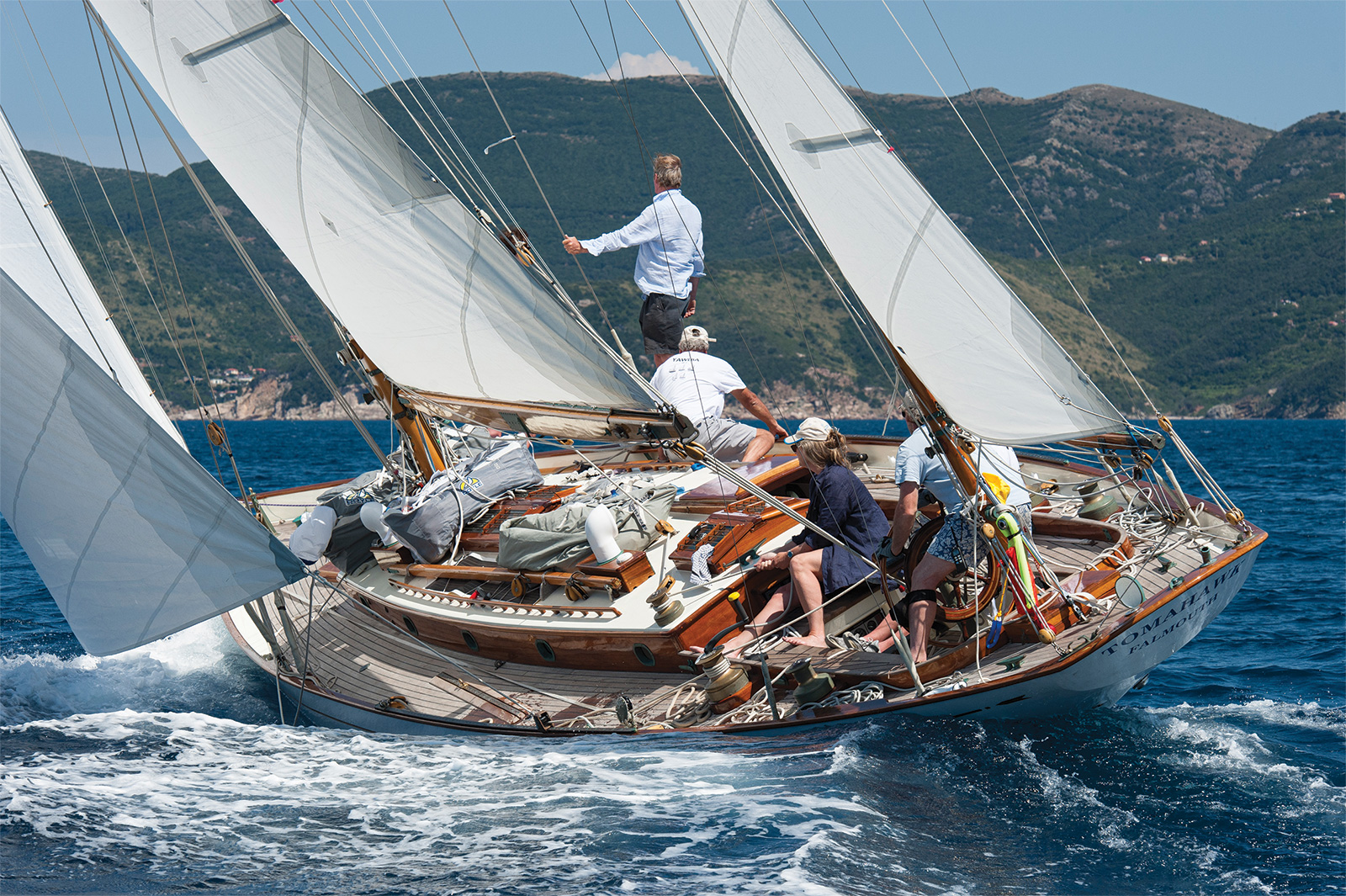
48′ Sparkman & Stephens yawl TOMAHAWK of 1938.James Robinson Taylor

The 48′ Sparkman & Stephens yawl TOMAHAWK of 1938—which was the subject of the first “Save a Classic” in WB No. 148 in 1999—was restored by Brian Pope at Ocean Yacht Company in Cornwall, England. She is seen here sailing off Portoferraio, Italy, during a 2013 regatta for S&S yawls.

One of my goals for as far back as I can remember has been to save good wooden boats. I don’t like waste, and devising ways to recycle worthy old boats became a role I seemed to have a knack for. So, when WoodenBoat Editor Matt Murphy offered me the back page of every issue for spreading the word about needy boats that I felt were worth saving, I jumped at the chance.

Thus, “Save a Classic” has occupied WoodenBoat’s back page for more than half of the magazine’s life—beginning with issue No. 148 in 1999. On those 152 pages, I’ve described 207 classic wooden boats that I felt were at risk or had already become near derelicts. The results of a recent accounting show that more than half of the classic boats whose owners replied to my recent questionnaire have been saved or are well on their way. While the page can’t take complete credit for all the major restorations of all the featured classics, since word-of-mouth was also at work, I believe it raised awareness generally as well as specifically.

The very first back page brought results when Brian Pope acquired the 48′ Sparkman & Stephens yawl TOMAHAWK and shipped her overseas to his Ocean Yacht Company in Cornwall, England, where she received a full restoration. She continues to sail and race—primarily in Europe.

Our stated goal at the beginning was that the page would “put potential buyers in touch with present owners for the good of the boats.” While “Save a Classic” brings the magazine no direct revenue, it surely keeps the passion alive besides being a key step in saving the kinds of wooden boats that we so treasure.

In the pages that follow, I’ll tell of success stories that have been particularly gratifying.

MASHNEE and EVELYN

46′ Herreshoff Buzzards Bay 30s of 1902

YOUNG MISS, QUAKERESS II, and EVELYN in Belfast, Maine.Benjamin Mendlowitz

The French & Webb shop staged side-by-side restorations of (left to right) YOUNG MISS, QUAKERESS II, and EVELYN in Belfast, Maine.

I had known MASHNEE ever since my friend Ken Mahler purchased her in the late 1970s. Having sailed and often been aboard her with Ken, I felt compelled to attempt a rescue via “Save a Classic.” She’d been abandoned in a North Carolina boatyard. I wrote about her in WB No. 179, and to my great relief, Jan Rozendaal became hooked and decided to have her restored by Darling’s Boatworks of Charlotte, Vermont, near where he lives.

Other boats of the same one-design class became slated for restoration at about the same time thanks to Victor Paul, who called me while searching for ISTALENA, the lovely 87′ double-ended champion M-boat designed by L. Francis Herreshoff. He’d about given up, so he immediately became engaged when I suggested he switch quests and restore a pair of smaller but equally classic Buzzards Bay 30s designed by L. Francis’s father, Nathanael. First, he bought YOUNG MISS, which was languishing in the cross-Florida Intracoastal Waterway (and had recently been advertised for sale in WoodenBoat). He then went for CATSPAW, which I knew was available from the International Yacht Restoration School in Newport, Rhode Island. (I’d dreamed of buying YOUNG MISS myself and had previously talked by phone with her owner, Alan Black. Earlier, as a youngster in Rockland, Maine, I had drooled over CATSPAW when Perry Coke Smith of nearby Islesboro sailed her to town. In 1976, after taking part in her sale to Bob Hellier, I helped him and his wife, Joann, deliver the boat to Noank, Connecticut, where we all lived at the time.

Victor partnered up with his close friend, Charlie Ryan, keeping YOUNG MISS for himself with Charlie getting CATSPAW, which immediately reverted to her original name of QUAKERESS II. Victor would manage their restoration by French & Webb in Belfast, Maine. But because he lived in Finland and I lived only an hour from the shop, he asked me to help oversee the work.

In the meantime, Victor discovered EVELYN and had her trucked to Belfast in hopes of finding a third sponsor for the Belfast trio. On the WB No. 187 “Save a Classic” page, I featured EVELYN, and shortly after it came out, Paxson “Packy” Offield called me just as we were walking out the door for Thanksgiving dinner. Luckily, I decided to pick up, learned of Packy’s interest, and put him in touch with Victor that very day. They bonded, and Packy committed to buy the third boat. They agreed that Victor would manage the restoration of all three BB-30s, with French & Webb’s Bill Buchholz leading the project at first and Todd French taking over as soon as he was free from another project, and with me assisting throughout as needed.

Digging through archives for old photos, drawings, and other historic information, we learned a lot and the boats benefited greatly. Victor was obsessive, demanding perfection throughout all three years of very careful work, with almost every original piece of wood renewed with the same species and configured the same way. MASHNEE remained at Darling’s, while at French & Webb LADY M (née EVELYN) and her two sisters were restored simultaneously, with hulls brought into conformity by means of internal molds shaped according to the original offsets. With brand-new hulls, decks, trunk cabins, coamings, rails, and more, all four Buzzards Bay 30s came out beautifully.

MASHNEE at Darling’s Boatworks in Charlotte, Vermont.Darling’s Boatworks

At the same time that French & Webb was restoring three Buzzard’s Bay 30s, Darling’s Boatworks in Charlotte, Vermont, was rebuilding a sister, MASHNEE, to equally exacting standards.

French & Webb staged an extravagant three-boat launching, positioning them side-by-side on the town ramp and orchestrating a big gathering of friends, vendors, and associates. Not long afterward, MASHNEE went overboard in Lake Champlain, also beautifully restored but somewhat modified in rig and interior. All four raced together that summer, culminating in the Eggemoggin Reach Regatta off Brooklin, Maine.

For me, this was heaven—a sight I never expected to see: Four yachts of one of my favorite designs, built more than a century earlier, racing together. I have to say that it’s my favorite result from “Save a Classic.”

EVELYN (left, called LADY M at the time of this photograph), YOUNG MISS (center), and MASHNEE (right) .Benjamin Mendlowitz

EVELYN (left, called LADY M at the time of this photograph), YOUNG MISS (center), and MASHNEE (right) are three of the four Buzzards Bay 30s restored simultaneously and relaunched in 2008. “Save a Classic” brought attention to EVELYN (WB No. 187) and MASHNEE (WB No. 179).

MASHNEE has since been donated to the MIT Sailing Program in Massachusetts, where she has successfully trained sailors for the past six years. She’s homeported in Boston and cared for by Dion’s Yacht Yard in nearby Salem. According to the donor, “They have very competent captains and take out kids who will probably become very affluent and possible wooden boat lovers. They are very careful to maintain her properly and do some racing, although they are not very successful as they have no regular captain and crew.”

After her debut in Maine, EVELYN (relaunched as LADY M) sailed for a few years in fresh water from Harbor Springs, Michigan, until Packy replaced her with a smaller and more easily handled Herreshoff replica named LITTLE M. Sold and renamed WACHIWI, the yacht is now homeported at Masons Island, Connecticut, along with Barney Walker’s other classic Herreshoffs, and she is maintained at Thomas Townsend Custom Woodworking in Mystic.

“Trolley-car” trunk cabins.Benjamin Mendlowitz

Great pains were taken to match original Herreshoff Mfg. Co. materials and configurations, including replicating the low and rectangular “trolley-car” trunk cabins.

The Buzzards Bay 30s were the first of several similar racer-cruisers that Herreshoff Mfg. Co. built in a three-year span that culminated with the famous 18-boat fleet of New York 30s of 1905. Low freeboard, overhanging bows and sterns, bowsprits, gaff rigs, and rectangular “trolley-car” trunk cabins make them easily recognizable. As their name signifies, the BB-30s were designed to race on the upper reaches of Buzzards Bay, Massachusetts, where the water is thin. Drawing only 5′6″, they make wonderful cruising boats that are able to poke into anchorages off-limits to most other full-keel boats of their size. For more information about the class and the above restorations, see WB No. 203 and the chapter about them in the book Herreshoff: American Masterpieces.

Other than the four restored yachts mentioned above, ANITA (which is available via French & Webb) and LARIKIN are the only other known survivors of the 14 boats built in the 122-year-old class.

VEGA

A 33′ open launch of 1936

VEGA running with electric power.Nick Parson

VEGA today runs with electric power but retains her configuration as an open launch, as she was intended when built in 1936. Above—VEGA was refurbished and repowered at Hylan & Brown Boatbuilders, including the addition of a new and larger steering console that contained the electric-propulsion motor and its components.

VEGA was refurbished and repowered at Hylan & Brown Boatbuilders.Hylan & Brown Boatbuilders

VEGA was refurbished and repowered at Hylan & Brown Boatbuilders, including the addition of a new and larger steering console that contained the electric-propulsion motor and its components.

VEGA is a 33′ open launch that was lying unused at Cranberry Island Boat Yard, Maine. Her owner had bequeathed her to his nieces, one of whom reached out to me after unsuccessfully trying for a brokered sale. We agreed on a substantially lower asking price, and I featured VEGA in issue WB No. 272, and soon she had a buyer who bought her sight unseen. I arranged for launching and transportation to Hylan & Brown Boatbuilders in Brooklin, Maine. The new owner’s idea was to convert her to a cruiser, but concept drawings proved VEGA to be too small for the desired accommodations, so she again went up for sale. This time, she went to an owner who had the yard replace the rusty old 292 Chevrolet gas engine with an electric power plant but otherwise keep her as the handsome open launch she’d always been. The repowering has proven very successful, enabling speeds of 9 knots and distances (at her 6.5-knot cruising speed) of 35 miles while running almost silently. For more on VEGA’s reincarnation, see the video at www.OffCenterHarbor.com. VEGA, it happily turned out, didn’t need much repair or restoration—or even wholesale refinishing. A handsome new steering console to contain much of the new electric power gear was the primary change. VEGA is still in Maine, operating summers out of Sorrento, just a few miles east of where she was built. She returns each winter for storage and maintenance at Hylan & Brown.

MADDY SUE

A 36′ Chester Clement lobster yacht of 1932

MADDY SUE, a lobster yacht.Benjamin Mendlowitz

MADDY SUE, a lobster yacht built in Southwest Harbor, Maine, by Chester Clement in 1932, was restored and repowered by Darling’s Boatworks in Vermont.

MADDY SUE had been stored in a shed.Maynard Bray

Before restoration, MADDY SUE had been stored in a shed on Cranberry Island for years, awaiting a new owner.

MADDY SUE, like VEGA, came from Cranberry Island Boat Yard. She’d been stored there (fortunately inside a shed) for several years and needed repowering and a general upgrade, including a refinishing. Her new owner, Jan Rozendaal, gave the restoration task to Darling’s Boatworks, which is near his home in South Burlington, Vermont, and the boat emerged looking like new. Gone was the aged six-cylinder Chrysler gas engine, replaced by a 130-hp Chris-Craft. So outstanding was the boat, and the work done, that she was the subject of an article, and a cover photo, in WB No. 238. She was subsequently sold to another Lake Champlain owner, but leaking of late has shown the need for major work due to rusting steel fastenings. Returning her to Maine for the repair or refastening is being considered.

SYLVIA II, KRISTEN, and ROSE

A 36′ powerboat, a 33′ sailboat, and a 29′ project boat

SYLVIA II.Left—Zoe Orechwa/www.zoeorechwa.photography; Right—Bob Graham;

Left—Today, SYLVIA II (once again for sale) is well appointed for cruising. Right—Built at Morehead City, North Carolina, for fishing on Core Sound, SYLVIA II was rescued after a 1976 sinking by a couple who fixed her up and used her for cruising for decades. In 2014, Bob Graham saw her in “Save a Classic” in WB No. 238 and bought her for a thorough refit.

ROSE is a Joel White design.Maynard Bray

Jim Pearson, a talented amateur builder in Vermont, started building ROSE to a design by Joel White of Brooklin, Maine, but died after completing only the hull.

When there was a backlog of needy boats, I ganged them up on a single page, and all three boats of issue No. 238 produced results. SYLVIA II is a Core Sound, North Carolina, fishing boat of 1934 whose longtime owners were aging out and wanted to pass her on. Bob Graham stepped up and gave her a total and very elegant rebuild with backbone timbers and frames of angelique, floor timbers of heart pine, planking of new cedar, a deck of sheathed plywood. Outwardly, she looks the same, but inside she’s set up exceptionally well for cruising, partly by moving the engine to the cockpit and connecting the shaft via a V-drive.

KRISTEN, an Atkin-designed sloop built on the Great Lakes in 1927, reportedly has changed hands twice, and I’m told that she has been passed to an owner considered well qualified to continue caring for the boat.

NORTHERN ROSE for completion at Brooklin Boat Yard.Maynard Bray

After seeing the boat in “Save a Classic” in WB No. 238 and receiving an appeal from the builder’s widow, Steve White of Brooklin Boat Yard purchased the hull and brought it to his yard for completion for a client who named her NORTHERN ROSE at launching.

ROSE is a 29′ double-ended Joel White design whose construction was interrupted by the death of her Vermont builder, Jim Pearson. The bare hull was purchased by Joel’s son Steve, who succeeded Joel as the proprietor of Brooklin Boat Yard. Steve quickly responded to “Save a Classic” as well as a note from Pearson’s widow, Sandy. Steve immediately found a buyer in a neighbor, Bob Johnson, who sadly only got a single season’s sailing before he, too, died. Fortunately, NORTHERN ROSE, as she is called now, still has local owners who store her where she properly should be—right where she was designed and finished off.

CRUSADER

A 34′ modified Herreshoff Fishers Island H-23 of 1932

CRUSADER, a modified Fishers Island 23 sloop from 1932.John Hutchison (left); Benjamin Mendlowitz (right)

Right—John Hutchison worked on his own to beautifully restore CRUSADER, a modified Fishers Island 23 sloop from 1932. Left—Hutchison restored the yacht in a project lasting more than three years. The deadwood, stem, transom, sheerstrakes, and sheer clamps are original; everything else has been replaced. Her new planking is Alaska yellow cedar.

CRUSADER accommodations.Benjamin Mendlowitz

CRUSADER has comparatively comfortable, if rudimentary, accommodations.

CRUSADER is a wider centerboard version of the Herreshoff 23-footer class of eight boats. The originals have full keels, draw 1′6″ more water, and were inspired by the Scandinavian square-meter sloops: low, long, narrow string-beans with easily driven hulls and distinctively short mainsail booms. CRUSADER was sold soon after my column in WB No. 196 of 2007 hit the streets. A second-in-line offer came from John Hutchison, who convinced the buyer to resell him the boat. CRUSADER went on, over the next three-and-a-half years, to become one of the very finest and most authentic restorations I know of. John had previously constructed two other boats of N.G. Herreshoff’s design (a Coquina and Joel White’s Haven 12½ adaptation of the Herreshoff 12½), so he was experienced in the ways of HMCo. and acquainted with the cognoscenti. He sailed the restored CRUSADER in the 2012 Herreshoff Rendezvous in Bristol, Rhode Island, after which she sailed Lake Champlain for 12 years. Another caring (and very lucky) owner recently acquired CRUSADER and sails her on Lake Winnepesaukee, New Hampshire. For more information, see the chapter I wrote in the book Herreshoff: American Masterpieces.

VARLET

A 30′ Lawley launch of 1930

The launch VARLET.Darling’s Boatworks (both)

Left—The launch VARLET now calls Lake Champlain her home waters. Right—Darling’s Boatworks in Charlotte, Vermont, repaired VARLET, which mainly needed some sister frames and a few plank replacements.

After serving three generations with the Forbes family and calling their Naushon Island, Massachusetts, her home port for her entire life, this lean and varnished open launch needed some repair, but the estimated cost was high and considered prohibitive.

She was pretty much unchanged, even after 83 years, and her large cockpit with ample seating could easily accommodate eight passengers, making her a perfect craft for entertaining. She’d always been stored in a boathouse and used with care, so she didn’t exactly fit the “Save a Classic” mold in that she was not in jeopardy and didn’t need a full restoration. But with her pedigree, I decided to feature her anyway in hopes of attracting a suitable new owner.

A buyer from Lake Champlain purchased VARLET and took her to Darling’s Boatworks for refurbishing. There, she received some sister frames, a few planks, and a thorough refinishing. She returns there annually for winter storage and maintenance. Fresh water will be easier on her than her native salt water—at least on the fastenings and the brightwork—so she’s found a perfect place to live out her remaining years, which I hope will be many.

OLD BALDY and BLACKJACK

Friendship sloops of 1900 and 1965

OLD BALDY sailing.Kathe Newman Walton

OLD BALDY still sails with the Newman family.

Both of these classic Maine sloops are easily recognized because of their high clipper bows with long bowsprits, springy sheers, gaff-rigged mainsails, and two headsails. They’re lovely! BLACKJACK is original, and OLD BALDY is a replica shaped and rigged from drawings in Howard I. Chapelle’s book American Small Sailing Craft that were based on a 25-footer named PEMAQUID. Construction, although wood, was more contemporary than the depicted original.

OLD BALDY, a 1965 Friendship sloop.MAYNARD BRAY

OLD BALDY is a 1965 Friendship sloop that Jarvis Newman of Mount Desert Island, Maine, used as a plug for his fiberglass boats of the type. Years later, the boat came up for sale and he leapt at the chance to own her.

OLD BALDY is the boat that Jarvis Newman, a Mount Desert Island boatbuilder, borrowed to use as a plug for his fiberglass versions. Later on, when he heard via “Save a Classic” that OLD BALDY was looking for a new owner, he jumped at the chance, trucked her to his shop in Southwest Harbor, carried out the needed repairs, and set about sailing her. Jarvis died in 2019, but the boat is still treasured by the family. She sails mostly in the Mount Desert area, but sometimes participates in the annual Friendship Sloop Rendezvous in Rockland each summer.

BLACKJACK receives substantial work.Maynard Bray

BLACKJACK’s hull needed substantial work, which was undertaken by Jim Loney and later Tim Clark, working with substantial help from museum volunteers. She was relaunched in 2019.

BLACKJACK is an original of the type, modeled and built by the legendary Wilbur Morse. Typically built, she’s rather crude in places that don’t show, such as in frame alignment and spacing. Acquired by the Sail, Power & Steam Museum in Rockland, Maine, shortly after her story was published in “Save a Classic,” she was trucked from Bristol, Rhode Island, to Rockland. The museum’s founder, Jim Sharp, hired Jim Loney to begin her restoration. And she really needed it, although lots of original material remained despite more than a century of use and repair. Her stern, which had sagged, was posted up to where it should be. Lines were then taken. She’d had a ballast keel added when she was converted to pleasure use, and that was retained. New white-oak frames harvested in the town of Friendship, Maine, were installed, along with a number of new cedar planks, a new deck frame and deck, cockpit, and trunk cabin. This later work was carried out by Tim Clark, who wrote about the project in WB No. 270 and became as interested in Friendship sloop history as Jim Loney and I had been. She was quite authentic when completed, with tiller steering and no engine, and for the first few years after restoration she took museum visitors out sailing.

LITTLE GULL II

A 42′6″ Hand/Herreshoff power cruiser of 1929

The 42′6″ power cruiser LITTLE GULL II designed by William Hand.Tom Jackson (left); Mystic Seaport Museum (right)

Left—The boat is undergoing a years-long meticulous restoration at MP&G in Mystic, Connecticut. Right—The 42′6″ power cruiser LITTLE GULL II was designed by William Hand and built by Herreshoff Mfg. Co. in 1929. Her current owner previously had the Buzzards Bay 25 MINK restored at MP&G to exacting “as built” standards.

Shortly after Tucker Reynolds bought this boat in the early 1980s and put her inside his Deep River, Connecticut, shop, I couldn’t resist visiting, having studied and written about both William Hand, her designer, and HMCo., her builder. She was a treasure, for sure, virtually untouched since her 1929 launching. But Tucker’s plan for restoration languished, and she was still there when, in 2014, Brad Baker decided to follow up with a powerboat after restoring a gaff sloop, the Herreshoff Buzzards Bay 25 MINK (see WB No. 258). I had put LITTLE GULL II in “Save a Classic” in WB No. 183 in 2005, and Baker hoped to buy her and have MP&G, once again, do the work. Despite his enviable track record, Baker had a tussle convincing Reynolds to let the boat go. A sale finally took place, after which she was moved to MP&G’s shop in Mystic, Connecticut, where she has been the primary restoration project for the past decade. Like Brad’s MINK and his brother’s Buzzards Bay 15 MARIBEE before her, she is getting a “just as launched from Herreshoff’s” job done with the fewest possible compromises. This means fabricating missing pieces that can’t be purchased, restoring rather than replacing individual wood and metal pieces that are worn out, rotted, or otherwise damaged. Any quirks made by the original workmen are replicated: if a fastening is not where it should be, that’s the way it goes back. It’s understandably a slow process and not everyone’s cup of tea. Only Andy Giblin (the “G” in MP&G); his assistant, Jeff Steele; and Bryan Burdick, a retired friend who helps locate specialized items, work on the boat, having Brad’s philosophy now nailed down. This project gives authenticity a whole new meaning and surely raises the bar for others.

Of the 207 boats featured in “Save a Classic” over the past 25 years, I’ve been able to reach about half of the named contacts. Based on their responses, I can state that:

  • 30 percent have been saved or restored.
  • 20 percent are presently being restored.
  • 23 percent of the remainder have new owners and await restoration.
  • 15 percent have been demolished.
  • 12 percent are still available (and listed in the latest “Save a Classic,” on page 128 of this issue.  Article ends.

Maynard Bray is WoodenBoat’s technical editor.