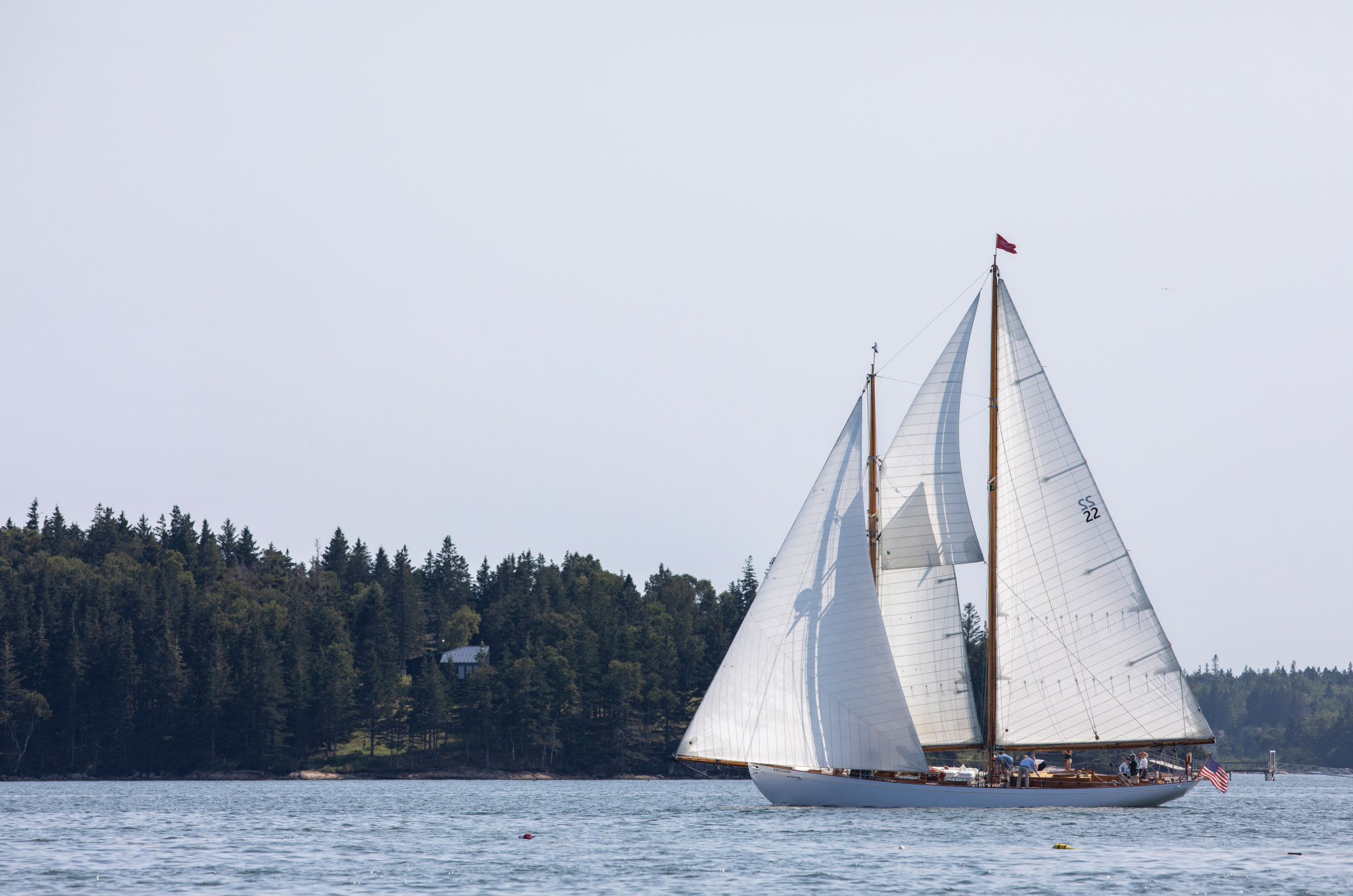
The schooner BRILLIANT on the water.

The schooner BRILLIANT, designed by Olin Stephens and launched by the Henry B. Nevins yard on City Island, New York, in 1932, has served as a training vessel for Mystic Seaport Museum since 1953. She has benefited from conscientious maintenance for all those years and only recently needed attention to long-monitored structural and systems concerns.

While sitting aboard the schooner BRILLIANT on a quiet Wednesday afternoon in the early summer, I finally had a chance to reflect on the major work done to the yacht the previous winter. While the teen crew was ashore with the mate, off in search of well-deserved ice cream after a long day barreling around Gardiners Bay, New York, I snuck a scone from the galley and soaked in the relative calm. With 12 people aboard, quiet is rare aboard BRILLIANT and, even at anchor, she was far from silent. But the sounds were familiar and comforting: the slap of water against the hull, the low hum of the refrigeration compressor, the 1932 Chelsea clock chiming every 30 minutes.

When the crew and mate returned to BRILLIANT in our nearly 19′ Herreshoff lifeboat, AFTERGLOW, we sat down to dinner and pondered the questions we ask every day: “What was something today that was expected? What was unexpected?” Later, we gathered for navigation class and worked to solidify the charting skills we’d been developing on the fly, while on watch.

We’d made it to the South Fork of Long Island during a five-day voyage. I chose this destination partly because I hadn’t brought the boat here in a while and partly because it seemed like a relatively calm alternative to jockeying for anchorage in Block Island, Rhode Island’s crowded Great Salt Pond. The trip was a reminder that much aboard BRILLIANT remains unchanged, even after 93 years of operation. Though she’s older now, we’re not so different from the sailors who first took her across Long Island Sound, throughout New England, across the Atlantic, and back.

Launched in 1932 from the Henry B. Nevins yard on City Island, New York, BRILLIANT was commissioned by Walter Barnum and designed by Olin Stephens when he was just 24 years old. Conceived as a fast, oceangoing auxiliary schooner, she was an ambitious project at the height of the Great Depression. Her construction provided rare and welcome work for a team of highly skilled shipwrights, and the result was a vessel of exceptional quality and endurance and one that remains remarkably original more than nine decades later.

BRILLIANT’s early career was defined by ambition and achievement, none more notable than her record-setting transatlantic crossing in 1933. But her most enduring legacy has taken shape over the past 72 years, in her role as a sail-training vessel. In 1953, the celebrated AMERICA’s Cup skipper Briggs Cunningham donated BRILLIANT to Mystic Seaport Museum with the express hope that she would introduce young people and adults to the experience of life at sea. Since then, she has become a fixture at the Connecticut museum and the heart of one of the country’s longest-running sail-training programs.

Primarily sailing the waters of New England and the Mid-Atlantic states, BRILLIANT offers hands-on experience in the routines and rhythms of working and living aboard a traditional sailing vessel. After 93 years under sail, she remains a powerful and effective platform for maritime education. Her longevity is a testament not only to the quality of her original construction but also to decades of thoughtful stewardship and forward-looking maintenance. From her beginnings at the Nevins yard to her longtime home at Mystic, BRILLIANT is beloved by generations of sailors.

BRILLIANT sails from May to October, logging around 120 days per year. Teen programs fill out most of the summer, and adult programs fill the spring and fall. During the winter months, we happily fall into a familiar cadence of careful, well-established maintenance.

I am only the seventh captain to serve her since BRILLIANT came to the museum, and I’ve benefited greatly from the legacy of forward-thinking maintenance established by those before me. The care we give her is deliberate and ongoing; we varnish, we paint, and we tend to every component we can remove from the boat and haul into the shop. The rig is pulled each winter and the vessel is covered. Each block, turnbuckle, rig component, sail, line, and spar is in some way disassembled, inspected, serviced, and reassembled.

Large projects come along now and then: the engine might need an overhaul, the unusual chain drive that connects the shaft to the engine might need servicing, the keelbolts call for inspection, a spar needs to be brought down to bare wood, or the standing rigging must be replaced. For the most part, however, we live by a rhythm: disassemble, service, reassemble. The captain and mate are employed year-round, and dedicated volunteers come in for several full days a week to augment our efforts.

It’s a model that has worked. Despite nearing her centennial, BRILLIANT is largely original. This does not mean that some major projects have not come along over the years: in the 1950s, her rig was modified; in the early 2000s, the deck and transom were replaced; in the 1960s, and again in the 1980s, she received a new engine. But throughout all of this, she has never undergone a “rebuild.” She has been preserved and not remade. Throughout her nearly uninterrupted operation, she has never languished at the dock, and this has helped to keep her going.

During the extended winter of 2024–25, however, she required major attention to elements of her structure, ballast, engine, and driveline. This was another layer to the effort of preservation and operation. Over the next several pages, I’ll break down this project into its constituent elements, and describe how our team made decisions about materials, design, and process.

Damaged frame heels on a wooden boat.

Delignified frame heels under the engine, and a few cracked frames, catalyzed the recent work on BRILLIANT.

The Catalyst: Deterioration of Frame Heels

After nearly a century of use, BRILLIANT had developed several areas of concern that were monitored and managed by Mystic Seaport Museum in partnership with the U.S. Coast Guard—notably two cracked frames amidships and frame heels beneath the engine that decades earlier had shown signs of delignification.

The project began with a close assessment of those delignified oak frame heels where they meet the bronze diagonal strapping deep in the bilge. BRILLIANT’s steam-bent oak frames presented additional challenges. She might be the largest hull for which the Nevins yard employed steam-bent construction, and over time several of these frames had cracked. In addition to the deteriorated frames beneath the engine, the two cracked midship frames remained a known and closely monitored concern for both the museum and the Coast Guard.

A thought exercise often whirs through my brain: had BRILLIANT ever needed a restoration like so many vessels of her age, many of these monitored items would likely have been repaired during such a project. Despite long-term monitoring, in the spring of 2023, Coast Guard inspectors and our own shipwrights identified eight frames requiring attention—six of which lay directly beneath the engine. The Coast Guard’s Sector Long Island Sound was a partner in this project; they worked collaboratively with our team to understand the best approach we could find. We all understood that the schooner was more than safe to operate as usual, but that we needed to look ahead to a major project.

Line drawings for the schooner Brilliant.

Careful planning was paramount. The required structural repairs were mapped on both sides or BRILLIANT’s hull.

Inside the Work: Preparation, Structure, and Systems

Over the 18 months following our resolution to address BRILLIANT’s deteriorated frame heels, we planned. Anyone who spends time around boats, let alone classic wooden ones, knows how projects tend to grow. Scope expands. Surprises multiply. Time and resources diminish. From the beginning, we knew this would be some of the most involved work BRILLIANT had seen since her construction. If she were to continue to serve our community as a safe, functional, and meaningful sail-training vessel, we had to plan carefully—and realistically. We also had to be honest about what we might find once we got into the discovery phase.

We started by identifying eight oak frames for repair, but we suspected that number would grow once we gained better access. We were not wrong; the number doubled, and we added almost as many small frame repairs. To reach the deteriorated frames located beneath the engine, we had to remove the cast-bronze floors—the same floors that support BRILLIANT’s 130-gallon bronze fuel tank. The tank is bolted to the floors, and the engine rests on top of the tank. It was clear early on that removing the engine was unavoidable.

The fuel tank presented its own set of logistical challenges: it was too large to remove from the hull; it had to be hoisted out of the way but kept aboard. We would have to work around it. As we evaluated the Detroit 3-53—installed in 1983 and long overdue for retirement—it became clear that this was the moment to repower.

BRILLIANT’s old diesel was beloved even if it was loud, dirty, and at times unreliable. We could always get it to run, and we usually knew how to fix most of what went wrong. For me, a modern diesel will take some getting used to, where the CPU rules the engineroom and I, but a lowly operator, keep the faith. I used to joke that BRILLIANT’s Detroit could eat a cat and keep going, but each year brought another fruitless phone call met with: “Oh, that? That’s a legacy part! Try eBay. Good luck!” With only 80 hp on a good day, maneuvering the yacht could be a challenge, and getting anywhere under power was a test of patience.

Also made accessible during this work were the original keelbolts. It made obvious sense to replace them, and while we were at it, to rebed the lead ballast keel. This would allow us to inspect the condition of the timber keel above it. Floor timbers throughout the hull would benefit from renewal, and we planned to replace them as needed.

Frame section work on a wooden boat.

Left—Most of the frame-heel decay was near the diagonal bronze strapping that runs between the planking and frames. Right—New white-oak frame sections were scarfed in using a slope of 8:1, which minimized disruption of the interior. The scarfs are backed by ⅛″-thick bronze strapping and mechanical fastenings.

We were committed to in-kind replacement wherever possible, but in some cases we found that sticking with original material would not serve BRILLIANT—especially when available material was not of appropriate quality. Her frames are of white oak, to which we tend to have ready access in the required dimensions. Where possible, we planned to use the bell ends of oak logs for frame stock in the less shapely sections of the hull—particularly under the engine. In more shapely sections of the hull, we would laminate new frame ends. The original white-oak floor timbers were replaced with purpleheart, a choice that allowed us to use solid pieces rather than laminated ones, because the wide dimensions required for the floors made it very difficult to find appropriately sized white oak.

Roughly eight strakes of planking would need to be removed to access the floors, frames, and keelbolts. These would be replaced with new teak. We needed long stock—more than 20’—of old-growth teak appropriate for 2″-thick planking. Bohlke Veneer in Fairfield, Ohio, was able to supply full logs, or boles; due to the high cost of this wood and what seemed to be volatility in the lumber prices, we moved quickly. I was relieved to purchase three logs and some additional dimensional stock about five months ahead of the start of the project.

Rockport Marine in Maine executed the work, with JMS Naval Architects of Noank, Connecticut, contributing to the planning and documentation. Glenn Pease led the project at Rockport Marine, managing a team of shipwrights, mechanics, and electricians on a tight timeline and budget—complicated not only by BRILLIANT’s seasonal program but also by her status as a Coast Guard–inspected vessel. To accommodate the project, we ended BRILLIANT’s 2024 season early, just after teen summer programming wrapped up, and planned a late start to the 2025 season—just in time for the next group of teen sailors to board. That left us with just 10 months to complete a complex, multi-phase project. Coast Guard inspectors from Sector Northern New England visited the yard frequently to review plans and progress while coordinating with our home sector of Long Island Sound.

The Frame Heels and Floors

The deterioration in BRILLIANT’s frames was most pronounced, as anticipated, near the diagonal bronze strapping that runs inside the planking and outside the frames. Deterioration of the white-oak frames, and to a lesser extent the teak planking, was likely caused by an outdated and long-ago-removed bonding system. The damage varied in its location and height due to the nature of the original construction and the irregular elevation of the strapping, but it was generally worst in the engine area and in the deepest, wettest parts of the bilge.

To gain access, planking low in the bilge was removed, along with interior furnishings, ceiling planking, and sole. The engine surround was dismantled and the bronze fuel tank was hoisted up to the overhead with electric hoists. Once it was supported in place, the Rockport Marine crew could work beneath it.

Woodworker shapes and places floor timbers on a wooden boat.

Left—To gain access to the structure below the fuel tank—which due to its size could not be removed from the boat—the tank was secured aloft in its space, out of the way of the work. Right—Twenty-two floor timbers were replaced with new ones of purpleheart.

We scarfed-in new white-oak sawn frame sections where feasible and laminated frame sections in the more-shapely portions of the hull. While the industry standard accepts that a scarf ratio of 12:1 replaces 100 percent of original strength, we proposed using an 8:1 scarf backed by ⅛″-thick bronze strapping and mechanical fastenings. This would limit the interruption to hull planking and interior joinery, especially around the heavy external ballast. The structural calculations were encouraging: Referencing Elements of Boat Strength, we determined that BRILLIANT’s frames are approximately 16 percent oversized for her scale, and that her frame spacing is roughly 25 percent closer than typical for a vessel her size. This gave us an additional margin of safety. The bronze strapping added redundancy and ensured that even at the reduced scarf ratio, the repairs would exceed original frame strength. Scarf ratios, strapping lengths, and locations were ultimately adjusted as we uncovered the true extent of delignification.

We ultimately repaired 32 frame heels, with 18 of them receiving full scarfs and bronze reinforcement and the others getting something akin to graving pieces to renew end-grain low in the bilge.

The bronze strapping—installed along the inboard face of the repaired frames—extended across the scarfs and well into original timber, spanning the equivalent of at least three planks. In places where planking had been removed, the strapping was through-bolted directly to the frame. Elsewhere, bolts were installed in place of original plank fastenings to minimize new holes. The concept of backing up frames with bronze strapping is not new; in fact, several of BRILLIANT’s frames aft were originally backed with bronze. We replicated the fastening schedule of that original bronze strapping.

Like her frames, BRILLIANT’s floor timbers are generously proportioned. Eleven of them (those through which the keelbolts pass) are nearly twice the size of the others. Most were in decent shape, though some showed signs of deterioration. To ensure a tight fit for the new keelbolts, we replaced all the floors they passed through, as well as any others we felt could be improved while we had the access and opportunity. In the end, 22 floors were replaced, all with single pieces of purpleheart—a dense, durable wood well-suited to the task.

The five cast-bronze floors under the engine and onto which the bronze fuel tank is bolted were carefully removed, one at a time to maintain the hull’s shape. Each was media-blasted and reinstalled after inspection.

The Keelbolts and Ballast Keel

Wooden boat with the ballast keel removed.

Before BRILLIANT entered the shop, her lead ballast keel was removed for the first time since construction.

Before BRILLIANT was brought into the shop, her 33,500-lb lead ballast keel was removed for the first time since her construction. After the team loosened the keelbolt nuts, they were able to open a small gap between the lead and the timber keel. A cradle was built to support the lead, the original bolts were cut, and BRILLIANT was lifted off her ballast. Inspection showed that, despite their age, BRILLIANT’s original keel bolts were in relatively good shape, with only minor wear at the intersection of the wood keel and floor timbers, a testament to material and construction.

Later, with the engine removed and the fuel tank hoisted up to the overhead, the team had full access to the bilge, allowing for inspection of the timber keel and reinstallation of the lead.

Reinstalling the ballast was no small feat. The crew at Rockport Marine used a combination of heavy jacks and several pneumatic air bags to carefully maneuver the keel back into place. After spreading several buckets’ worth of tar along the mating surfaces, they slowly aligned the lead back onto the timber keel. Soft enough to flex under its own weight, the lead had to be positioned so the new bolts could be driven through the floors, wood keel, and lead, each one angled slightly inward. The keelbolts were replaced in kind, using 1⅜″ bronze rod, threaded at each end to accept a washer and nut above and below.

Boatbuilders work on the rudder of a large schooner.

A stopwater aft and low in the deadwood had been pierced by a deadwood bolt, likely during construction. The inspection of this area led to replacement of all of the deadwood bolts. Dropping the rudder allowed access to this area.

The Deadwood and Forefoot Bolting

Renewing the deadwood bolts wasn’t part of the original plan. I remember joking with the team at Rockport, while scrambling to confirm timelines, that I expected the scope to grow within the vicinity of the known work. But scope creep outside the project zone? That caught me flat-footed. Chalk it up to my own inexperience.

Glenn Pease of Rockport Marine flagged it right away. The moment BRILLIANT was out of the water, he said, “You’ve got a leak in the deadwood. We might have to pull the rudder.” I brushed it off at the time. But months later, when we had to move BRILLIANT outside to drop the rudder and reach the deadwood bolts, I was grateful Glenn didn’t say, “I told you so.” He would have been well within his rights.

Upon investigation, the team discovered that a stopwater aft and low in the deadwood—where the deadwood knee meets the wood keel and sternpost—had been perforated by a deadwood bolt, likely during the original build. The likelihood of long-term water ingress led us to inspect and ultimately replace all of the deadwood bolts, including six through the sternpost, three through the keel, and one large lag screw into the sternpost. Together, they form a fan-shaped pattern tying the deadwood into both the keel and the sternpost.

Removing the rudder gave us full access to the sternpost bolts and also allowed us to renew the copper flashing along the sternpost and inspect the rudder’s components.

The deadwood bolts had clearly suffered from long-term saltwater exposure, and their condition confirmed that we’d made the right call. That discovery prompted us to replace four forefoot bolts as well, another decision validated by the condition of what we found.

Engine attached to a chain drive being lowered into a wooden boat.

The existing 80-hp engine was replaced with a 110-hp Yanmar. The engine connects to a chain drive that turns a long shaft that runs the length of the bilge beneath the saloon. Re-engineering of the chain drive was part of the project.

The Repower

The repower presented a puzzle: We had to marry old and new materials and technology, work around an unusual driveline configuration, and meet the operational demands of a sail-training vessel. We started hunting for replacement-engine candidates, looking at footprint, power, and compatibility—and kept circling back to the Yanmar 4JH. I was eager to upsize from our existing 80-hp motor, especially with the Yanmar putting a 110-hp option on the table, but BRILLIANT’s long, unusual driveline kept us cautious.

BRILLIANT’s original design prioritized quiet in the cockpit and balanced weight distribution, achieved by placing the engine well forward, between the masts. As noted earlier, the engineroom floor, engine beds, and 130-gallon fuel tank are all part of a single bronze casting, bolted to cast-bronze floors. According to the stories I have been told, it took the Nevins crew three tries to get the tank casting right. The tank is large enough to inhibit removal entirely; photos from 1931 show the hull being built around it.

Bolted to the after face of the cast tank is a custom chain drive, also fabricated at Nevins, which handles both reduction and a vertical shaft offset—dropping the propeller shaft 20¼″ to clear the mainmast step and interior sole.

The existing Detroit 3-53 engine was (on paper) rated at 80 hp at 2,800 rpm. The engine output passed power through a 1:1 Velvet Drive marine gear to the chain drive, which provided a 2.7:1 reduction before sending it aft via 25′ of shaft to a flax-packed stuffing box. The wet exhaust also ran the same length, eventually exiting through the transom.

The chain drive had always been something of a novelty, and one I’d hoped we could leave alone. But the naval architects at JMS wisely recommended a closer look. With increased horsepower and rpm on the horizon, we needed to know whether the system could take the load. It turned out that the existing chain wasn’t a particularly good match for the Detroit: it was operating right at the edge of its design capacity. We also had concerns about the higher operating rpm of the Yanmar (3,200, compared to the Detroit’s 2,800), the back-pressure tolerances in the exhaust, and the fact that the existing 28″ three-blade Luke feathering propeller would no longer be appropriate for the new engine.

The team at JMS set about reengineering the chain drive. Its overall configuration stayed the same—a shaft and small input sprocket driving a chain to a shaft and large output sprocket, tensioned by a lignum-vitae shoe and enclosed in a bronze case—but the internal components were entirely renewed and uprated to handle the new loads. To assuage concerns about any excessive heat buildup with the higher rpms, we would pair the new engine with a 1:1.25 ZF gear, ensuring that the chain drive input shaft, coming off of the new marine gear, was at least spinning at a rate similar to the previous driveline configuration. Reworking the drive also gave us the opportunity to deepen the gear reduction, allowing us to fully commit to the larger and more powerful Yanmar.

Worker applies caulking to new planking of a wooden boat hull.

With the hull work completed, the new planking was caulked and payed as original.

The propeller shafts, 2″ in diameter and split into forward and after sections around a thrust bearing, needed to be replaced. The stainless-steel after section simply was not strong enough to handle the torque of the new engine. The forward section, composed of an unidentified bronze alloy, offered no reliable way to verify its strength. Replacing both with Aquamet 22 shafts allowed us to retain the same dimensions and configuration while gaining significantly greater durability.

The 28″ Luke feathering propeller was deeply overpitched, to the point that the old engine couldn’t reach its operating rpm. I can only guess a previous captain thought, “If I have to be underpowered, I may as well be maneuverable.”

With more horsepower now available, we needed more propeller but were unwilling to modify the rudder aperture. A four-blade 28″ VariProp gave us the performance gains we needed without increasing diameter. On paper, everything finally added up, and we were thrilled with the result.

The schooner Brilliant being relaunched.

BRILLIANT was relaunched in spring 2025 at Rockport Marine.

Looking Forward

When we were first considering everything this project would entail, Shannon McKenzie, vice president of watercraft operations and preservation at Mystic Seaport Museum—told me, “Sarah, you’re going to learn so much.” She was right, and I often found myself wishing I had started this project knowing everything I was now learning.

But mostly, I’m grateful for my hardworking colleagues at Mystic Seaport Museum, our team at JMS Naval Architects, our friends at the U.S. Coast Guard, and the talented team at Rockport Marine. I’m grateful to be entrusted with BRILLIANT’s care and stewardship—alongside and on behalf of an institution willing to invest in a vessel’s future before that future becomes uncertain. This is a lucky boat, and I am lucky to spend time aboard her.

After a fast sail home, BRILLIANT returned to Mystic just two days before The WoodenBoat Show, after 10 months away and a scramble and blur of launch, up-rigging, commissioning, sea trials, and Coast Guard inspections. More than once I wondered whether we’d use the very last 30 seconds of our timeline and the last 30 cents of our budget. At The Woodenboat Show, I was deeply honored to see BRILLIANT receive the Best in Show award for a professionally maintained sailing vessel—and we remain tremendously grateful to everyone who takes care of her. This milestone is just part of a longer arc, one that reaches back to a Depression-era project on City Island and stretches forward into a hopeful future.

As a sail-training vessel, BRILLIANT carries students, mentors, mariners, and friends through formative moments in their lives. She teaches seamanship, resilience, and responsibility. She builds confidence and connection. Each person who steps aboard becomes part of a living lineage: a 93-year continuum of shipmates who have kept her tradition alive. This project is an investment in them, too, in the next watch and the next generation.  Article ends.

Sarah Armour is captain of the schooner BRILLIANT. She sends gratitude to the schooner’s wide community of supporters who assisted with the recent project, including sailors, museum staff, shipwrights, and friends.