
BURGESS • FIFE • GEARY • HUNT • RHODES • STEPHENS
Some designers achieve greatness mostly through the beauty of their designs— they are apt to rely on traditional proportions and only small, incremental innovations to ensure good performance and avoid mistakes. This is how the majority of working craft and yacht types evolved, in a process akin to evolution in the natural world. While at first glance this approach might seem primitive, it is the safest and most conservative method and over the years has produced many of the yachts we admire most.
Others are innovators, whose work is often criticized when it first comes out but later is seen to have advanced the field to the benefit of all. As time passes, that which is good technically tends to become good aesthetically, either through an adjustment in people’s tastes or through discovery of a new aesthetic that may have been hidden, at first, in emerging technology. Plywood, for instance, was not felt to be an aesthetically pleasing material until recent years, when a host of designers seem to have unlocked its visual potential. The ultimate example may be rotomolded plastic construction, in which almost any shape is as easy to create as any other, resulting in whitewater kayaks, for instance, whose shapes are starting to resemble living things as much as boats, and have an appeal all their own.
Innovative designers are more apt to be numbered among the greats, because they are more likely to achieve sudden breakthroughs in speed, or comfort, or practicality, as the case may be. Often an innovator will perceive in new technology the possibility of lighter structures for a given strength, an advantage that would often be used to increase the percentage of a boat’s overall weight that is in the ballast, giving her the ability to carry more sail and thus be more powerful. Some major advances have occurred by putting together longexisting characteristics in new combinations. Today, innovative designers are grappling with the implications of computer-controlled cutting machines, which seem poised to start a whole new round of innovation.
In this issue, our subjects are Olin Stephens, Philip Leonard Rhodes, Charles Raymond Hunt, W. Starling Burgess, William Fife III, and Leslie Edward “Ted” Geary. In Part 1, the subjects were John G. Alden, William Atkin, Bowdoin Bradlee Crowninshield, William Garden, William Hand, and Nathanael Greene Herreshoff.
As mentioned in Part 1, further reading about all of these designers and their work can be found in numerous WoodenBoat magazine articles (see the online index at the “Research” tab at www.woodenboat.com) or in biographies written about the designers or in books written by the designers themselves. The books listed at the end of each segment in Part 2, as in Part 1, are available through The WoodenBoat Store, www.woodenboatstore.com.
William Starling Burgess
1884–1962, Boston, Massachusetts, and New York, New York
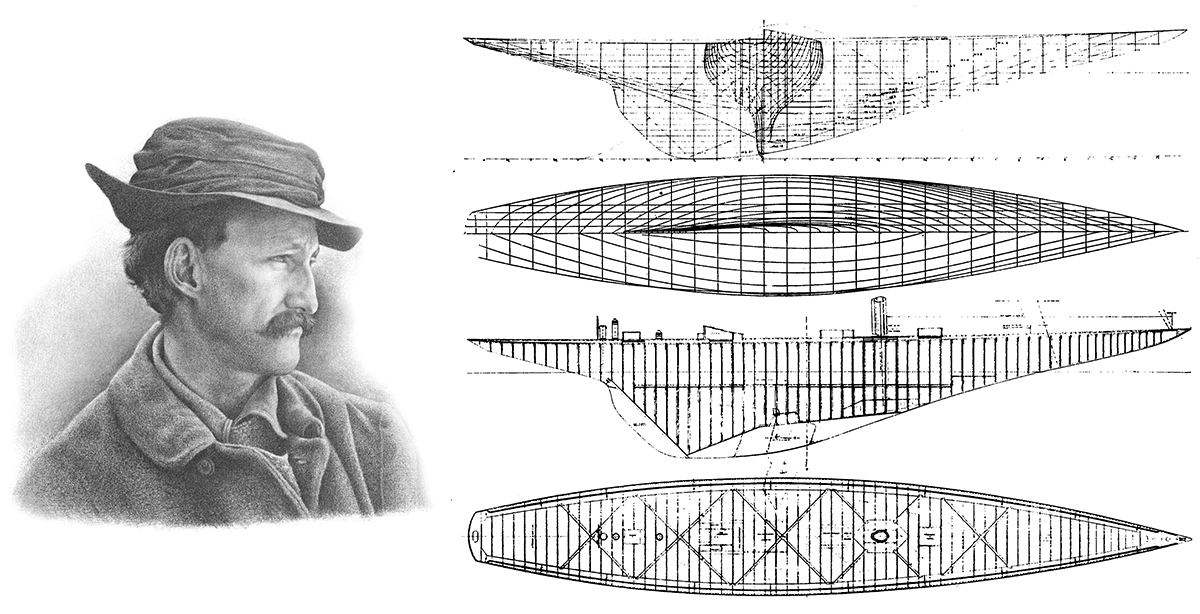
W. Starling Burgess designed boats ranging from small daysailers to the largest racing yachts, such as the J-class RAINBOW, right, which was launched in 1934 at the Herreshoff Mfg. Co. and successfully defended the AMERICA’s Cup that year.