Sailing is a hungry business. “It’s the sea air,” some say. Others, including us, say that balancing and winching and hauling lines all day whets a fierce appetite. Voracious appetites challenge you to make meals afloat more special than common shore fare.
To expand your casual sailing elegance, plan your menus as high points of the cruising day. Good food generates good morale: Ambitious breakfasts, snacks, late-afternoon tea, and an expansive, serious dinner will go a long way toward making a happy crew.
By “serious,” we mean a family meal that everyone off-duty attends, with glowing light, good food, and a beautifully set table. Troll through some cookbooks and magazines. Challenge yourself to create a marvelous meal. And give thought to the entertainment afterwards— recitations, poetry, songs, reading aloud, cards, board games. If you can make a cruise into a happy adventure by serving forth memorable meals and bringing each crew member into a well-knit family, your boat skills are turning into life skills.
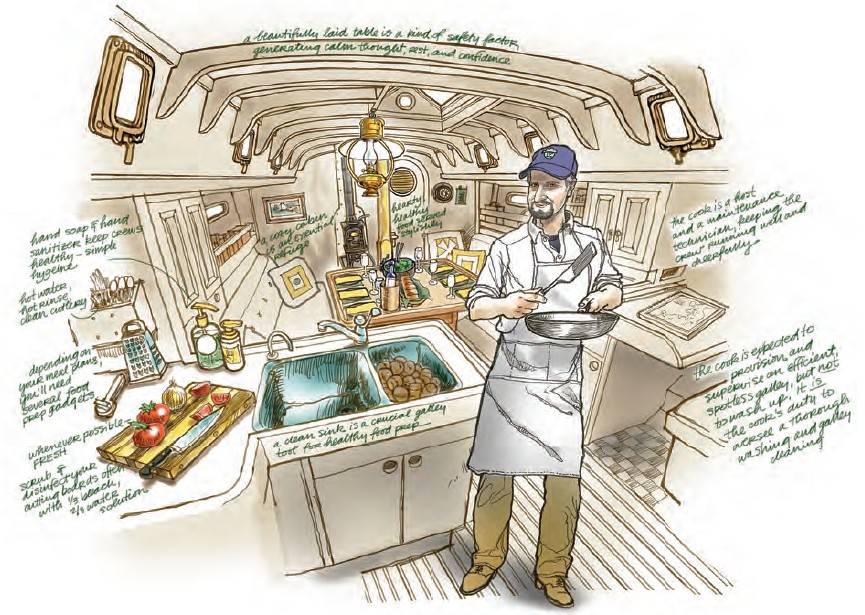
To meet the challenge of good food afloat you’ll need a properly equipped space and good tools. Consider your tools, your galley, and your approach. On the following pages, we look at fundamental equipment in a functional galley.
Small Spaces, Big Meals
Getting started in boats often means cruising on a shoestring—piloting a small boat for intimate adventures. Small size is no excuse for boring food.
For camp and beach cruisers, allow us to introduce some canoe technology into the sailing canon: the wanigan. This is a light wooden box built to fit into the canoe amidships (it often has a contoured round bottom to aid this fit) with fold-out cutting boards, racks for utensils, plates and cups, a hideaway for camp stove and fuel, herbs and oils, and a nesting set of essential cooking implements and equipment. Traditionally the wanigan was carried across portages by tumpline, but we suggest a fourhanded carry along the dock. It’s a great winter project. Once your wanigan is stocked and fitted out, you won’t lack for any necessity in your al fresco kitchen.
Stoves
Boat stoves can be doll-sized or massive, and they are powered by a variety of fuels. Accept the immutable fact that concentrated cooking fuel and naked flame are inherently dangerous. The danger isn’t insuperable but it will require more vigilance than you’d ever give your home stove, which doesn’t pitch and roll.
The commonly available boat-stove fuels are:
Propane and butane are easily available in the U.S. in pressurized containers of many sizes—from backpacking puck-tanks to small canisters to watermelon tanks installed in special vented lockers. The two fuels are virtually equal in cooking heat and are often mixed. Butane is not a good choice for cold-weather cooking, since it doesn’t vaporize when the temperature drops to near 32°F. Both fuels are dangerous: their vapor is heavier than air, so a burner left on will invisibly fill up your bilges with explosive gas. The most minor spark could set it off. Compressed natural gas, CNG, is methane. Its vapor is lighter than air, which is a virtue. But it must be held under terrific pressure, about 2,250 lbs per square inch within a special thick-walled tank. These tanks and thinnerwalled propane/butane tanks (at about 200 lbs per square inch) can be refilled but must be inspected for recertification regularly. CNG is dangerous: If overfilled, the tank can rupture with a sharp rise in temperature. Carrying a pressurized bomb may not fit with your idea of carefree sailing.
Diesel and kerosene are essentially the same petroleum product, more filtered and refined in the case of kerosene stove fuel. They’re often the stove fuels of choice on large commercial vessels. The fuel itself is not explosive. Indeed, it’s difficult to light in a non-pressurized state; kerosene stoves are usually primed with alcohol around the pressure-generating coil—a process that’s a fire hazard in itself. Both fuels are dangerous, however: When spilled they’re slippery underfoot and will soak into anything to create a long-term fire hazard. They can be smelly. Diesel/kerosene stoves are usually cast iron and large.
Alcohol in several commercial forms has been a traditional choice for heating coffee and cans of soup, but it falls short as an ideal culinary fuel. Its heat output is low, it’s smelly, and it’s among the most expensive fuels. It’s dangerous, too: The blue alcohol flame is nearly invisible, often leaving one to wonder, “Is it on, or has it blown out?” The priming and pressurizing process can result in a ball of fire, which is bad for curtains and morale.
White gas, the traditional camping fuel, has no place on a boat. This stuff is highly filtered petrol—gasoline—and is among the most explosive and dangerous substances we commonly handle. Its vapors are heavier than air and its combustion effects are spectacular. In fact, while we’re on the topic, another word of warning is in order: Camping stoves themselves aren’t good sailing tools. They are designed to be used on rock or scraped soil, with solid footing and little chance of tipping over. Aboard, they need elaborate support (as shown above) and ample ventilation. A sudden wake catching your hull awkwardly shouldn’t be a disaster.
Wood is an alternative to the fuels listed above, but it’s clunky and troublesome and not without its dangers. We can’t recommend it strongly to new sailors because it requires a lot of infrastructure and expertise, but it’s embraced by traditionalists for good reasons. A small, tight, cast-iron woodstove can be a companionable fixture in a cruising boat. Even in the summer, the atmosphere below is humid; with a tiny fire in the stove, humidity is beaten back to more comfortable levels. New England and Northwest Coast sailors will advocate a bit of warmth on a
gray afternoon of fog, in a crisp evening anchorage, or meeting a bracing dewy dawn. A woodstove starts well with carpentry scraps and will carry on with beach-scavenged driftwood.
Safety first: No matter what stove you choose, all burning fuel produces toxic effluent. Be sensible: install a carbon monoxide sensor in the cabin.
Refrigeration
Some boats have it, some don’t. Built-in refrigeration units are usually connected to working engines, requiring a few hours of idling or motorsailing every day to keep the locker cold.
Portable 12V powered coolers run to two systems: thermoelectric plate and fan; compressor and evaporation (like most home refrigerators). Thermoelectrics are cheaper ($50–$200 range) but limited in their ability to chill contents more than 40°F below ambient temperature: 90° out, 50° in the cooler. Compressor/ evaporation units are expensive, $600 to $1,000 but effective. Both are meant to plug into a cigar-lighter 12V plug. The principal drawback (beyond price) is the hefty drain of current from your onboard battery. Even the smaller thermoelectric units can exhaust a single battery in a day.
If you don’t have a mechanical cold unit, then you’ll heft a portable ice chest from shore. To cool your perishables, get the biggest blocks the ice chest will accept, for they last longer than cubes or small blocks. Select an ice chest for its insulation, tightness, cleanability, and security (stays shut). Cheap Styrofoam coolers aren’t worth their expense, even over a week’s cruise.
Keeping your food cold over the course of a cruise is a discipline. Use home-frozen food as part of your coolant. Open the chest as little as possible; try to get out everything you need for lunch or dinner in one brief visit, and whenever you crack the seal, swiftly reallocate the positions of items to keep things secure and out of meltwater. Plan your meals to use perishables early, sealed cans and jars later.
Plenty of the food simply doesn’t require cold storage. Citrus fruits keep well with good circulation in a mesh bag. Eggs lightly coated with olive oil can keep for weeks on a shelf. Potatoes, onions, carrots, and squash keep very well away from light if they’re well ventilated. Organize your food as a dwindling resource, shifting it from several canvas bags down to a few. Know where your main courses, vegetables, and cold stuff are located. Don’t improvise your menus; rather, stick to your planning unless the fish are biting.
Hardware
The following are only some of the essentials of your galley equipment. Your personal tastes will dictate how this list is modified. You’ll collect tableware— flatware, knives, forks and spoons, plates, mugs—over time, and they needn’t all be plastic, please.
Two knives. One should be a French chef’s knife, 8″ or 10″. You may favor a santoku Japanese vegetable knife with a deeper blade. Look for one with Granton grinds—ovoid depressions ground out of the blade above the cutting edge to break suction. Another essential is a paring knife of about 2½” to 3¼”, slight from back to blade so it curves easily in paring vegetables. If you’re fish-foraging, add a fillet knife. Buy, or make from light cardboard and duct tape, blade sheaths to keep your edges from dulling and damage. And be sure to have on hand a small touch-up sharpener, such as a Smith coarse/fine pass-through tool. A sharp knife is a precision tool.
Cutting board. Edge-grain maple or bamboo make excellent boards that are more sanitary than plastic surfaces. Don’t confine yourself to a miniature board. You’ll be preparing multiple foods on it and serving with it, as well. If you have a prep surface with a flush edge, you may wish to screw a batten along the lower front of your board; this will discourage it from skittering about.
Towels. Buy a package of shop towels to wipe up spills, remnants, crumbs, and dribbles. Paper towels are the wasteful norm, but if you bag the soiled towels and launder them ashore, you’ll never run out. You need towels to wipe up, to make a non-slip base, to serve as sailor-sized napkins, to handle hot dishes, and to dry dishes during cleanup.
Spoons. You’ll need stainless-steel serving spoons and a ladle, and you’ll need wooden stirring spoons. You stir with a wooden spoon because its edge is smooth and rounded, so it won’t scrape up burnt “cake” on the bottoms of stewpots. They’re also good tasting spoons that don’t burn your lips.
Spatulas, pie server, tongs, long chopsticks. Use these items to turn and serve eggs, cut and serve cornbread, pick up bacon, stir and set aside stir-fry, serve salad, and turn browning sausage.
Steamer. Have on hand an insert for one of your larger pots, or a folding-leaf unit that fits in a medium pot to revive cold pasta, steam cut vegetables, and warm leftovers.
Colander. This is a critical tool for pasta or steamed vegetables—drain and immediately lower cooking heat with a shock of cold water.
Skillet. A heavy black-iron skillet at least 10″ across (if your stove will accept it) is a necessity, better if it’s deep and has a lid. Oil/fat-cure it carefully ashore, and wipe it with a drop of olive oil occasionally. It will prepare eggs, pancakes, Montecristo sandwiches, omelettes, beans, stews, stir-fries, Sicilian spinach, cornbread (if the oven will accommodate its handle), and sugar-glazed pecans for salads.
The pots. You’ll need a two-quart soup pot with a lid for cooking soup, oatmeal, grits, sauces, and for steaming vegetables. You’ll also need a boiling pot with a lid for pastas, chowders, boiled fowl, and steaming crabs and lobsters (if you’re lucky). Try to find thick-walled, substantial pots—stainless steel, if they’re available (try a commercial kitchen supply house like Wasserstrom, www.wasserstrom.com). Ideally, their lids will be tight and the pots will nest.
Teapot. It should be large enough to provide hot drinks for the entire crew and hot washing water after dinner, if necessary.
Coffee. Do not neglect the sailor’s ritual pick-me-up. Coffee can be crucial to a shipmate’s internal and cerebral workings: no coffee, no performance. Determine how you’ll brew; will you use a percolator, a French press, or our current onboard favorite, the Aero Press (www.aeropress.com)? Will you fresh-grind your beans, or bring already ground aboard? Or (shudder) will you risk “instant”?
Determine what you’ll need with it— condensed milk, milk, cream, sugar. Coffee is an individual and passionate preference point. “Engineer’s coffee” drunk in the 150°F swelter of the engineroom was laced with salt. Grand Banks coffee was sweetened to thickness with molasses. The cook should discover what’s needed and provide.
The Cleanup
The cook does not do the dishes. But he or she can be expected to “keep up” by rinsing and even washing utensils and pots, cutting boards, and knives, as the preparation goes on. Clean as you go.
Before the evening meal, determine who is on cleanup duty. The entire crew cleaning would be an awful spectacle within limited space below. Better to rotate a pair for each evening.
After the meal, the dishes are passed down and cleanup begins. You’ll need hot water, surface cleaners, sponges, scraper, mild detergent, scraping sponges (like Dobies), abrasive sponges (like 3M Scotch-Brite), and clean dish towels. Orts are scraped into the garbage or (in the case of wholesome vegetable parings and such) tossed overboard. Dishes and pots are given a saltwater sluice with the scraper working to clean away clumps and crumbs. The dishes are thoroughly washed in the dish bucket’s hot soapy water (fed by onboard motor heat exchanger or teapot) and set to drain, then rinsed with more hot water, dried, and put away. Stove, prep, and dining surfaces are cleaned by a fresh sponge with soap or a surface cleaner. A special note: “Disaster at sea” was once defined by an elder and very salty friend as “dumping the dishwater overside and watching the flatware go with it.”
Within 20 minutes of a grand meal the galley should be brought to a spotless, sanitary state—a new and healthy beginning point for the following day.


