
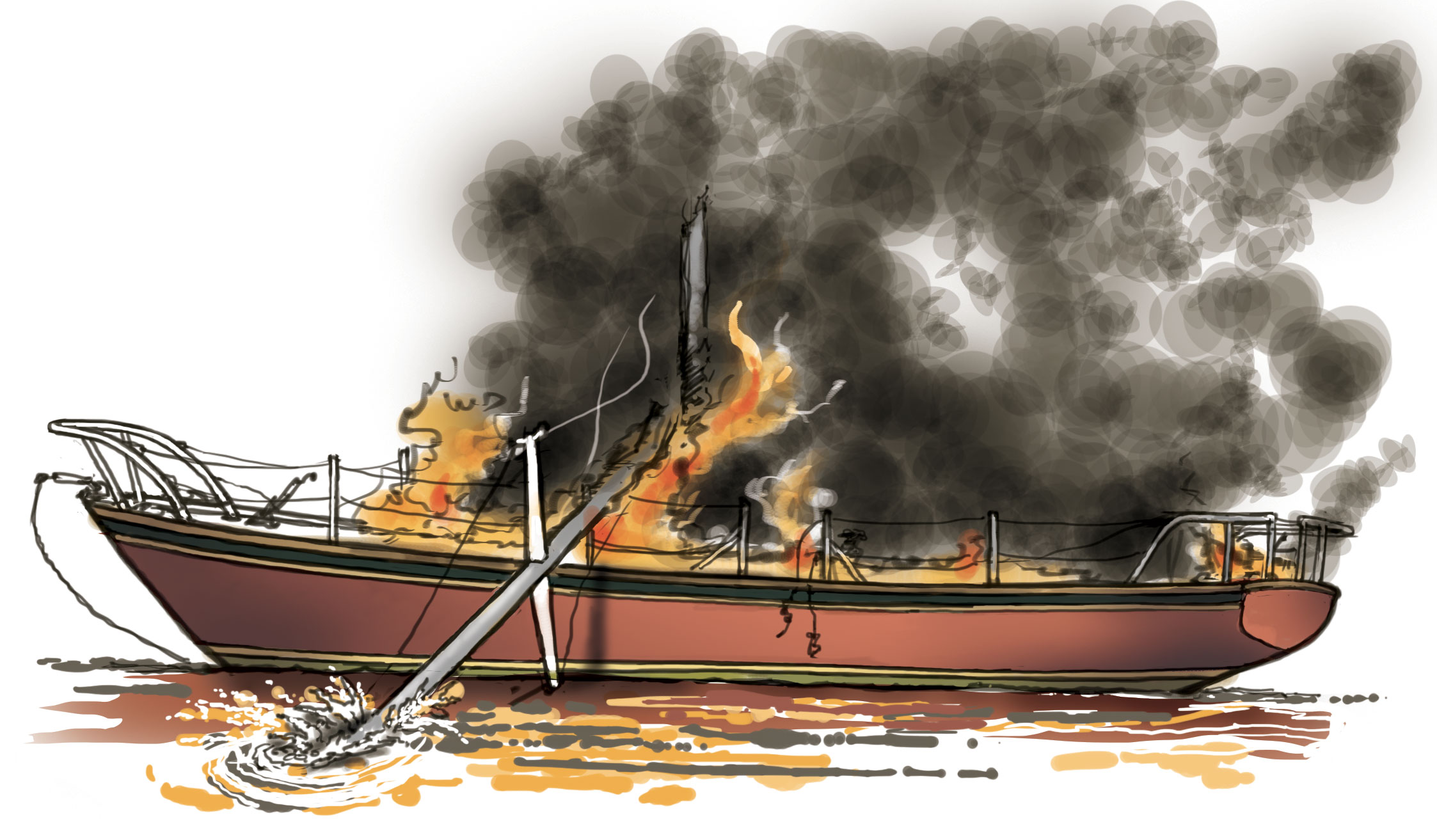
Boats are wretched, awkward, and mortally dangerous places for a fire. Most boats are built of flammable materials, and most cruising boats have an auxiliary engine fed by highly combustible fuel within a tight compartment. Most cruising boats also have a galley—essentially, a fire-pit designed to contain a fire to some degree. A boat offers no easy retreat from a blaze: Most have but a single path for movement fore-and-aft.
That sounds like a grim scenario, but take heart: There are rules and sensible tactics to minimize fire risks and even to deal with fires on boats. As you get started in boats, you’ll learn to be obsessively vigilant of flame in any form, and to have an awareness of the risk of fire every moment of your time on the water. The key to fire-risk management is preparation. Thoughtfully preposition all the tools of defense within ready reach, alert every new crew member to the locations of these tools, and describe their functions.
There is no good outcome to a fire at sea. The best you can hope for is a mess and some expense. In the event of a fire, make the mess, expend your tools, and don’t spare anything in killing a fire.
What Fire Needs
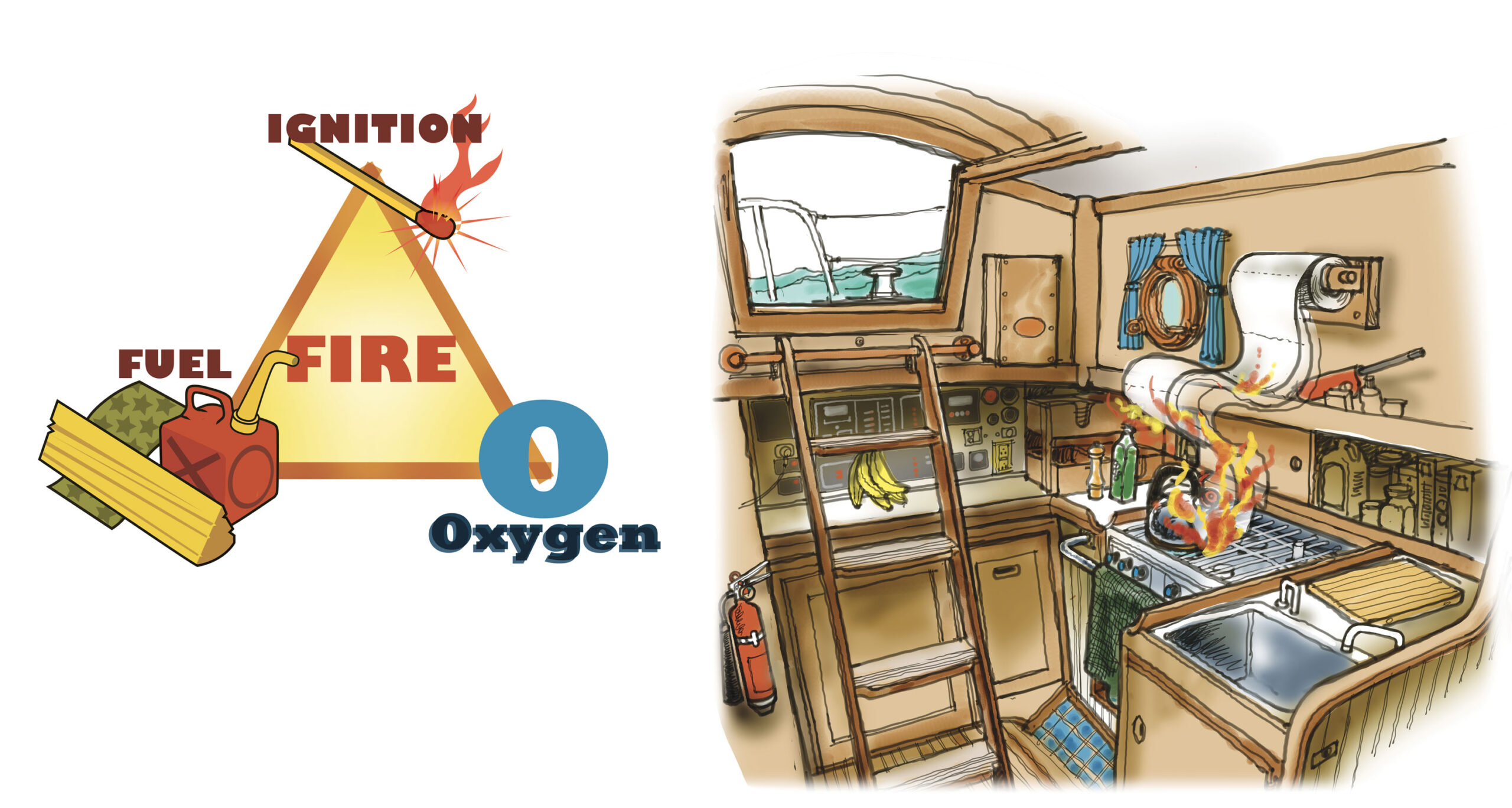
Fire requires: Ignition, fuel, and air. Deny it any one of these, and it dies.
Prevent ignition studiously. Open flames of any kind will at some time bolt for escape. Imagine these three scenarios: priming fluid for a kerosene stove—flaming alcohol—spills onto the sole; a lee lurch of the vessel throws a dish towel onto the lit stove; a corroded electric connection arcs across flammable cleaning supplies; an unshielded electric motor ignites fumes. Avoiding these scenarios, and any others you can imagine, requires organization and forethought.
Deny fuel. Identify all of the combustibles on your boat—fuel, fabric, aerosol cans, solvents, grease, paper, wood—and keep them away from any means of ignition. One boat owner imagined that the place where paper towels would be most useful was over the stove. A vagrant breeze unwound the roll while coffee was brewing. The dangling paper ignited and the flames began to travel up toward the curtains, the overhead, and the plastic food containers. Only a quick-witted and lucky throw of the entire roll—up and out of the galley and overboard—stopped a potential grief.
Cut off air. Scientifically, fire can be defined as “rapid, exothermic oxygenation.” Easy-bond oxygen atoms combine with flammable atoms of many kinds. That’s why many commercial vessels have a paint locker— a tight-seamed metal compartment or chest that isolates flammables from oxygen. Use caution with these in the event of an emergency: Opening the door, lid, hatch, or whatever seals the locker introduces a gust of oxygen. In fact, if you’re ever opening any compartment during firefighting, you’ll be introducing more oxygen, so beware the possible jet of flame that will blast out of the oxygen-deprived space.
Fire demons. Among the most dangerous substances pleasure boats carry is gas under pressure, be it propane, butane, or LNG (liquefied natural gas). Gasoline, which is highly volatile, is almost as explosive. The sinister qualities of these demons is that they easily spread as explosive vapor. That vapor is heavier than air. Vapor sinks and collects in a boat’s bilge, where the feeblest spark can set it off. From a distance, the results would be spectacular.
Boaters have learned by bitter lesson to store gasoline with exaggerated care. The parts of the fuel train that supply gasoline to an engine are subject to vibration, damage, and subsequent leaks. They must be checked many times through the season. There is no excuse for not being intimately acquainted with your fuel-lines, no matter how cramped your engine space is.
Propane Safety
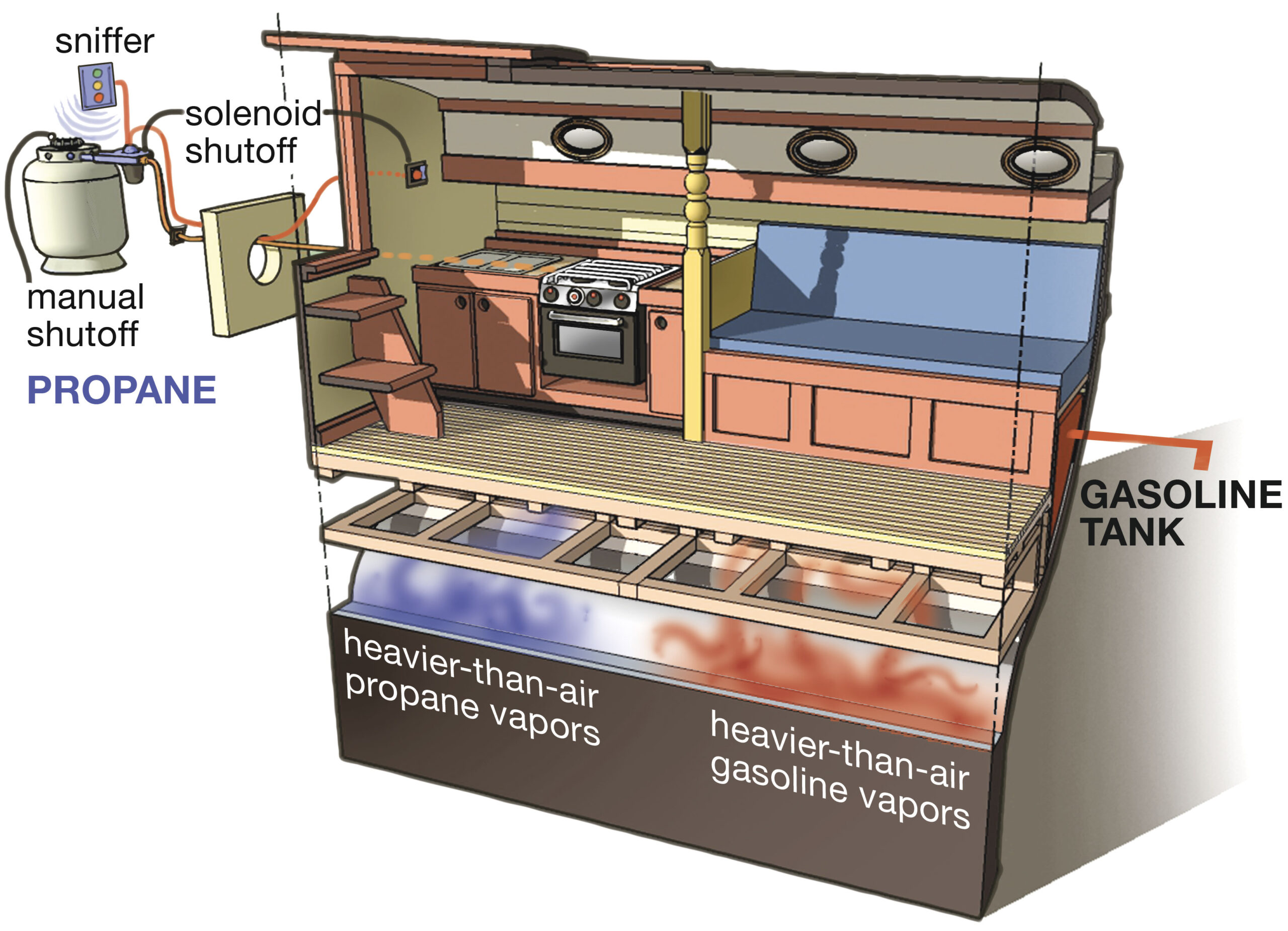
Propane is stored in a separate, vented locker and provided with quadruple safeguards. Here are the essential elements of the system:
1. A propane tank has a manual cutoff. It must be hand-closed if the stove isn’t used for even a few hours.
2. The propane line has a solenoid cutoff that requires you to electrically activate its opening. It usually has a red “on” light. When you’re finished cooking even a light meal, turn the solenoid off.
3. Most propane stoves have a pilot-light sensor that turns propane off if the flame is extinguished. Close the valves to each burner and the oven, every time.
4. Many recent propane installations include an electronic “sniffer” within the propane locker.
Chemically, propane has no odor. Bottlers add smelly mercaptan to warn you of a leak. If you smell a propane leak at the dock: Stop. Think. Then act. First and deliberately, put out all open flames, close the solenoid to the propane line, and turn all electric power off with the airtight main battery switches. Do not turn off individual electric devices, since this might create a gap-spark. Open forward windows; move along quickly but not recklessly. Take a care not to strike metal on metal and create a spark. Open skylights, and exit through the companionway, leaving the hatch open. If the engine is running, turn it off. Leave the boat and call 911 for firefighters. Notify all nearby boaters to make a perimeter and let natural ventilation take its course.
If you smell a propane leak on the water, turn off your propane’s solenoid and the manual valve. Stabilize the boat; if you’re in a sailboat, reduce sail as practical, and maintain steerageway, with the engine off. If you’re in a powerboat, call for assistance—preferably from deck, on a handheld VHF or mobile phone, since you should also shut down all power using the main battery switches. Open portholes, skylights, companionway, and hatches. Avoid metal-to-metal sparks. Ensure all crew are wearing PFDs, and place all but essential crew in the bow. Check for smell in 15–30 minutes. Sniff your bilges. If the smell is completely gone, sail or be towed to the nearest easily fetched dock. Call firefighters (again from a portable device) and alert them as to your arrival at the dock.
Fire Extinguishers
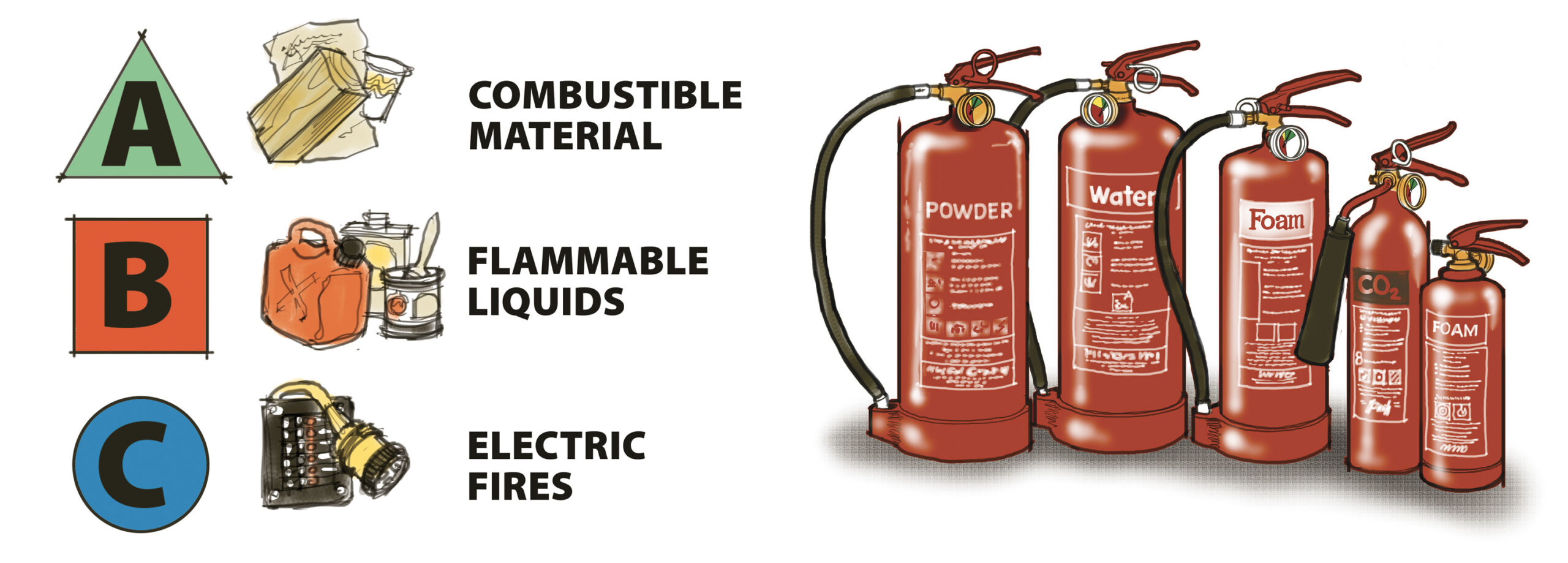
THREE TYPES OF FIRE EXTINGUISHER deal with three classes of fire. One type can’t handle all three.
A – combustible solids such as wood, paper, fabric, plastic
B – flammable liquids such as gasoline, kerosene, alcohol, grease, varnish, paint, solvents
C – electrically energized fires (using a nonconducting agent)
TYPE A extinguishers are often water-based foam, meant to cling to and snuff embers. But these may actually spread a flammable-liquid fire. Used on an electrically charged fire, water can conduct a damaging shock. A few extinguishers use a recently developed aqueous foam; it’s low-conductive, and may be used on Type C fires.
TYPE B extinguishers are often drychemical suppressants, sometimes compressed CO2, which simply deny oxygen to the fire. They’re effective if there is restricted ventilation; their gas dissipates quickly, so reignition is a hazard. Used on a Type A fire, the drive of high-pressure CO2 vapor could spread live embers to other fire hazards. A flammable liquid fire can easily reignite from a glowing ember or bit of red hot metal; keep at it.
TYPE C extinguishers can be CO2 or can use non-conducting dry agents such as sodium bicarbonate and potassium bicarbonate. Some use mono-ammonium phosphate—a corrosive substance meant to melt barriers and creep into tiny crevices when fighting complex electrical circuit fires; you don’t want this stuff near your computer or nav equipment.
Coast Guard requirements for extinguishers are minimums and don’t constitute a practical firefighting tool set. Many boat owners see a red cylinder, install its holder securely, and assume all is well. Consider consequences. You need at least two types of extinguishers: an A type and a B–C type. You and your crew must know which to use in a fire incident.
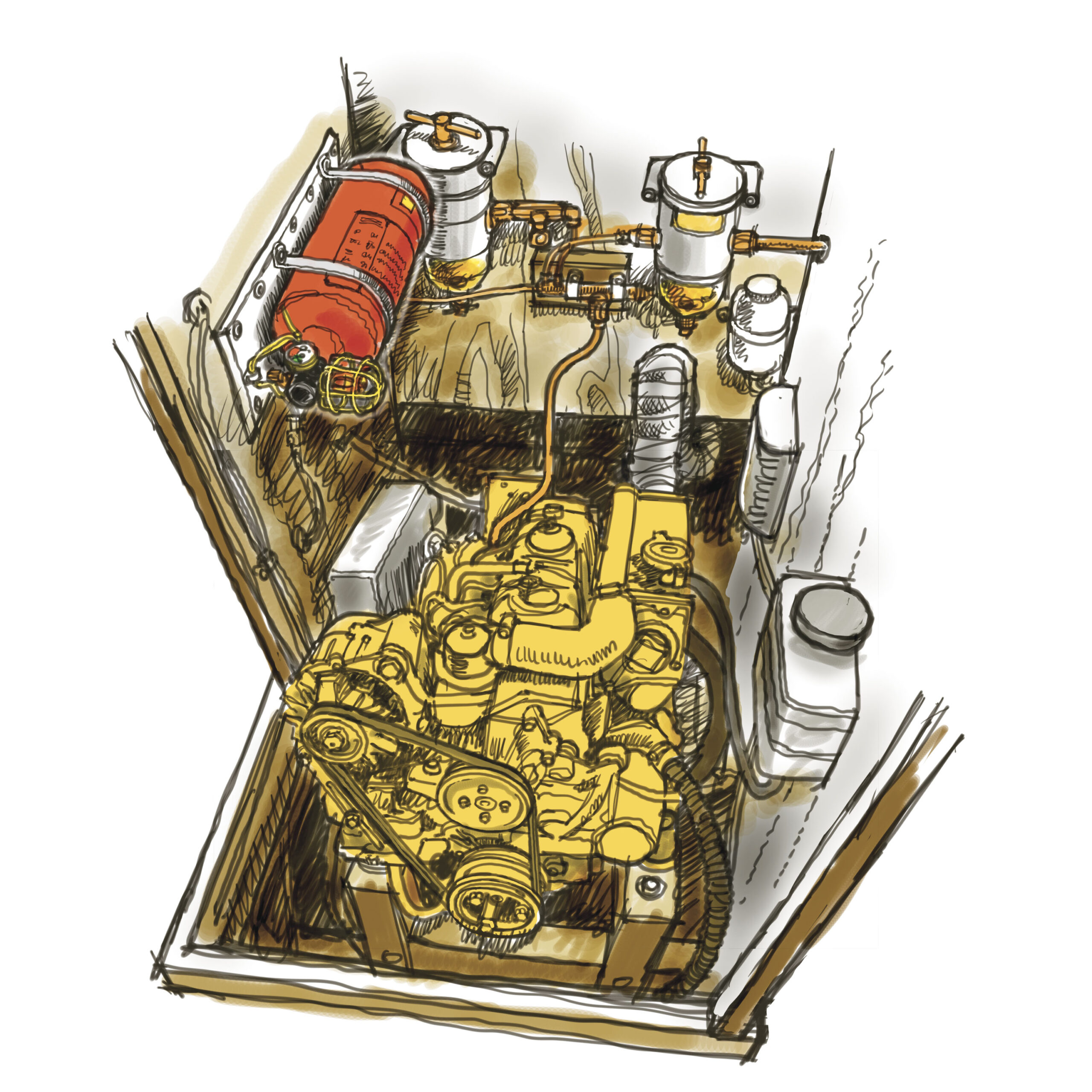
You may seriously consider a third extinguisher: a permanently mounted fire suppressor in the engine space. These are seldom CO2 canisters because their sub-zero blast could crack your engine block. Until recently, the suppressant used in this application was Halon, a nontoxic gas that excludes oxygen. Halon is no longer used because it’s especially harmful to the ozone layer, but several gas substitutes serve its purpose.
Hotspots, and Placing Fire Extinguishers
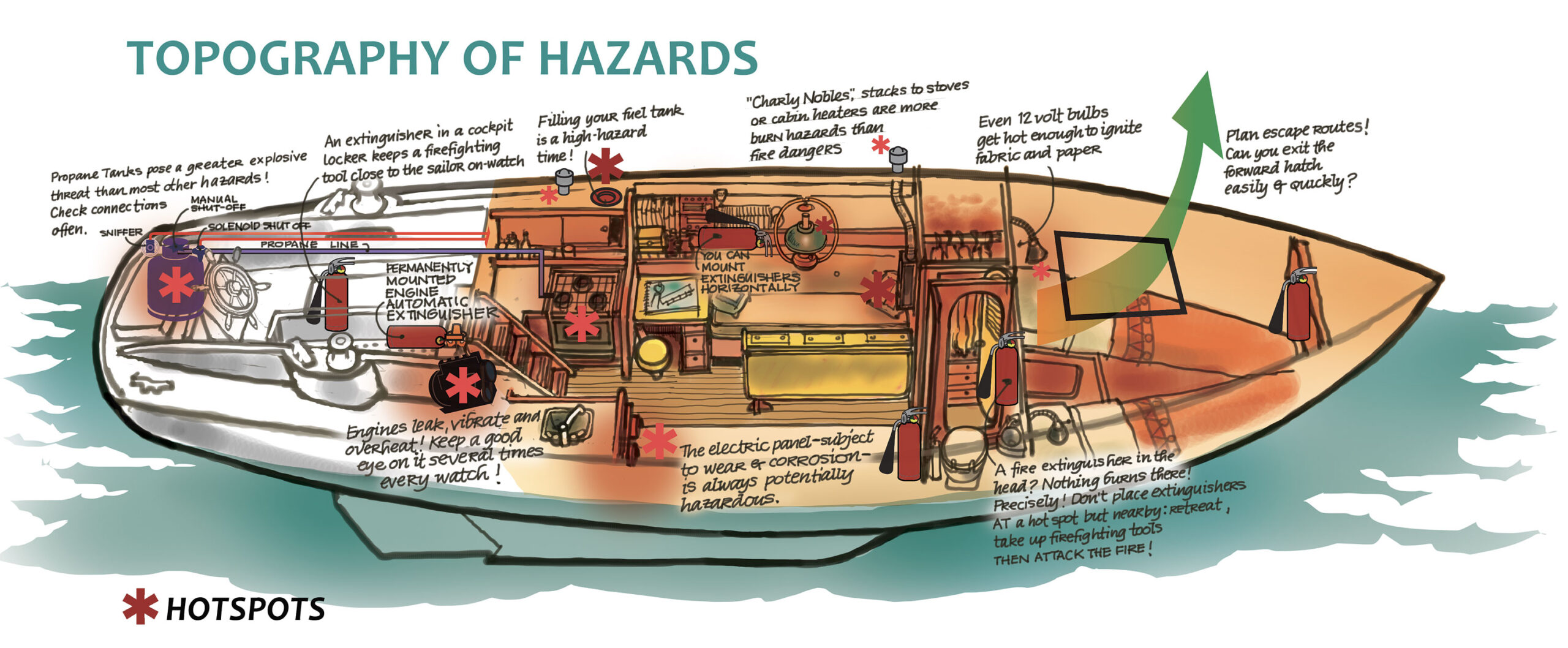
Where will a fire happen? The engineroom, galley, and electric panel are common hot spots. If you have a cabin heater, then you have another battleground. Examine your situation, and choose your tools and where to place them to plan for a swift and complete victory.
The first rule of fire-extinguisher location is to place them outside of the hot spots. You don’t want to reach through a fire to get an extinguisher. Also, disperse them: One should be reachable from the helm, another a step and a bit from the galley, and another forward.
Fighting a Fire
Do not allow fire to escape its bounds.
Know your tools: Your extinguishers should release easily from their mounts, and you should know where the safety pin is and where the nozzle is.
Don’t fight the flame: Fight the fire beneath it. Stand back a body length and look at the fire; think slow, act fast.
Get all of the fire out: Remember reignition: Fetch another extinguisher and stand watch; the emergency is over only when the fire is dead.
Beware cascades of error: If a fire started, something was wrong. Identify it and correct it. What damage has the fire wrought?
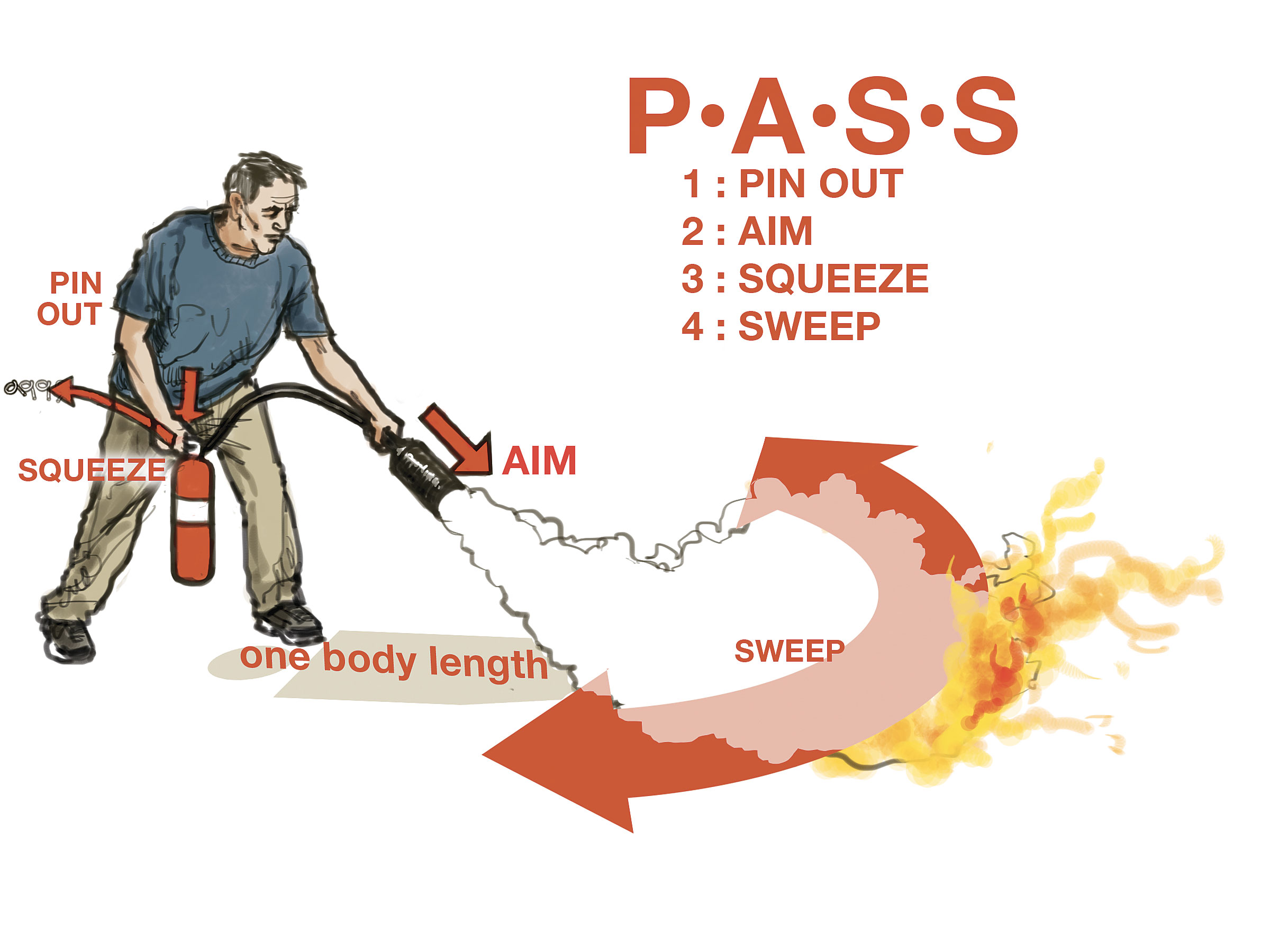
To use a fire extinguisher, remember this memory aid: P.A.S.S.
It stands for the following:
Pull the safety pin—an easy step to forget in the literal heat of the moment!
Aim well, because few extinguishers will last more than 10 seconds.
Squeeze the lever.
Sweep the suppressant in a back-and-forth motion at the fire’s base.
Treating Injuries
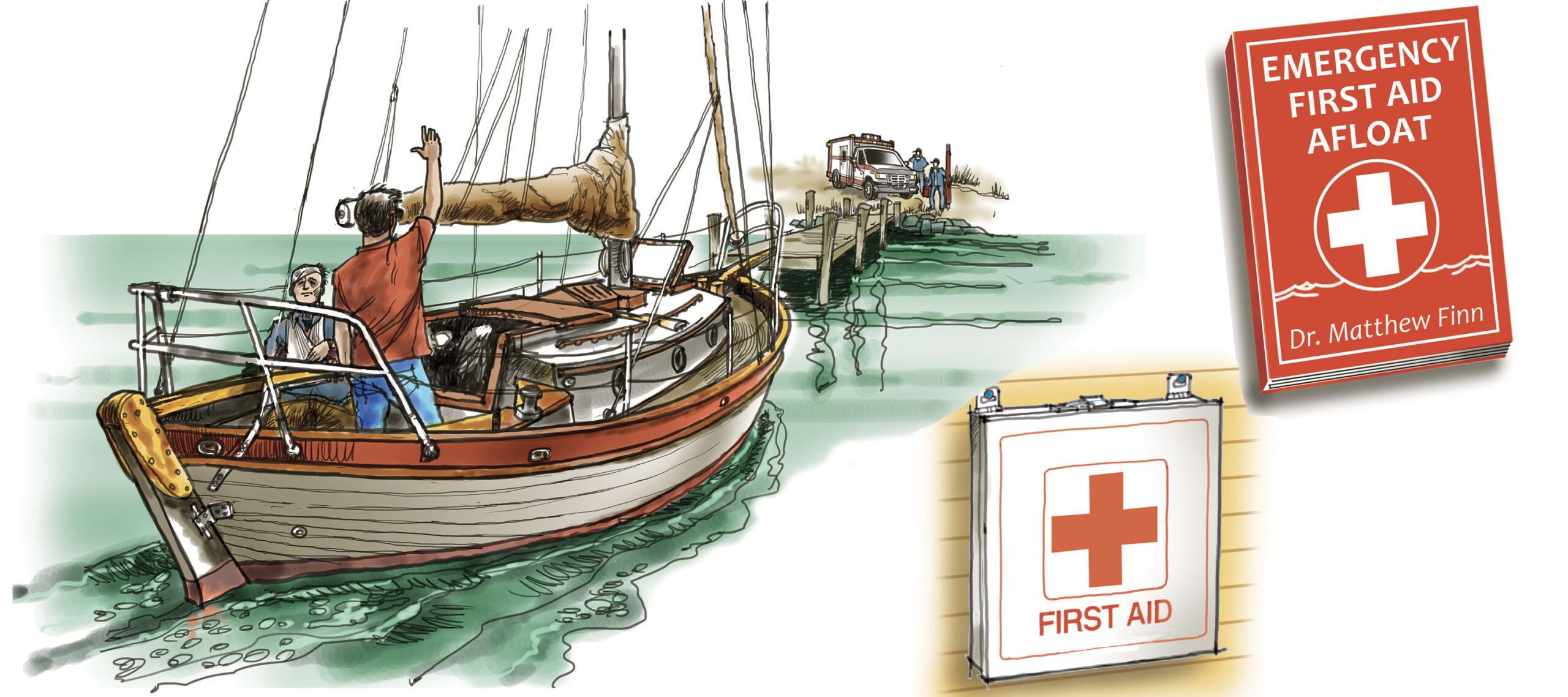
Is anyone scalded or burned? Do you know how to assess and treat a burn? These subjects are beyond the scope of this brief introduction to firefighting, but critically important topics. Copy a good burn reference and clip it into the logbook. The American Red Cross is a good source for training and information (www.redcross.org). No burn is inconsequential; get to shore and have a burn of anything more than a superficial nature professionally tended.