Ancestors and Heirs.

Classic boats: clean lines, deft construction, proven strength. Theyre recognizable across the harbor, across the bay.

What we esteem isn’t a matter of pedigree. Our classic working craft were born out of necessity and practical pressure. And they’re parochial: every workboat is an answer to a specific set of intensely local problems, sometimes emerging from only one stretch of coast, one bay, or even a single port. What excites us is that these solutions, generated out of many hands, many generations of craftsmen, are so persistently useful and beautiful. They are lean, ingenious, apt, and complete; they are elegant.

It’s easy to be agog at Roman aqueducts or Dutch windmills. Surprisingly often, ancient technology blossoms forth with preternatural ingenuity, presenting us with a historically sudden fait accompli of sheer genius. The pyramids are an example of this. Our local accomplishments aren’t so grand, but they are intricately fascinating.

We usually deal with how, but the why is persistent. Why should you care about boats? Because they’re a part of you. Your national heritage of maritime excellence, commerce, adventure, skullduggery, practical necessity, and foolishness is an enormous part of our national character. Alas, we’ve become so wed to pavement that we’ve tossed away our own splendid sea lore. Reclaim your heritage.

—JA

The Dugout

Kawakiutl dugout

We might condescend to the “primitive” dugout as little more than a log repurposed for ignorant savages. Doing so, we’d be repeating our early federal disregard of the native nations and their formidable cities, earthworks, art, and communication, only now being revealed by less Eurocentric historians. Creating a useful watercraft from a tree trunk required an intimate knowledge of wood and how it responds to fire, water, and pressure, and just how far a craftsperson might reshape the material. Ingenuity far beyond most contemporary woodworkers was required to tailor evolving design hopes to the abilities of stone- or shell-edged tools.

There’s a history lesson here. We know the form of the Lake Titicaca reed boats only because they were so ephemeral: the material wore out in a season, so new reed boats were rebuilt on a proven design every year, and they didn’t change over centuries. We don’t know much about dugout design. Only a few dugouts have persisted beyond European contact and metal trade tools.


The pirogue and johnboat.

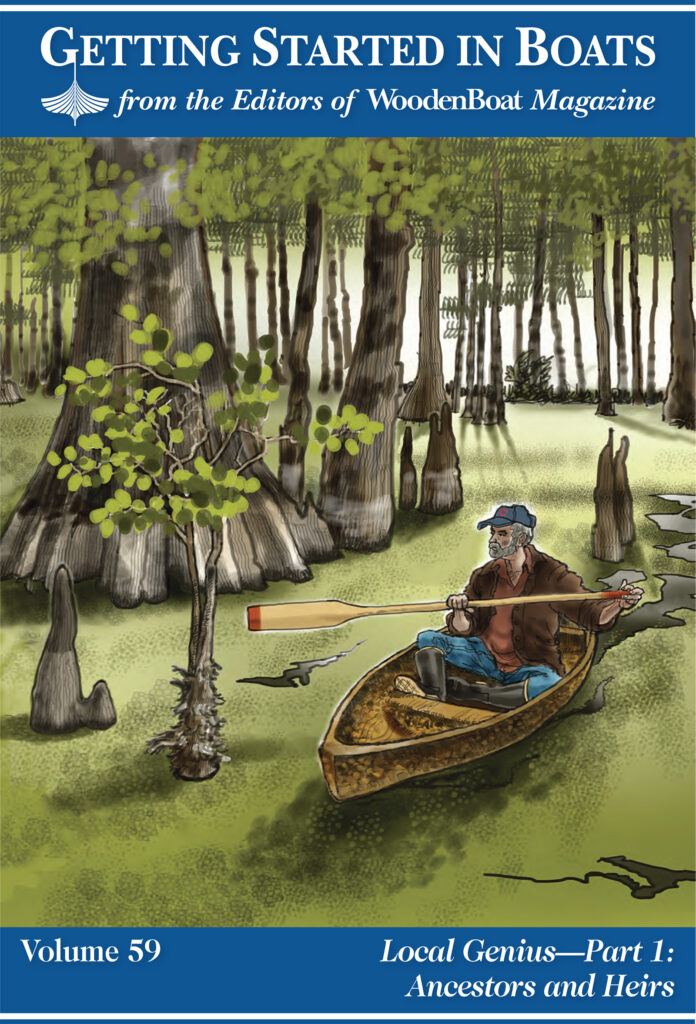
One example is the Louisiana bayou pirogue. Its modern adaptation as a simply built plywood form is only a crawdad toss away from its log ancestor, and is still an ideal vehicle for swamp excursions.

There are a few generalizations in dugout construction. Early Native Americans used controlled burns to char deadwood for chipping out the hollow shape, often flanking deeper burns with wet grasses to preserve gunwales. Depth-measured contrasting wood pegs were sometimes driven into the outer hull as gauges to keep a consistent hull thickness: the builder charred and chipped down to the pegs. The near-complete hull form was sometimes soaked, then filled with water that was brought to a boil by adding a succession of hot rocks—an early “hotbox”—so boatbuilders could gently lever out the round log-form and brace it open with thwarts for more volume.

The smart, stylish lines and the sheer size of the west coast Kwakiutl dugouts, where native boatbuilders had access to enormous red cedar butts, dismiss the belittling “primitive” term for North American dugouts.

The dugout.

Heirs to the simple dugout form might be the ever-useful johnboat, the workhorse scow sloop, the garvey, and even, at a stretch, the flop-front World War II Davis boat, still delivering interisland freight in the Maine archipelago.

The Ojibwe Canoe

Ojibwe canoe.

One of our most passionate historians, Admiral Samuel Eliot Morison, famously declared “…Never, in these United States, has the brain of man conceived or the hand of man fashioned, so perfect a thing as the clipper ship.” We beg to differ.

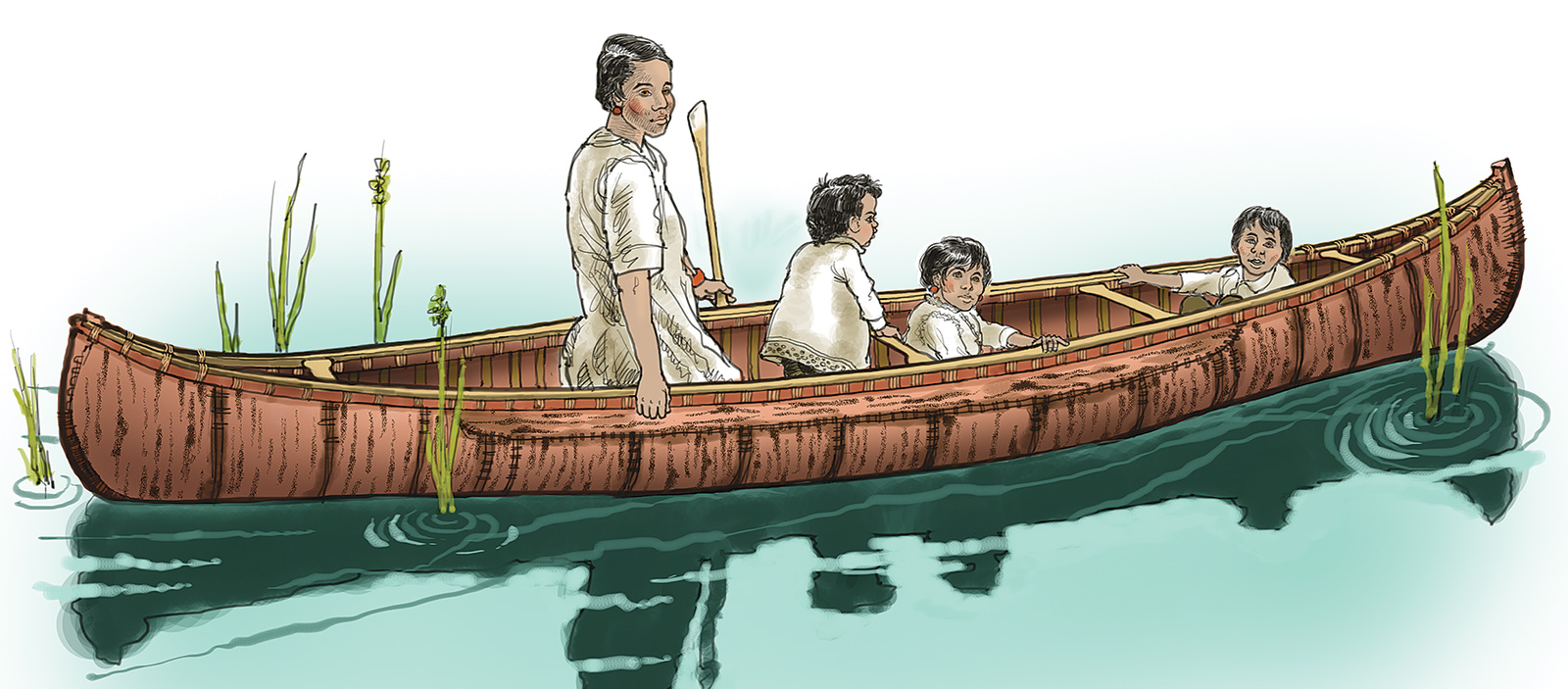
No vessel has been so completely born out of its own environment, waters, and resources, or has so broadly and profitably served its builders across a continent, as the simple, sublime Ojibwe canoe.

First fashioned with edge tools with stone blades, later perfected with little more than hatchets and the “crooked knife,” the canoe was built on the forest floor beside the birch tree that supplied its bark skin. It was shaped within pounded-in stakes, stiffened and reinforced with bent-wood ribs, fastened with twisted white pine root, and sealed with boiled pine or spruce sap. Out of this coarse mill came a graceful, sophisticated shape with remarkable hydrodynamic lines allowing effortless speed and intricate maneuverability in still or rushing waters.

The term “Ojibwe” refers to the First American nation inhabiting the northeastern woodlands around the Great Lakes, and “canoe” comes from “kenu,” an earlier term for tree-trunk dugouts.

The slim, seemingly frail canoe was essential to the economy of the native people: trade and transport, fishing, seasonal migrations, hunting forays, and harvesting water grain (“wild rice”). Later European settlers could not improve on the form as transport and freight carrier at a time when waterways were the only commercial routes. Light enough to portage from lake to lake, canoes might be small enough for a single hunter, or large enough to carry a crew of twelve. The dashing French-Canadian voyageurs carried more than two tons of trade pelts to market in big canoes that shrugged off rapids and big-lake rough water.

Ojibwe cannoe.

But the canoe is most at home in thin water, moving with almost eerie silence with careful paddling. It was also a superb poling boat for lakebeds and small streams. Skillful paddlers used its skittish agility for shooting white-water runs. Its sleek shape was also adaptable to the nearly lost art of lining a heavy-laden canoe through nasty rapids.

Birch bark tools.


No need to search far for heirs to the Ojibwe canoe. Like the shark, its form was so practical that it never had to evolve. It’s been produced in every modern material—aluminum, plastic, and even concrete—but the classic example might be the Old Town Otca, painted canvas over cedar ribs and sheathing.

The Kayak

The kayaks.

Europeans often use “canoe” and “kayak” as interchangeable terms, but the kayak is another kettle of fish. It is just as native and locally endowed but born of a harsher life above the tree-line. The Ojibwe canoes smooth form is monocoque, expressing its external folded bark basis. The kayaks angular form was dictated by its skeleton, inherited through unrecorded generations. The Inuit made their frames of wood, which is scarce in the Arctic. The frame was covered with flexible stitched skins, resulting in a seaworthy, tough craft that was portable on the shoulder of a single fisherman-hunter.

Heirs to the Eskimo kayak are alive and well, and produced in many versions, sizes, and materials. One venerable and perennially useful wood-and-canvas version is the folding, roomy, clever Klepper kayak, shaped like its ancestors around flexible wooden staves and stiff wooden sections. And many designers today have adapted skin-on-frame craft by sheathing them with tough synthetic fabrics.

The Dory

The dory.

No thoroughbred, but with exquisite form and surprising virtues, the dory was a penny-common tool of trade. To apply a Yankee boatbuilding phrase, it was “built by the mile and cut off to suit”; it was simple, cheap, and tough enough.

Factory boatyards built thousands of identical dories, as lightly and economically as possible. They were used by inshore fishermen and lobstermen, and used far offshore on Georges Bank, the Western Bank, and the Grand Banks, where the particular skills of its users were hard tested. Mother ships such as the familiar Gloucester schooners carried up to a dozen dories nested on deck to those restless, fog-plagued seamounts where the sacred Atlantic cod and the cold water halibut once schooled in millions.

The Swampscott dory and St. Pierre Dory.

Iconic Banks dories had sharp and long entries with long, buoyant overhangs. The sterns typically had a narrow “tombstone” transom. Cordage sling-lines were made fast through holes in the transoms and bow blocks. The thwarts (each place interchangeable with other dories) weren’t settled into place until after the dory was launched from the mothership. These seat-less, thwart-less shells could be nested six or eight deep, lashed to the deck of big fishing schooners.

Industrial overfishing has reduced cod stocks on the Banks below the level that suggests revival. But once cod was a staple of the American diet. American natives taught the Pilgrims (nice British folks out of Holland who didn’t bring much in the way of fishing gear) to catch cod, which probably saved them. In salted and transportable form it fed the Union Army in the Civil War. It was economically significant in the vile triangle trade between New England, Africa, and the Caribbean: New England rum and salted cod sold in Europe paid for African slaves; slaves were traded for molasses in Caribbean islands; molasses was processed into rum; and so around and around.

Dory stack.

Before the early 20th century the cod fishery was carried on by hand. Longlines dangling 1,200 to 1,600 hooks were baited with slivers of by-catch menhaden and other species, strung out to anchors and buoys. The line was taken up over a hauling block, the catch (some bigger than the fishermen) was unhooked, and the line reset again until the dory had less than a foot of freeboard. The catch was transferred to the mother ship, dressed out, and salted down to keep until the hold was chockfull.

It was a dangerous trade. The dories actually gained stability as they took on load, but uncounted dories were lost in the fog, to rogue waves, or to sudden squalls. The mother ships evolved into fast, overcanvased, often top-heavy carriers—part barracks, part warehouse, part racing machine—to beat other fishermen into market for the best prices. Between 1866 and 1890, in the Gloucester Banks fishery alone, more than 380 schooners simply disappeared, along with 2,450 men. The storm of August 24, 1873, took a toll of nine Gloucester vessels and 128 fishermen.

Cheap, stable, stowable, and useful, dories evolved beyond the cod fishery in hundreds of variations—fishing and work boats, lifeboats, tenders. Its heirs are all around us: the Swampscott dory and the St. Pierre dory are hardy examples.

Heritage

The Heritage.

The heirs of our earliest boat forms still carry us on our thin-water, picayune adventures. We hope they bring to mind a fact that most schoolbook history has ignored or expunged: we in the United States are a three-ocean nation with a tremendous web of commercially important rivers coursing across the continent. Perhaps the automobile and the airplane have blinded our vision and our sense of scale. Every Honda, every Fiat, every Hyundai arrived by sea.

As a young nation we were merchant seafarers, predominant in trade over half the globe, pre-eminent in navigation on all the seas. In Moby-Dick, Melville insisted, “Two thirds of this terraqueous globe are the Nantucketer’s. For the sea is his; he owns it, as Emperors own empires.” He was referring to more than the Nantucket whalers. He recognized our national maritime confidence and skill. Perhaps we can rekindle the old pride in our ocean heritage.