
 Eva Biederbeck
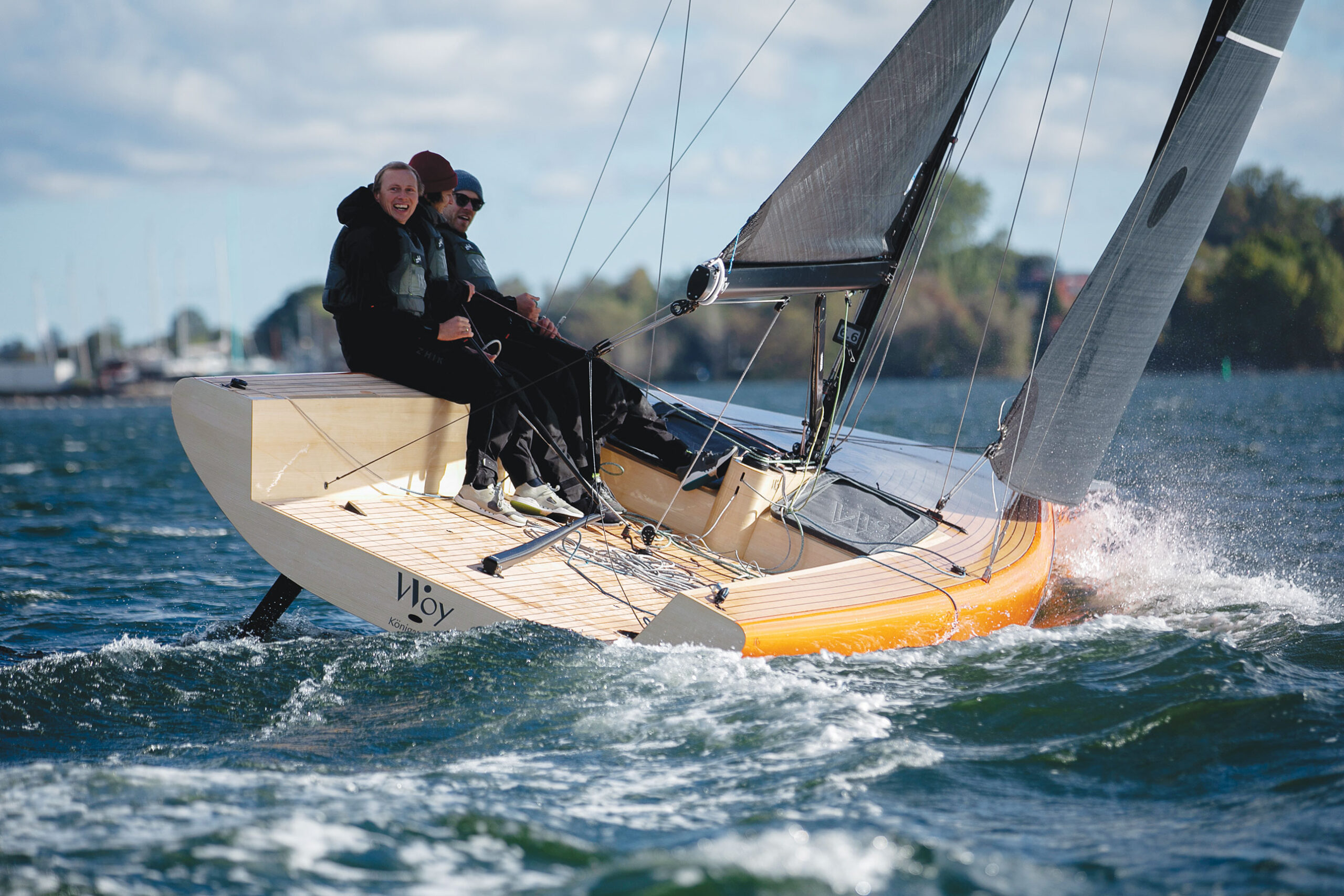
Jan Bruegge test-sailed his brand-new first WOY 26 daysailer on the Schlei, a northern German inlet, in October 2024. While WOY stands for “wooden yachts” in the design name, the first boat was also named WOY.
In autumn 2025 in the workshop of Jan Bruegge Boatbuilding in northern Germany, three boatbuilders were fitting out the interior and putting the finishing touches on the deck of hull No. 2 of a new design, the WOY 26 sloop. The deck’s Douglas-fir came from European plantations, and the larch hull planking and other woods used in the construction were also of local provenance. At the same time, farther back in the workshop, beyond a lapstrake dinghy getting its final finishes, hull No. 3 of the same design was taking shape.
Through the open barn door, foliage was visible on the shore of the Schlei, a 20-mile inlet leading into the Baltic Sea. This area—around the town of Kappeln and the historic village of Arnis, which with a population of 260 is the smallest city in Germany—is second only to the Lake Constance area bordering Switzerland as a center of German wooden boat building.
Jan Bruegge, the boatyard’s owner, was born and raised in the Elbe River harbor city of Hamburg, about 95 miles to the south. After completing high school, he began to study what is known in Germany as nautical science, with a career path to becoming a commercial ship’s captain; however, he quickly figured out that he would rather work with boats, not ships. He instead completed a boatbuilding apprenticeship in Kappeln and won an award as Germany’s best boatbuilding graduate. He completed his formal education as a master boatbuilder in 2016. In Germany, that is equivalent to a bachelor’s degree and is a prerequisite for certain entitlements, for example, educating apprentices of his own.
 Eva Biederbeck
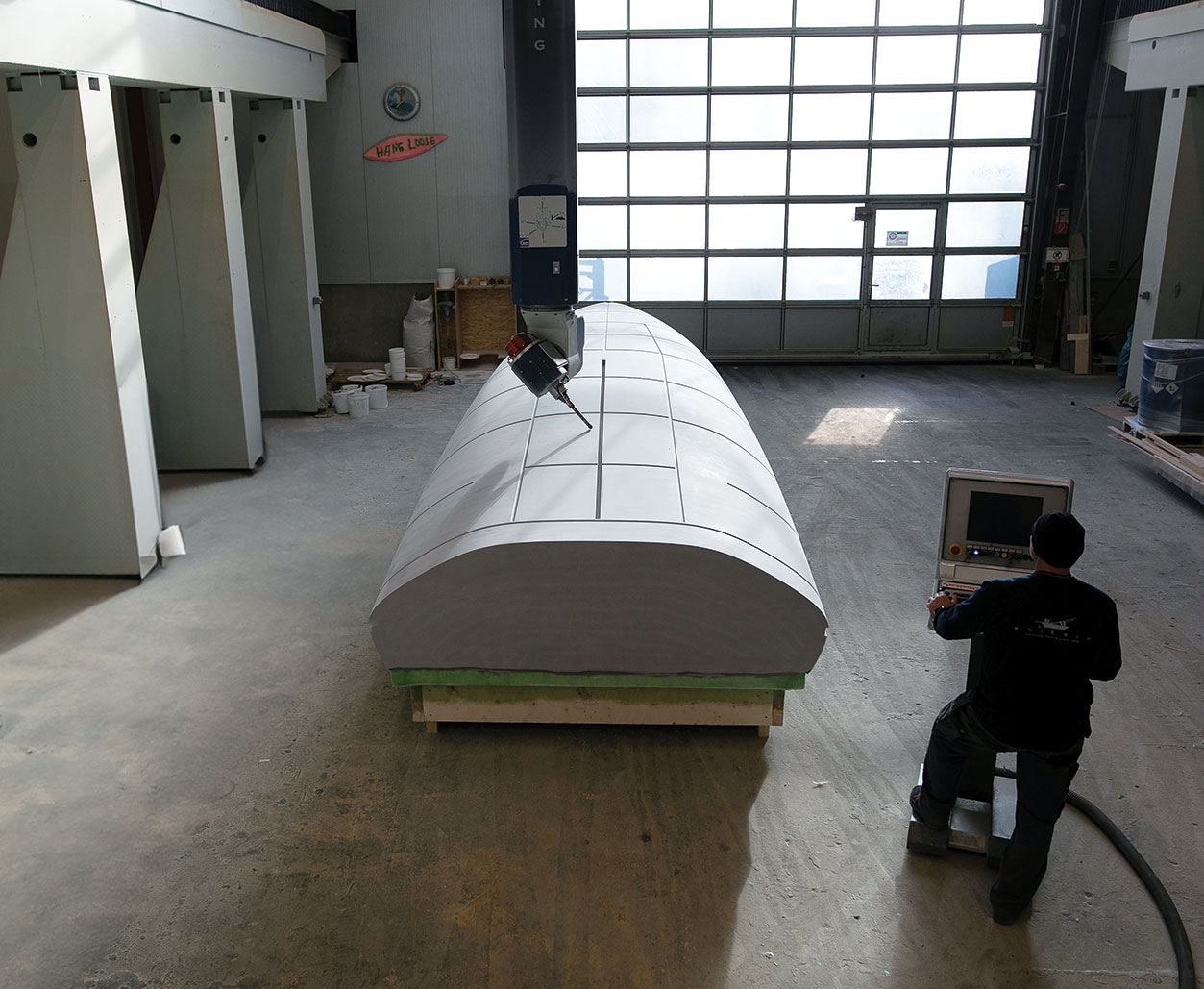
A high-tech upside-down building jig for all future WOY 26 hulls has been milled by Knierim Yachtbau in Kiel, Germany, and a second jig was made for the deck. The precise and smooth surfaces make the jigs ideal for perfectly shaped laminations.
Having achieved his certification as a master, he immediately founded his own boatyard. Only a year later, Jan was awarded a contract to build the hull of ELIDA, a beautiful 48′ racer-cruiser designed by the French firm Thomas Tison Yacht Design. While the deck was being built separately in Brittany, Jan Bruegge Boatbuilding built the hull, a cold-molded construction using four layers of Sitka spruce, one of carbon fiber, and one final exterior veneer of mahogany. ELIDA was launched in 2022, and Jan joined the owner’s crew that year for the Fastnet Race and returned in 2025 for the revival of the Admiral’s Cup at Cowes on the Isle of Wight, England.
Back in his office after touring the projects, I asked Jan to explain the ideas incorporated into his latest project: the WOY 26. The boat is conceived as a “bio-based,” high-performance class of wooden daysailers. He observed that wooden boat building has been around for thousands of years but had been displaced because it could not keep up with more modern technologies. Jan wanted to change that. He was convinced that wood, especially when adapted for cold-molded construction, still had a lot to offer in terms of durability and strength-to-weight ratio. For Jan, another important quality was wood’s haptics: “You feel wood immediately, and you will treat it automatically in a different manner,” he told me.
 Eva Biederbeck
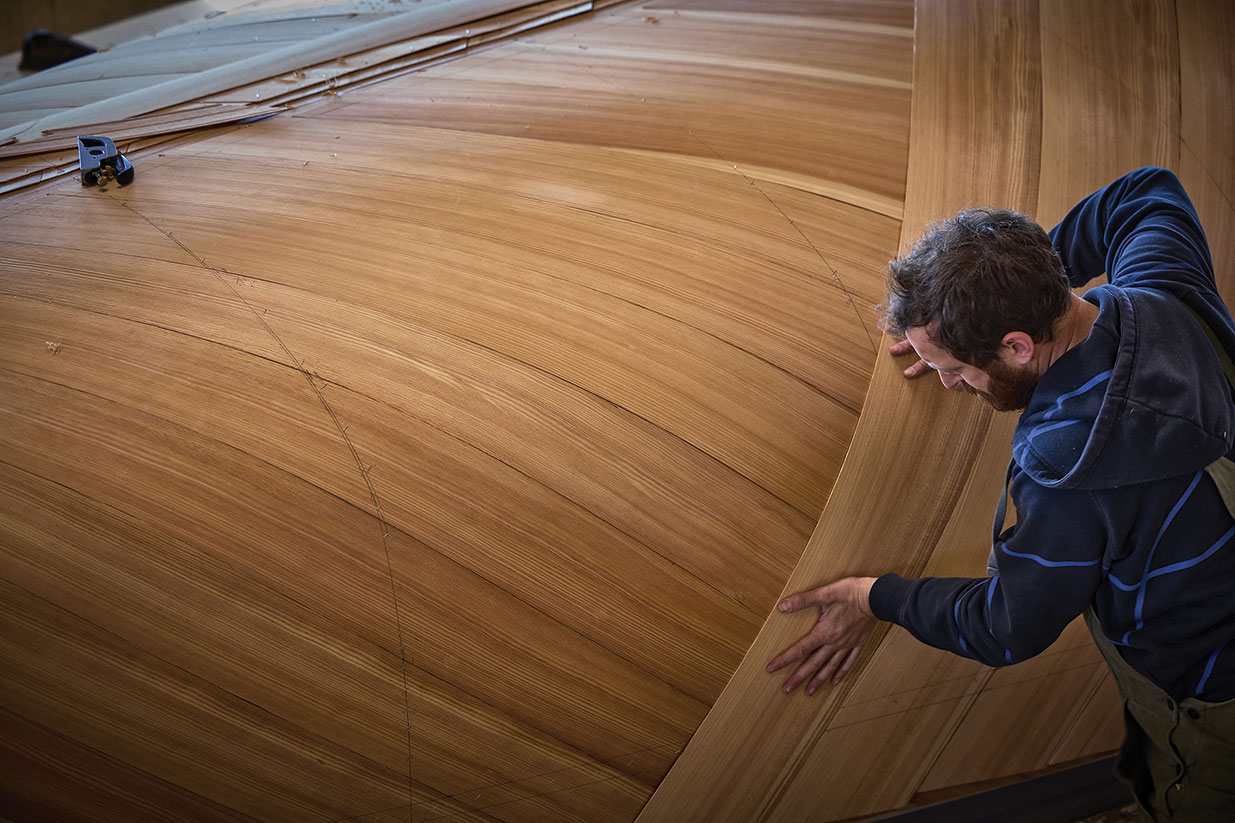
The third layer of 2.5mm-thick (³⁄₃₂″) larch planking veneers, set on the opposite diagonal to the previous layer, are stapled into place for hull No. 2. The innermost and outermost layers were placed longitudinally.
The Birth of a Class
It is said that the real start of the WOY 26 venture—multiple boats of the same design built in wood with modern techniques—occurred when Jan met the yacht designer Martin Menzner, head of Berckemeyer Yacht Design. The meeting occurred more or less by coincidence in a marina at the Kiel Fjord some six years ago. Jan had met with a customer there, and Martin—a passionate and successful competitive sailor—was just then docking his J80 sailboat. Having sailed and worked a bit on an LA28 (see WB No. 257) that Martin designed for another boatyard around 2014, Jan was fascinated by the radical design ideas displayed. “See, many of my peers are thinking about retirement,” Jan, who is 37, told Martin. “I am thinking about, ‘How do I build wooden boats over the next 30 years?’” Immediately, Martin was “all-in.” Berckemeyer Yacht Design is arguably best known for its designs of aluminum yachts, but Martin pointed out that the company’s catalog of designs also shows many intended for wooden construction, one example being RÉMY (see WB No. 290).
Over the next year, Martin and Jan worked off and on to create and revise a new design. They settled on a length of 8m (26′), although they had experimented with versions both longer and shorter. When I asked Martin how he came up with the WOY 26 and the earlier LA28, he replied that he was simply bored when strolling around the boat shows—all the daysailers resembled each other. He considered the LA28 his “Handschmeichler”—a German word that does not translate easily, but “hand charmer” comes closest; it describes an object of tactile delight. “I want to design boats that still fascinate after many years of looking at them,” Martin said.
As the result of the encounter of these two visionary men, the WOY 26 is a very straight-ahead daysailer in every respect. The curve of the topsides transitions to the sprung-plank deck without a separate covering board. A wave-piercing AC75-style bow with ample tumblehome leads into a fixed bowsprit. Forward, the deck rises slightly to the forestay fitting to reduce turbulence in the airflow to the jib, as Martin explained. With its comparatively flat bottom sections and its high-set waterline, WOY appears to be hovering over the water rather than sitting in it.
With the hydraulic lifting keel fully extended for maximum stability, the boat’s draft is 1.9m (6′2½″). Lifting keels typically must be fixed in the lowest or highest position, but Menzer’s design calls for a guiderail allowing it to be set at various depths. The keel lifts through a slot in the deck’s kingplank; with the keel fully retracted for transport by land, the draft is reduced to 1.1m (3′7″). Together with the boat’s twin rudders—which have less draft than would be necessary for a single rudder—WOY is designed to operate in shallow lakes or marinas.
Leanness was also a driving force in the design goals for Jan and Martin: A single winch allows line-handling amidships at the forward end of the cockpit between two closable hatches; the jib is self-tending; the carbon-fiber mast is secured by rod-rigging shrouds held in swept-back spreaders, which eliminate the need for backstays.
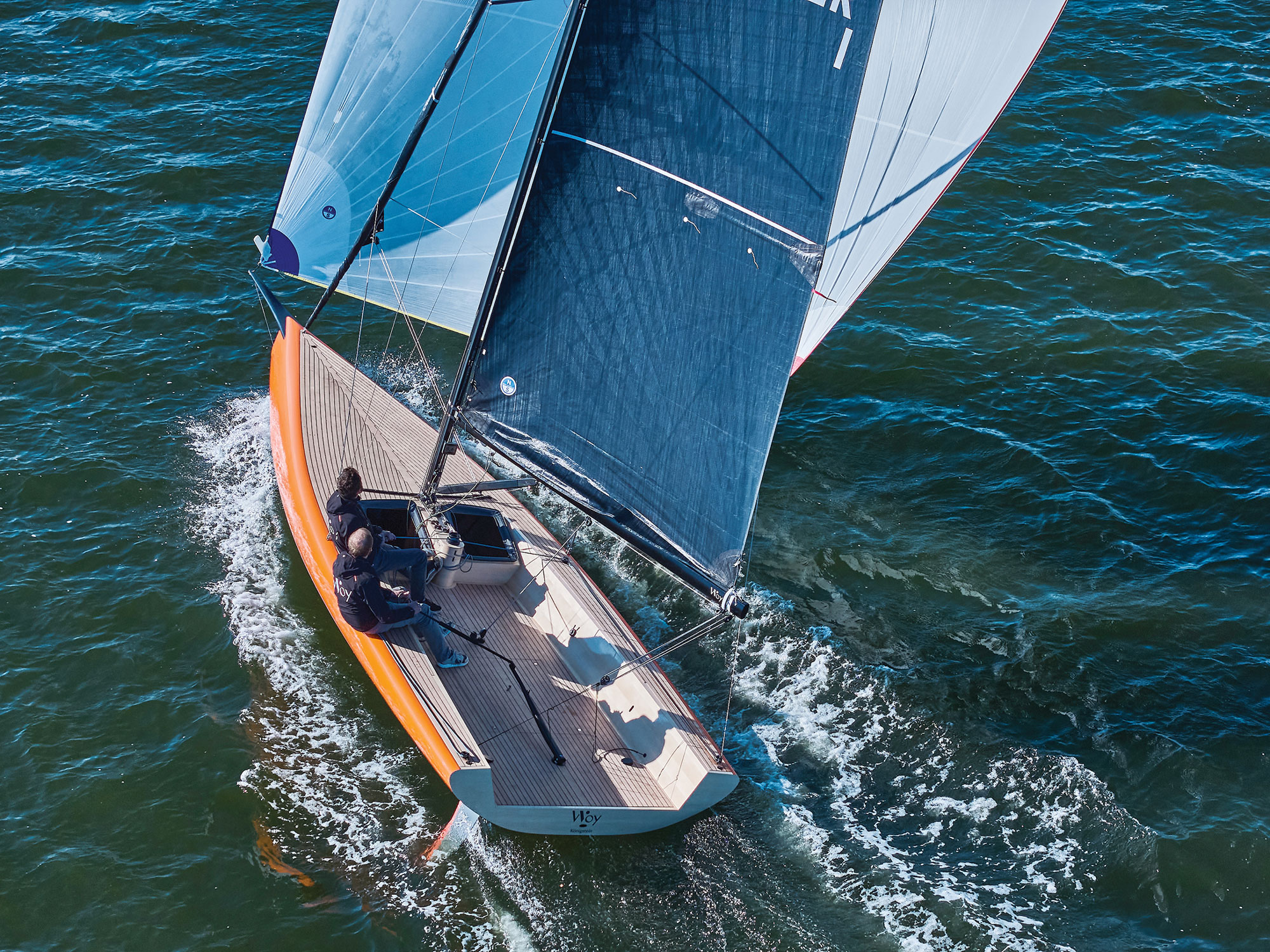
The yacht is ideal in light winds and easy to sail singlehanded or with a crew of two. But the WOY can also be well handled by a crew of up to four, and the form stability of the delta-shaped hull comes into play when the wind picks up. With a displacement of only 1.12 metric tons (2,470 lbs), WOY is intended to be fast.
And she is fast. She logged almost 19 knots in trials on the Schlei. “We planned for a daysailer; the result is more of a day racer,” Jan said. And how do you set the gennaker? “Carefully…. The 70m2 (753 sq ft) gennaker is packed in a bag under one of the two closable hatches, the tack line is running in the bowsprit, and you want to be careful not to touch the water with the huge sail. For mainly singlehanded sailors, we will offer a smaller kind of Code Zero sail.”
For maneuvering in marinas, the boat is equipped with an electric pod drive that can be manually lowered in a well, which has a fitting for closing off the bottom for undisturbed sailing when the unit is retracted.
Construction Innovations
 Nico Krauss
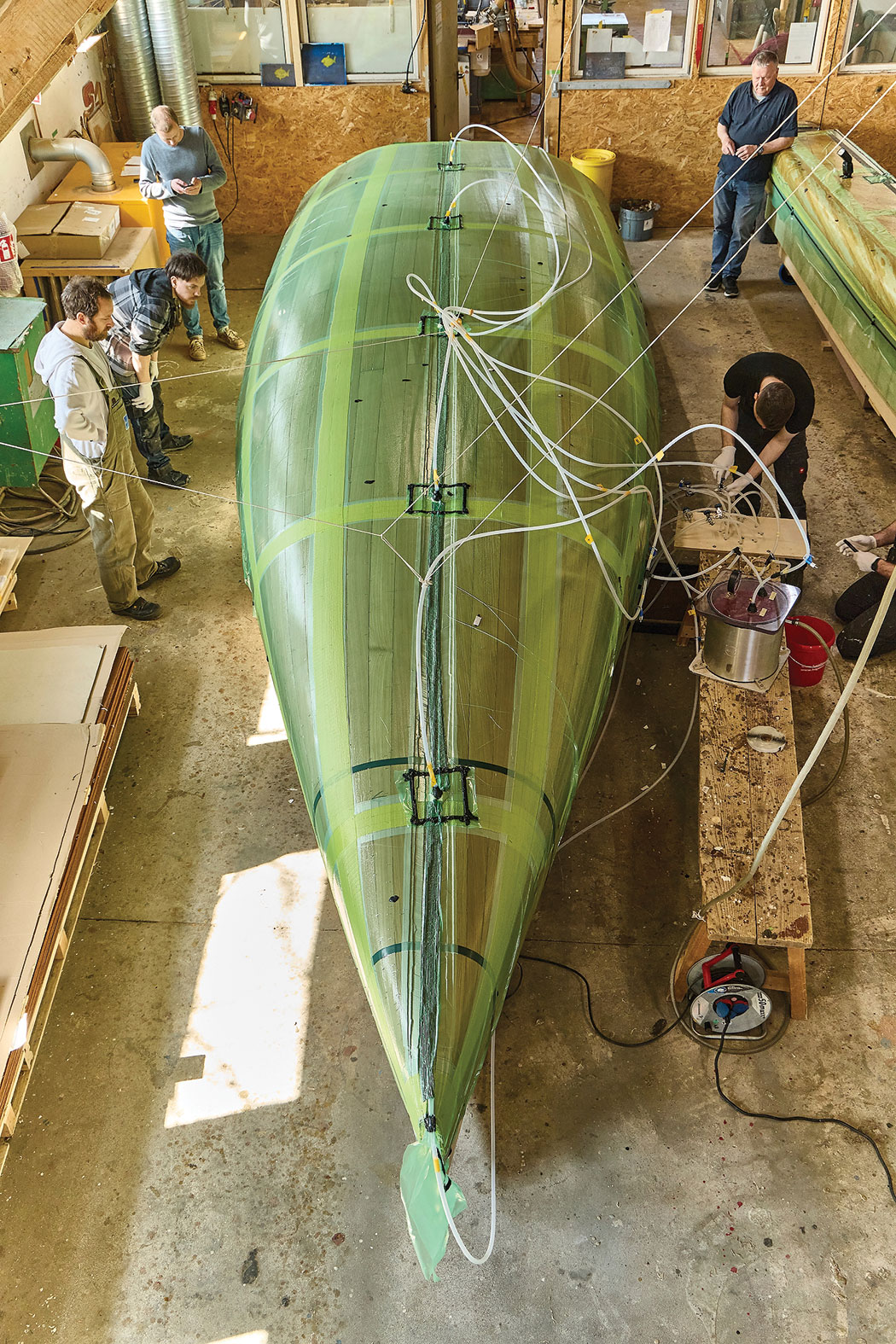
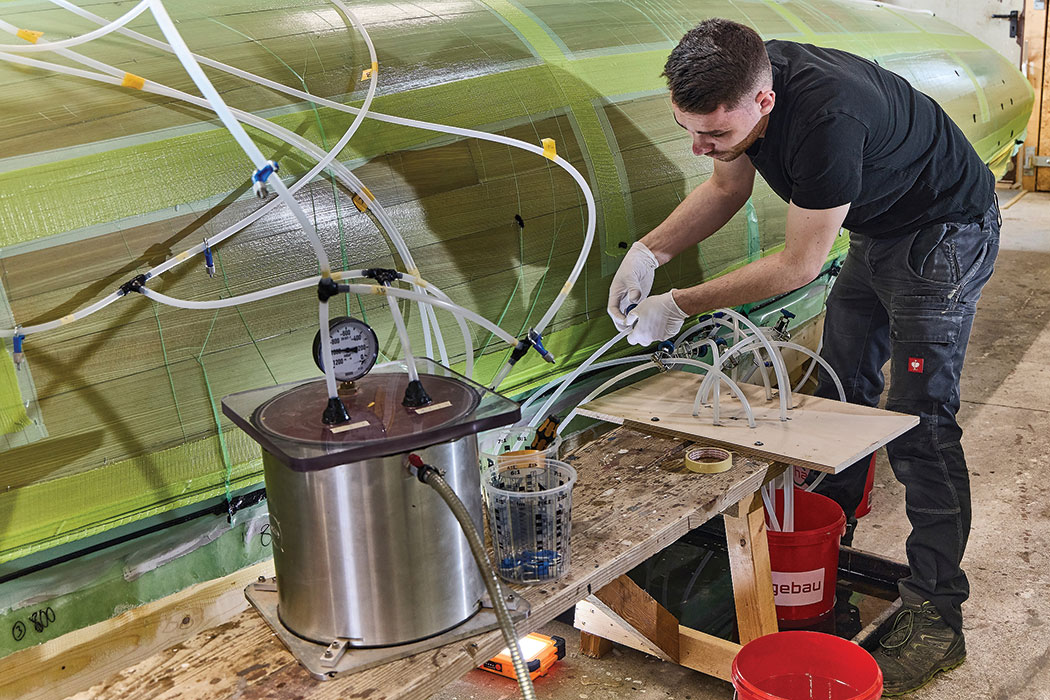
In the setup for the patent-pending full wooden-hull vacuum infusion process, the hull is partially covered by a mesh for additional pressure and fully covered by a green translucent film. The tubes fitted along the keel line draw epoxy resin upward, bonding all four layers simultaneously.
 Nico Krauss
The red bucket holds low-viscosity infusion epoxy.
 Nico Krauss
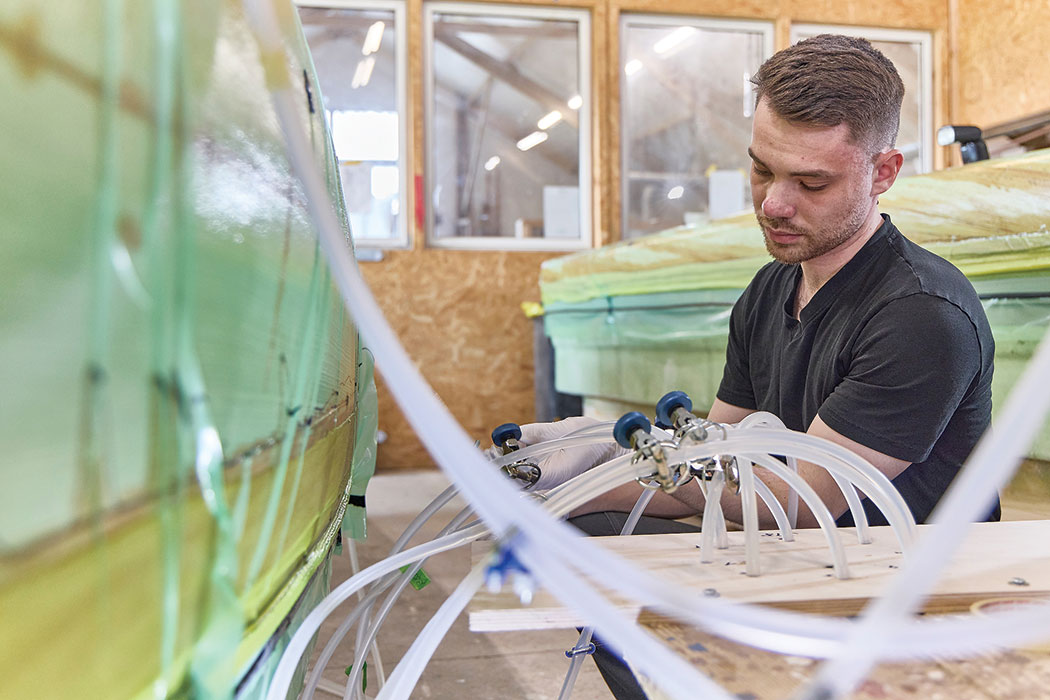
Eight tubes lead from the bucket to four entry points on each side, set slightly below the edge of the veneers. The vacuum pump on the worktable draws resin through the hull veneer layers and the excess flows into a so-called “epoxy trap” bucket.
While working with Martin on the WOY design, Jan was also striving for something greater: nothing less than reinventing his process for building wooden boats. The WOY 26 hull No. 1 was built in a basic cold-molding process over a wooden jig, using spruce and pine veneers. The first layer was, however, made of thin wooden strips bent over the jig and fastened temporarily. In contrast, hull No. 2, which will be sailed on Lake Wannsee in Berlin, was built over a more elaborate jig and glued with a full-fledged vacuum-infusion process. Like vacuum-bagging, this process involves using vacuum pressure to hold the pieces tightly together; however, it differs in that instead of directly applying epoxy to the pieces, the vacuum pressure draws epoxy throughout an airtight envelope created around the entire hull. The idea was to build wooden boats by adapting methods used for fiberglass-boat construction. Everybody who has laminated frames or hull and deck planking knows the tedious process of mixing and stirring epoxy resin and hardener, and maybe presoaking the wood pieces, maybe adding adhesive filler before applying it to the surfaces, pressing the parts together and waiting for the glue to set, removing excessive epoxy again and again, and repeating the process with the next piece. Like most boatyards building cold-molded boats, Jan’s shop knew about vacuum-bagging and epoxy infusion and sought to use these methods to build the WOY 26 hull No. 2 in a single glue-up.
 Nico Krauss
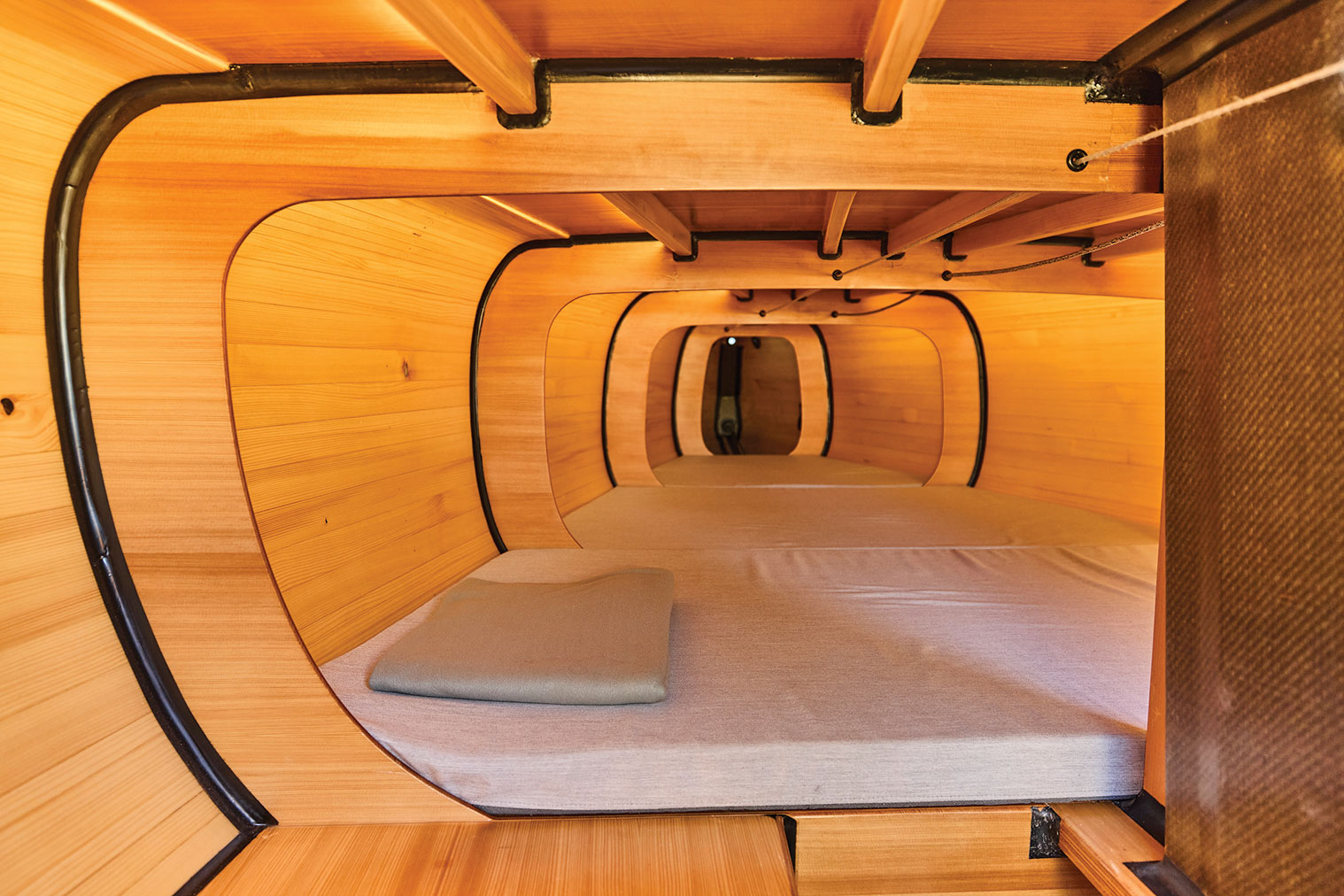
The varnished V-berth of WOY hull No.1, together with its plywood bulkheads, contrasts with the carbon-fiber keel trunk at right. In this prototype, strip-planking was used; in hull No. 2, larch veneers were used instead. The lines overhead are for the jib’s roller-furler and the gennaker’s tack line.
Through a business network called the Northern German Maritime Cluster, Jan had met Dr. Alexander Pfriem, a professor at the Eberswalde University for Sustainable Development. The two agreed to an ambitious project. The idea, as their prospectus described it, was for “Boats made from bio-based materials: Development of new composite materials and production techniques to improve efficiency in bio-based boat and yacht building” to exactly develop and prove this vacuum-infusion method.
 Nico Krauss
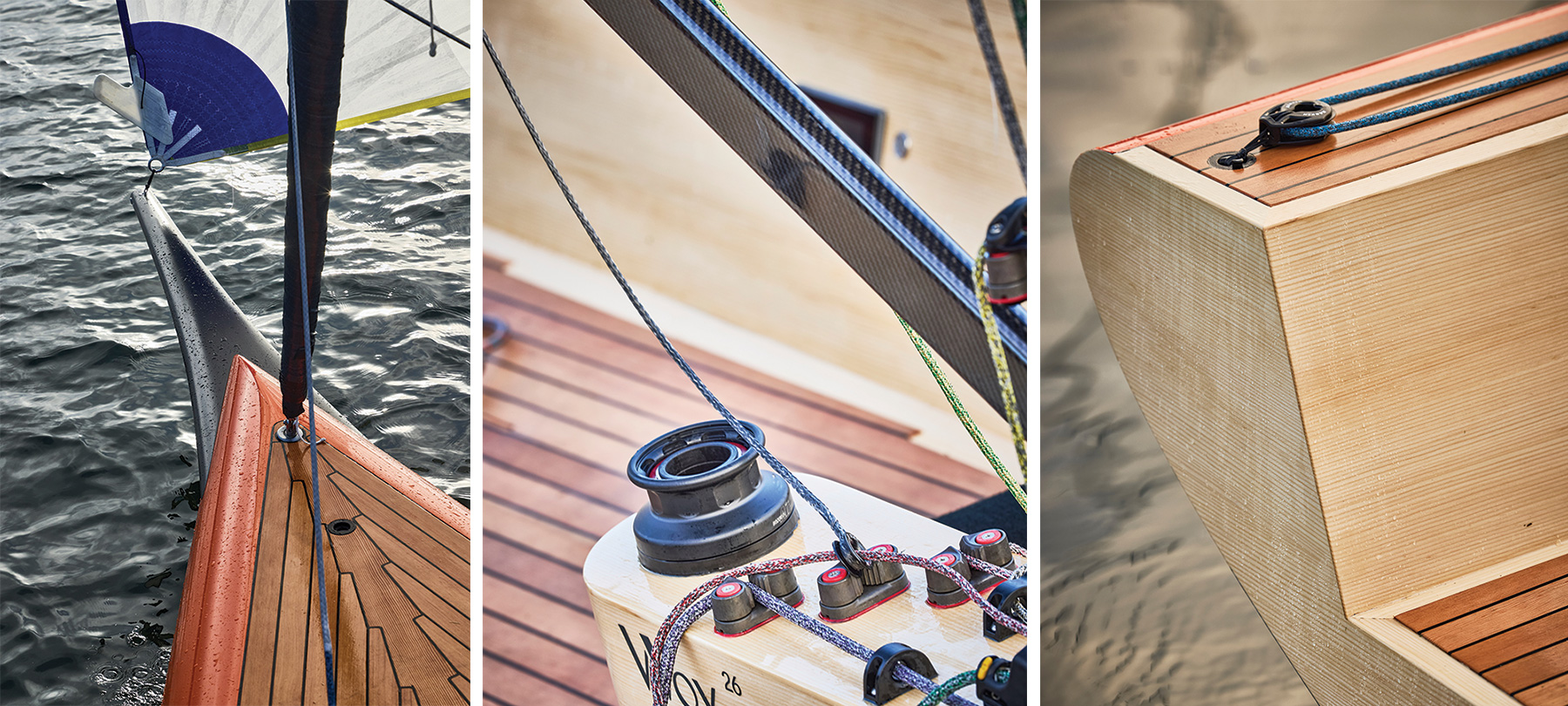
Left—The WOY’s gennaker tacks to the fixed carbon-fiber bowsprit, while the jib’s roller-furling gear is below the sprung-planked Douglas-fir deck. Middle—The control-line console has a single winch for handling all halyard and trim lines. Right—The center console, transom, and cockpit sides are veneered with silver fir.
Over three years, Jan and his team experimented first with small samples, then larger ones, and later with curved and complex structures. The university contributed research on the structural behavior of the resulting wood composites. In 2021, Jan Bruegge Boatbuilding received a sustainability award from the German State of Schleswig-Holstein, where Jan’s company is located. Jan’s vacuum-infusion method, for which a German patent is pending, was production-ready and successfully executed on WOY hull No. 2 in April 2025. The method not only minimizes material use and waste, compared with previous wood-epoxy methods, but also protects workers, which was an important rationale for the award jury. Jan explained that many professional boatbuilders develop a well-recognized epoxy sensitivity over time, but the vacuum-infusion method alleviates the problem by decreasing their exposure to getting epoxy on their skin or inhaling vapors.
Jan also focused on using sustainable materials. WOY hull No. 2 was built using exclusively local or regional woods and deliberately excluded the use of tropical hardwoods. She was planked with larch veneers, and her frames and transom were made of larch plywood. Her stringers and deckbeams were made of spruce. European larch has a durability rating of 3 or 4 on a scale of 1 to 5, with 1 being the most durable. Siberian larch, which has a rating of 3, has been widely used for planked daysailers in Europe, including the famous Folkboats designed in Sweden in the 1940s. The same value of 3 to 4 holds for European pine. Spruce has a value of 4. Hull No. 2’s decks are of 3-rated European Douglas-fir—which is called “Douglasie” in Germany and sometimes “Oregon pine” elsewhere; the species, which is native to the West Coast of North America, was first introduced to European plantations during the mid-19th century.
The interior of the hull and its structure are varnished. The transom is wonderfully veneered with silver fir with very dense annular rings; rather than being peeled, these veneers were quarter-sawn to really show the ring structure.
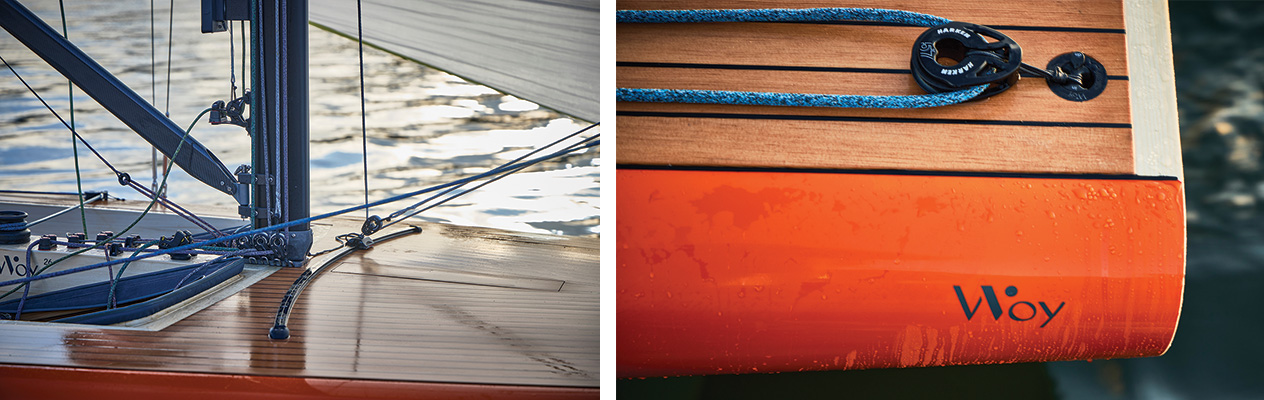
The hull surface could be veneered and varnished, but Jan believes that the best option for the modern shape of WOY is a colored plastic sheeting—the vinyl wrap made popular in the automotive industry. The first WOY’s color is “sunrise.”
Some components are made of composite materials for weight savings and stiffness. The mast and boom are of carbon fiber, built by a local sparmaker. Structural elements manufactured in-house, such as the drop-keel trunk, the double rudder, and the bowsprit, are also of carbon fiber.
 Nico Krauss (both)
Left—Forward of the mast, the self-tending jib’s sheet is controlled by a traveler block mounted on a curved track. To the right, the visible slot allows the lifting keel to be raised. Right—Instead of fixed cleats, which might disturb the smooth deck surface, WOY has “click-system” fittings. The hull color—called “sunrise”—was achieved with vinyl-wrap finish.
A Refinement of Vacuum-Bagging
Jan ordered a building form from Knierim Yacht Building in Kiel, taking advantage of that company’s five-axis CNC milling machine to make a precise jig of composite materials following Martin’s digital plans. Two such jigs—one for the hull and one for the deck—used for hull No. 2 will be the basis for all future WOY 26s. The precision of the plans and CNC cutting allow the deck assembly to be wedded seamlessly to the hull.
Next, Jan and his team selected the 2.5mm-thick (³⁄₃₂″) larch planking veneers. Especially for the innermost layer, which was laid longitudinally and would be visible from the interior, the veneers were first laid out on the workshop floor. The jig was treated with a release agent to prevent epoxy-soaked veneers from bonding to it. Then, the first layer of planking was stapled to the jig, followed by the second and third layers on opposing diagonals and the final fourth layer, which was again longitudinal.
By April, hull No. 2 was ready for the vacuum infusion of epoxy. The outer veneer layer was covered with a mesh film at several critical areas for increased pressure on the hull. Finally, the hull was sealed with a greenish film (visible in the photographs below). Four tubes were fixed slightly below the edge of the planking and connected to a pot containing epoxy. Calculations showed that 40 to 50kg (88 to 110 lbs) of epoxy would be needed. Jan used a special low-viscosity bio-epoxy, a blend of resin and hardener that has low crude-oil content.
 Nico Krauss
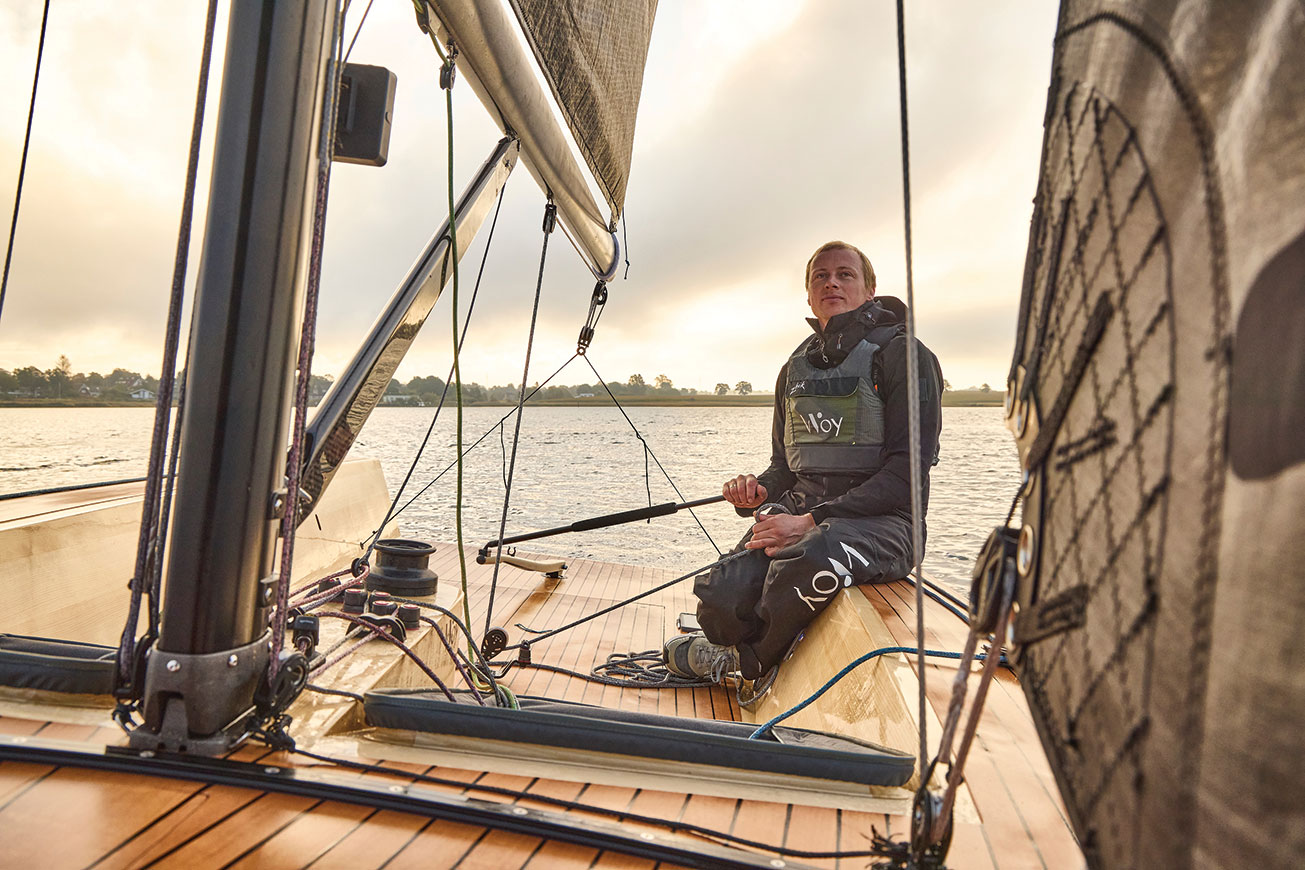
Jan Bruegge enjoys a singlehanded sundown sail on the Schlei inlet; on other occasions his son assumes the role of bowman.
More tubes were fitted along the keel and held in place and made airtight with butyl tape. These tubes were connected to the vacuum pump and finally to a so-called “epoxy trap” to collect excess epoxy. All of the tubes were equipped with valves to control the flow of epoxy during the infusion.
The pump was started with a vacuum pressure close to 1 bar (14.5 psi). In barometric measure, a vacuum pump at 0.9 bar creates a pressure of 9 tons per square meter (184 lbs per sq ft). The fluid epoxy is sucked upward through the plank edges. In Jan’s method—and this is the game changer—grooves less than 1mm deep (about ¹⁄32″) were cut into the veneers to facilitate flow. Slowly, the veneer layers filled, and in less than two hours the hull was completely glued with infused epoxy. Jan said he can better control epoxy flow for precise penetration of the wood when the epoxy is sucked upward rather than flowing downward. Jan was so confident for WOY No. 2 that he invited Germany’s largest yachting magazine to observe the process.
After the epoxy had set, the green film was removed, and the hull was “post-cured” by warming the ambient air to 55°C (131°F), which allowed the infused epoxy to fully cure. Jan raved about how little filling and sanding were required afterward, a testament to the jig’s perfect surface.
The completed hull was removed from the mold and turned upright so that the interior construction could begin, starting with gluing and filleting the plywood bulkheads into place. The deck assembly, which was produced using the same infusion method over its own jig, proved more challenging because of the tight curves in its surfaces.
 Nico Krauss
So far, hull No. 1 is still the only WOY 26 sailing on the Schlei inlet, but No. 2 is nearing completion, and Jan’s long-term dream is to create a one-design racing class.
Looking to the Future
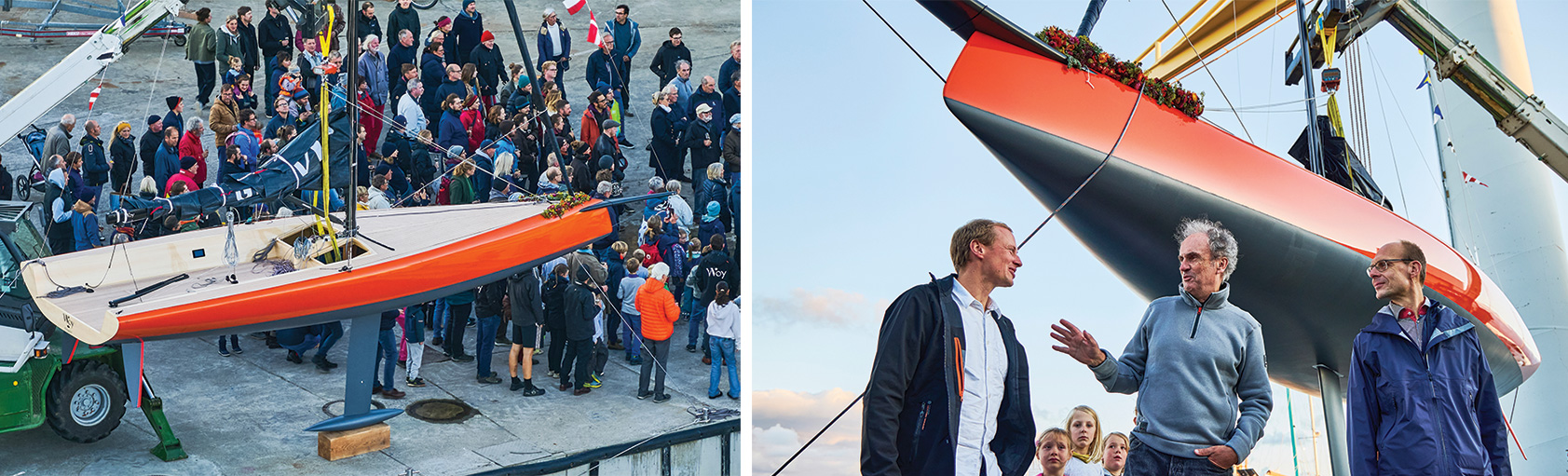
The prototype WOY 26 was launched in October 2024 and named WOY, giving the class its name. The launching took place under the eyes of a significant crowd that included Jan and his team, Martin, Dr. Pfriem, other experts, friends, and family. Not surprisingly, WOY has attracted a lot of media coverage since then. She won the German Innovation Award 2025, which was initiated by the German parliament to celebrate innovative products, technologies, and services. She has been nominated for the European Yacht of the Year 2026, an award presented by the 12 leading European yachting magazines and praised as “the Oscar of yachting sports.” Jan’s long-term dream is to create a one-design class with the WOY 26.
And Jan is far from being done. He and his team are investigating recyclable epoxy to tackle the problem of the end-of-life cycle of a yacht. He also has started a study using so-called finite-element analysis, a calculation to divide a hull mathematically into many small simple forms, the physical behavior of which can be investigated for forces and loads and an element’s interactions with neighboring elements. All of this to better understand how WOY behaves under various conditions as well as for future new projects.
“Wood is the most archetypal and natural material for boats,” Martin said. And one possible future of wooden boat building is being written here—in Jan’s workshop just outside of Arnis, a city of 260 souls in northern Germany.
WOY 26 Particulars
- LOA: 26′3″ (8m)
- LWL: 23′5″ (7.13m)
- Beam: 7′11” (2.42m)
- Draft:
(keel down): 6′2½″ (1.9m)
(keel up): 3′7″ (1.1m) - Displacement: 2,470 lbs (1.12 metric tons)
- Ballast: 794 lbs (0.36 metric tons)
- Sail area:
Mainsail, 226 sq ft (21m2)
Jib, 151 sq ft (14m2)
Gennaker, 753 sq ft (70m2)

Michael Sauter took up boatbuilding in retirement from his former life with a global consulting company. He spends most summers in the Penobscot Bay area of Maine, and has taken several courses at WoodenBoat School.
For more information, see www.woy-yachts.com or contact Jan Bruegge at jb@janbruegge.de.