
 Courtesy of Viking Ship Museum, Roskilde
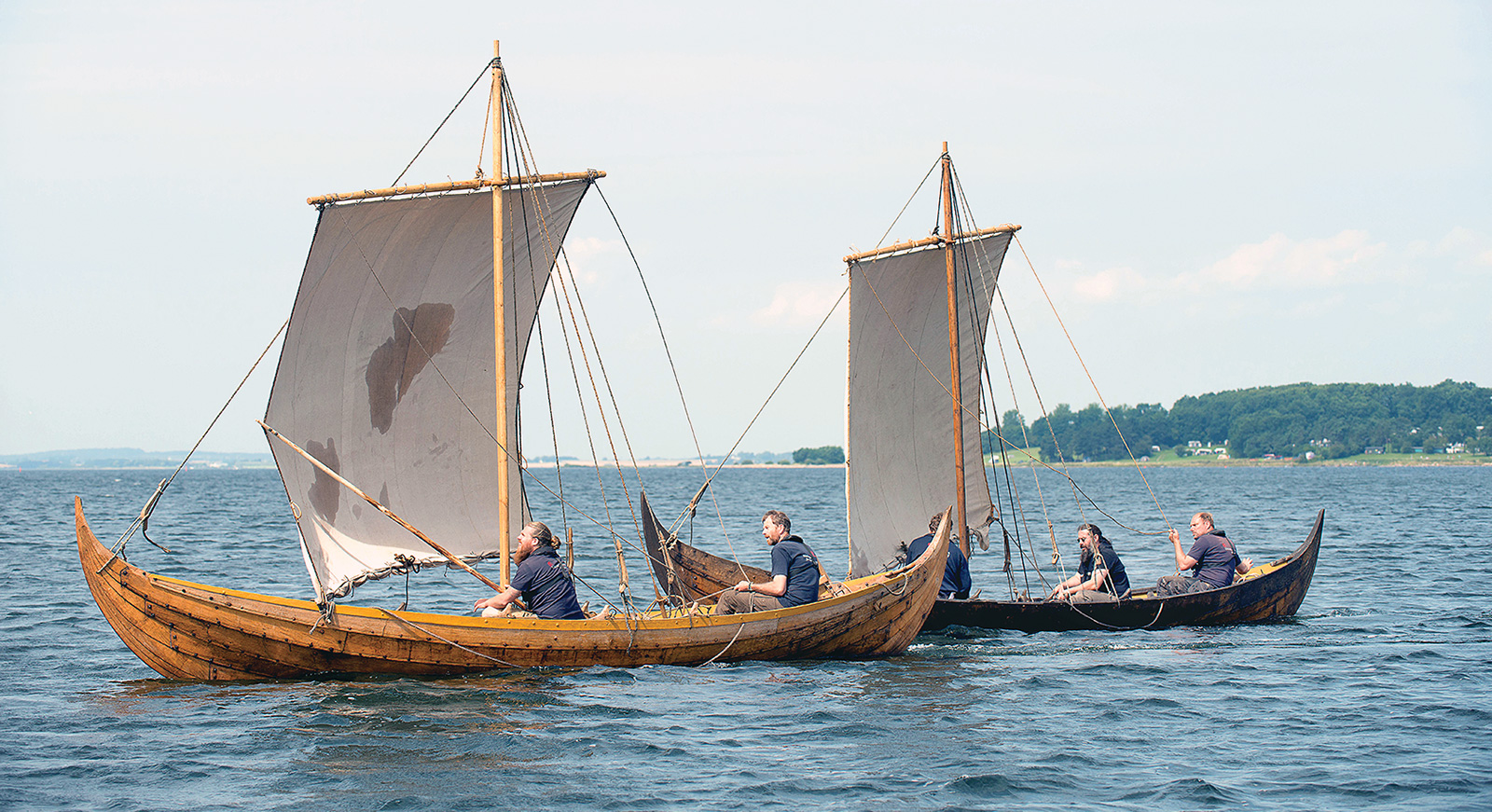
LANGÖE of 2017 (left), the Roskilde museum’s third reconstruction, reflects a reinterpretation of the original archaeological finds. She has one more strake than GISLE of two years earlier (right). Such constructions are a specialty of the museum’s boatshop.
Gislinge, a small agricultural town about 40 miles west of Copenhagen, Denmark, was built on land reclaimed from the shallow waters of Lammefjord. So when a 1993 excavation for a drainage project there happened upon the remains of a boat, it came as no particular surprise. What was surprising was the boat’s remarkable state of preservation. It was a typical early medieval craft of the region, and its wood was dated by dendrochronology to about 1130 A.D. This put it well after the peak of the Viking Age, though its construction was nearly identical to the techniques used in that earlier era.
Scientists from the Viking Ship Museum in Roskilde determined that this discovery was a common workboat. It was most likely used for local fishing and general transportation. With a length of 25′3″, beam of 5′3″, and a draft of just 7″, it is estimated to have been capable of transporting ten sheep. She likely had a crew of four, one aft steering with the rudder mounted off to the starboard side and three rowing with two oars each. When the wind was fair, the crew would handle the rig; the boat’s maststep implied the typical single square sail of the period. The hull showed evidence of having been repaired again and again; the boat’s working life, estimated at 50 years, was a long one by any standard.
She was a simple workboat, and yet her elegant shape and proportions are rooted squarely in the great Nordic tradition of riveted lapped-plank boatbuilding that extended back hundreds of years before. The tradition survived in some areas into modern times and, it could be argued, even to this day. Large boats built in this “clinker” construction carried Scandinavian seafarers well over a thousand years ago west as far as Newfoundland; to the east, they reached Constantinople (now Istanbul) and into the Mediterranean Sea for trade, settlement, and, yes, raiding.