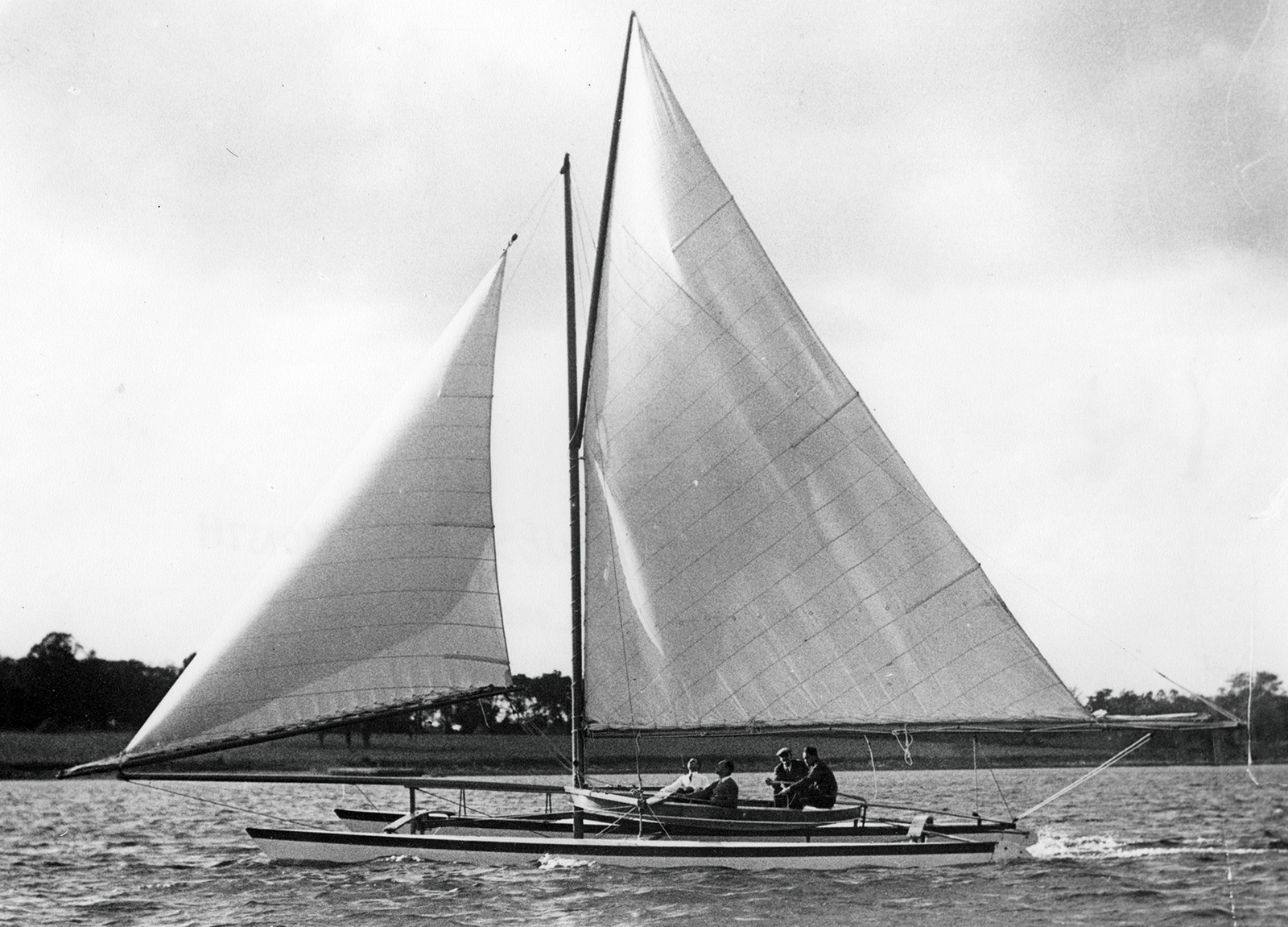
Nathanael Herreshoff designed AMARYLLIS in 1876.Herreshoff Marine Museum

The era of the modern multihull has paralleled innovations in the use of wood. Nathanael Herreshoff designed a series of catamarans, starting with AMARYLLIS in 1876. Her lightweight hulls moved somewhat independently, foreshadowing a design innovation that would come 100 years later.

Wood forms the skeleton of many modern multihulls—creatures more bird than fish. Largely unknown in Europe and the Americas until after World War II, often misunderstood, and sometimes maligned into this millennium, multihulls have evolved hand-in-hand with advances in wood-composite construction. They are rooted in ancient times, but increasingly popular for racing, cruising, and commercial use.

While multihull enthusiasts have never had any reservations about using whatever material seemed best suited to a project, much of the revolutionary multihull design of recent decades has been reliant on advances in how wood is used in boatbuilding. Conversely, multihull innovators have often pioneered new ways to use wood.

All evidence suggests that multihulls—catamarans (two symmetrical hulls), double-outrigger canoes (a single main hull or vaka balanced by two smaller ones called amas), and proas (two different-sized hulls)—were used to explore and settle the entire Pacific Basin beginning 5,000 years ago, reaching from the western Pacific to as far east as Easter Island 1,600 years ago. This makes them one of, if not the, quintessential voyaging craft.

The word catamaran stems from ancient Tamil roots—katta (to tie) and maram (log). These ancient Pacific craft were built of solid logs, dug-out logs, or planks, and joined using lashed cross-connecting structures (akas). They were ubiquitous across the Pacific by the time European explorers arrived.

This outrigger canoe was photographed around 1880.Wikimedia Commons

This outrigger canoe was photographed in Ceylon—current-day Sri Lanka—around 1880. Multihulls date back more than 5,000 years, and were used to explore and colonize the islands of the Southwestern Pacific Ocean and Indian Ocean.

From the earliest multihulls, it was obvious that tying a couple of skinny hulls together yielded enormous lateral space, shallow draft, and stiffness under sail. Thin hulls moving through the water also produce exponentially smaller waves of the type that limit the speed of displacement monohulls. Europeans noted that the performance capabilities of these boats were superior to their ships, but the indigenous craft of the Pacific remained little known, appreciated, or developed in Europe, the Mediterranean, or the Americas for centuries.

The English polymath Sir William Petty designed and built four catamarans from 1662 to 1684. They were horribly heavy, built like Admiralty ships of the era cut down their centerlines and the two half-hulls separated and spanned by a bridge deck. Still, the first one, INVENTION, proved both fast and weatherly, though the third, EXPERIMENT, foundered in a storm with the loss of 17 men. Other European and American experiments followed sporadically through the decades without much success until Nathanael Herreshoff’s series of catamarans, starting with AMARYLLIS in 1876. Built of ½″ planks on closely spaced ash frames and an oak keelson, she employed a complex central structure and three beams to carry primary rig loads while universal joints allowed the hulls to move somewhat independently. Herreshoff’s multihulls demonstrated superior speed potential over conventional racers of the era, and Herreshoff felt they would make good spartan cruisers if kept light. Other rare pioneers followed, from Commodore Ralph Munroe, to L. Francis Herreshoff, to Eric de Bisschop—the last of whom sailed with a mate from Hawaii to France in 1937–38 in his traditionally planked and caulked catamaran, KAIMILOA.

Yet, despite centuries of sporadic experimentation, the design of the modern multihull would start from a near tabula rasa as it sought to exploit the lighter, stiffer, and stronger structures made possible after World War II by plywood, synthetic fibers, and resins that could bond lumber and laminate wood in thin layers. These advances allowed modern multihulls to eventually surpass the capabilities of their forebears.

Birth and Childhood of the Modern Multihull: The 1940s and ’50s

38′ catamaran MANU KAI.Michael Schacht

In 1954, inspired by native outrigger craft of the Pacific, Woody Brown built the 38′ catamaran MANU KAI. It inspired generations of innovation.

As boats always have, the new breed of postwar multihulls reflected the society of their times—its faith in science, technological and material advances, an emerging middle class, and a can-do adventuresome spirit. Whereas displacement single-hulled sailing craft are very much like waterborne dolphins driven by wings in the air, multihulls lift from the sea as they are driven hard and skitter along—more like flying fish. It is thus no surprise that aircraft would inspire both the construction and the design of modern multihulls. The designers, builders, and sailors of multihulls would likewise reflect the open-minded, unconventional spirit typical of early aviators. Many of them were, in fact, fliers themselves.

Arthur Piver (1910–1968) is often called the father of the trimaran, although Victor Tchetchet, a Ukrainian immigrant to the United States, had experimented with multihulls on Long Island Sound before World War II and launched his first successful one, which he dubbed a “trimaran,” built of plywood, in 1945. She featured short outriggers (amas)—more like floats than hulls—and was modestly successful.

Piver, who had been a World War II pilot and was a resident of San Francisco, followed in the 1950s and ’60s with a series of plywood trimarans ranging from 16′ to 64′. By 1957, he had built six multihulls—two cats, an outrigger canoe, and three trimarans. His early trimarans featured strip-planked, round-bottomed main hulls and simple, box-section amas, but for his seventh—his 25′ Nugget design—he turned to a 90-degree V-bottomed main hull that had flat-panel topsides joined on a chine. Piver’s V-hulled amas were notably longer and more voluminous than Tchetchet’s, though many in yachting establishments would continue to call amas “training wheels” and considered Piver’s boats shamelessly boxy. By using a solid wing, though, he could exploit the lateral space of the cabin by parking berths over the water. Jim Brown would sail his tiny Piver Nugget from California to Mexico and back, and Piver would sail his own 30′ Nimble across the Atlantic in 1960, and a 35-footer around the Pacific in 1961.

Facing an uphill battle for acceptance of these exotic craft, Piver noted, “Normally, it is easier to change a man’s religion than it is to change his ideas about boats.” But Piver would nonetheless popularize the breed, and construction by amateurs, by designing boats for which “…traditional skills were not required, enabling craft to be built with average manual dexterity.”

Arthur Piver–designed JUANA.Jim Brown

Jim Brown completed the simple, backyard-built, Arthur Piver–designed JUANA in 1959, kicking off a lifestyle movement he called “seasteading.” The boat had a strip-planked, round-bottomed main hull and plywood, box-sectioned amas.

In 1954, impressed by native outrigger craft of the Pacific, Woodbridge “Woody” Brown built a 38′ catamaran with a 14′ beam called MANU KAI (“Sea Bird”). It would become legendary. An innovator in both surfboards and gliders, Brown had grown up in greater New York City among aviation pioneers; he was present at Roosevelt Field on Long Island when Charles Lindbergh took off for Paris in May 1927. Lacking centerboards or keel, his MANU KAI relied on deep-V asymmetrical hulls for fair upwind performance. Sailing on and off the beach, she gave thrilling rides to tourists in Hawaii.

Much like framing up a kayak or biplane with a light-but-robust structure and applying just enough covering to keep the water or air out, Brown and fellow builder Alfred Kumalai bent stringers and keelsons around frames, and then trussed primary bulkheads that would support the akas. Over this integrated hull mold, composing roughly half the hull’s weight, they bonded relatively light plywood skins to the outboard flat surfaces, while cold-molding—bonding together with glue that did not require an oven, or autoclave, to cure it—layers of veneer-plank angled to one another to form the more rounded inboard skins. The method eliminated a throwaway mold. In a departure from Pacific traditions, the akas were enclosed in a connecting wing structure, well rounded to minimize both wind and water resistance. The faster you go, the more such considerations matter. This frame-and-stringer construction with molded skins had been refined in aircraft such as the famous Mosquito bomber in World War II. Cold-molding and main bulkheads anchoring trussed plywood akas would become a standard, and multihulls would exploit the great strength and stiffness of these new “monocoque” or single-piece compositions in which everything, including interior furniture, became structural.

Kumalai joined Rudy Choy and Roy Seaman to form the company CSK, which would produce numerous notable and record-breaking plywood and cold-molded catamarans using the same basic methodology. Because narrow, deep hulls have much less curvature than a monohull, much less bending of plywood or spiling of the cold-molded veneers is required, further appealing to one-off and amateur builders.

Meanwhile in England, James Wharram began producing conservatively rigged, V-bottomed plywood catamarans that evoked the Pacific traditions (see related article, page 24). His boats had no keels or boards until much later years when he also began rounding his hulls, but all continued to be elegantly lashed together and featured open wing decks with spaced decking planks. In 1955 he made a west-to-east transatlantic passage in a mere 23½-footer; in 1959 he reversed the route east to west, sailing in his 40′ RONGO.

A CSK 27 offshore catamaran under construction.Courtesy Of Scott Brown

A CSK 27 offshore catamaran under construction. The relatively curvaceous centerline-facing hull surfaces have been cold-molded; the flatter outward-facing surfaces await closing in.

By the end of the 1950s it was clear that wide beam gives power to carry sail, and it yields lots of lateral space. But it was also clear that wide boats are a challenge to dock and transport, and slow-turning. Long, skinny hulls want to track straight. Wide boats span a large part of the churning sea, complicating diagonal motion and wracking loads. Generally, designers settled on an overall beam of about 40 to 50 percent of LOA for sailing cats; 60 to 70 percent for trimarans. Crew and stores compose a larger percentage of working displacement for light boats than for conventional displacement ones, and many multihulls thus ended up sailing heavier than their designed displacements. Typical load allowances were for 25 to 40 percent of designed displacement.

Tests and running in the real world indicated that wave-making resistance exponentially falls away when slim hulls exceed a length-to-beam ratio (LWL:BWL) of 6, but there were practical limits. With two hulls supporting displacement, catamaran hulls usually ranged from 10:1 to over 20:1. Beamier cruising-tri vakas might be only as slim as 6:1, but racers aimed for at least 10:1, and when heeled, all tris rested on an even skinny ama. Without ballast, larger percentages of weight are composed of akas, rig, and stores, which are necessarily spread out, aggravating pitching. Flexibility can reduce violent motions and reduce weight, but complicates the secure staying of rigs, particularly on catamarans with the mast and forestay between hulls. Stiffness to carry sail also imposes large loads on the rig, and as speed increases, the apparent wind moves forward, which tends to depress the leeward bow. Stiffening structures to allow tighter headstays and centerboards, daggerboards, or keels would become essential for upwind work. Seeking interior room across wing-decks either increased windage and height of the rig or lowered wing bottoms to where waves punished them. Improved clearance of akas above the water, and fairing their leading edges, would prove critical.

Adolescence: 1960s–’70s

The trimaran THREE CHEERS.Michael Schacht

Dick Newick revolutionized multihull design with flowing creations such as the trimaran THREE CHEERS.

hile the original trailblazers would continue to contribute to the development of the modern multihull into the 1960s and ’70s, an abundance of second-generation designers emerged in France, the United Kingdom, Australia, Hawaii, the Caribbean, and the United States. Many would focus on synthetic composites, but most at least offered wood-composite options—especially in the United States and Australia where wood was widely available and cost-effective.

Although multihull sailors were still considered sailing renegades, if not outright nut cases, the anti-establishment culture of the 1960s and ’70s complemented the movement. Science-based theory and empirical testing led by the Amateur Yacht Research Society (AYRS), founded in 1955, were crucibles for development. Races were sailed on every ocean, both around the buoys and across oceans. High-profile, non-handicapped, offshore contests such as the Observer Singlehanded Transatlantic Race (OSTAR), Round Britain, and Route du Rhum provided immediate feedback. As the legendary multihull designer Nigel Irens would later remark, “You can’t argue with the finish line.”

Multihulls faced a few well-publicized disasters in the 1960s. Piver himself would be lost at sea soon after this spate of accidents. But by 1972 multihulls would take four of the first six places in the OSTAR; by 1984 all of the first nine; and no monohull would win again until 2009 when only two multihulls competed—and both dropped out.

By the mid-1960s, designers had decided that deep Vs were not ideal. Most first turned to multichined hulls, approximating round bottoms but still easily built from plywood. Jim Brown’s Searunner series also featured center cockpits and partial- or full-wing deck options. In the era of the back-to-the-land movement, he focused on simple, affordable, do-it-yourself solutions to promote a multihull voyaging lifestyle he called “seasteading.”

The Harris 40, a multi-chined racer-cruiser trimaran.Barbara Bedell

In 1967, Robert Harris designed the Harris 40, a multi-chined racer-cruiser trimaran, which was built by Larry Bedell. Aluminum-tube akas allowed the boat to be disassembled for transport. The step above the waterline, visible here, widened the livable interior volume while keeping a critical narrow waterline beam.

While working for Sparkman & Stephens and inspired by both MANU KAI and Victor Tchetchet, whom he knew, Robert Harris designed the 17′ Tiger Cat, the eponymous prototype of which was cold-molded. That initial TIGER CAT took five straight wins in Yachting magazine’s 1959 One of a Kind Regatta and gave rise to the first one-design catamaran. It would lead to speed challenges from the American Prout brothers, Francis and Roland, who pioneered the cruising catamaran industry, and from the Scotsman Macalpine Downie, who in the early 1960s had switched careers from chicken farming to multihull design, and whose CROSSBOW proas would shatter world sailing speed records. TIGER CAT also inspired the eventual development of the C-class (and similar) catamarans, as well as the Tornado—the first Olympic-class multihull, which was often built in wood.

In 1967, Harris produced the multichined racer-cruiser Harris 40 trimaran, one of four trimarans built by Larry Bedell, an amateur typical of those carrying the art forward. Aluminum-tube akas allowed the boat to be disassembled for transport. She also featured a step above the waterline, widening the hull interior while keeping a narrow waterline beam, something Ib Pors Nielsen used on a 24-footer. When combined with a partial wing, the 40’s interior closely resembled a cruising monohull of the same length, but she was fast enough to place third and second in Newport Bermuda Races in 1971 and 1975.

Aeronautical engineers Norman Cross and Ed Horstman employed cold-molded, frame-and-stringer construction to primarily produce even roomier cruisers that, in larger sizes, might displace nearly as much as offshore racing monohulls and rarely escaped semi-displacement mode, but could still outpace typical monohulls on passage. These boats have traveled widely. Cross, especially, employed refined aeronautical frame-stringer proportions and spacings. Horstman’s TORTUGA TOO became the first trimaran to round Cape Horn, in 1979.

Cruising boats and racing boats increasingly diverged. CSK would continue to create cruising cats as well as racers that would set records in the Pacific. In the Caribbean, Peter Spronk would turn out a stable of low-slung catamaran beauties, primarily for charter and most of them cold-molded, but he also built boats using lapstrake plywood. His typical (but not universal) very low wing decks tended to suffer, and the lapstrake method would eventually be abandoned. Like CSKs, however, these boats continue to do their jobs today.

The typical Searunner construction.Jim Brown

This model shows typical Searunner construction, in which the total weight of the structure is about evenly divided between the skeleton and the skin.

In Australia, Lock Crowther was shaking things up, initially with light and deep cold-molded and multi­chined trimarans that hardly made any waves. Even his tris tended to have LWL:BWL ratios of greater than 10. Like Harris, his tubing or solid akas notably rested in brackets on the tops of the amas, keeping them above the ama sheerline and well above ocean chop. Even his later foam-’glass, round-bottomed catamarans and trimarans were tied together with trussed plywood beams.

Having sold his first kayak plans at age 14 and having kayaked through Europe after World War II, Dick Newick was obsessed by the advantages of lightweight thin hulls and streamlining above and below the water; this led him to become one of the premier multihull innovators who focused on sailing dynamics, reshaped boat aesthetics, and innovated construction techniques. After launching a 40′ sheet-plywood catamaran in 1957 that he and others employed in day chartering for 42 years, he turned to trimarans. Even his early TRICE—which was strip-planked on the bottom with plywood topsides—dispensed with conventional aesthetics. Her wing-deck underwings swept elegantly upward to his amas’ sheers, maximizing clearance over the sea as the boat heeled. He soon gave birth to a new kind of oceanic sailing canoe, the Atlantic proa, which keeps its large ama to leeward as opposed to the traditional proa that keeps a smaller ama to windward.

His extremely curvaceous Atlantic proa CHEERS! became the first multihull to place in an OSTAR (third in 1968). Her akas arced dramatically upward from the vaka’s fuselage-cabin and then down onto the tops of the amas, so that even if they were hit by waves, the streamlined beam ends would neatly cut through.

The 60′ Newick–designed ROGUE WAVE.Jim Brown

The 60′ Newick–designed ROGUE WAVE, built by Gougeon Brothers, weighed just under 10,000 lbs when launched. It was built of sheet plywood and cold-molded veneers on frames and stringers. The amas are designed to be capable of slicing off the tops of waves, and the boat demonstrated that multihulls could go very fast in very rough water.

Newick’s hulls had rounded V sections and featured plenty of keel rocker that allowed easy turning, and his sheerlines were quite saucy to help keep the bows up. When his trimarans were pressed, the ama’s center of buoyancy would move about 15 percent forward of the main hull’s. Jim Brown sums up Newick’s contributions succinctly: “Dick ditched the plywood box.” Newick’s THREE CHEERS! of 1972 was fully sculpted in every direction, highlighting low sheerlines, banana-shaped rocker, and thinned-out ama sections aft. She was typical of Newick’s subsequent designs. His cabin tops curved downward toward their ends, and his akas curved out and down to ama decks. His revolutionary “wing akas” melded the coach roof with a stiff, wide, streamlined beam, eliminating coach roof sides and vastly reducing wind resistance. Every component became structural with the smooth curves spreading loads rather than concentrating them via hard angles.

As boats became more shapely, wood versions demanded cold-molding, strip-planking, or the use of cores. Compound curves are never easy to build, but among Newick’s innovations was the master curve—a single sectional shape that, when moved along a reference line, would define all sections of the boat. This led to him being able to take shaped panels for amas and the main hull off one mold. In the late 1970s, amateur builder Michael Conley would launch a double-ended 45′ Newick trimaran that required only a half mold to produce all the hulls’ panels.

The 35′ ADAGIO.Courtesy Of Scott Brown

The 35′ ADAGIO, built in 1969, was the first all-glued boat built by Gougeon Brothers. She had no mechanical fastenings and combined a cold-molded vaka bottom with stressed-plywood vaka topsides and amas.

Hot-molding structures such as the Luders 16, a one-design sloop, had long existed, but required autoclaves. One-off molded boats required a revolution in adhesives. An epoxy patent dates back to 1934, but even into the 1970s resorcinol glues continued to be used for bonding, despite requiring a very tight-fitting—and tightly clamped—glue joint. Until the 1970s, epoxy was not widely used for laminating, sealing, or sheathing boats in fiberglass. Many boats of the 1960s were coated with fiberglass cloths set in polyester resin. Despite polyester’s poor peel strength, some well-maintained polyester-sheathed boats of the era are still happily sailing today. Nevertheless, the widespread adoption of epoxies by the mid to late 1970s led to very long-lasting multihulls and new construction methods.

Meade, Joel, and Jan Gougeon began selling bonding and coating epoxy in 1971, sparking a revolution in wood construction. Consider tortured plywood, for example. There’s nothing new about developed plywood surfaces, which consist of flat panels twisted or bent in just one direction. But the bending of plywood on both axes (compounded, stressed, distressed, or outright “tortured”) to stiffen the material and allow compound curves could be seen even in early Newick boats that featured rounded sections and touches of flare. The Gougeons, however, took stressed plywood to another level in 1963 with a “folded up” trimaran, the first of a series to compete against C-class catamarans. They “stitched” two one-piece hull sides along the centerline, forced the sheers apart, glued the seams, and inserted internal framework, eliminating lofting, setting up, and laminating layers, but demanding careful and tricky modeling of the eventual shape. The result, VICTOR T, named after Tchetchet, beat all comers in 1969. But such construction in thin, high-quality plywood was particularly well-suited to small boats such as Tornado cats and other day racers.

Stressed-plywood hulls.Russell Brown

Stressed-plywood hulls can be bent to precise shapes by forming them to a robust mold.

Russell Brown

Here we see a pair of amas under construction by the Port Townsend, Washington-based builder Russell Brown.

Never shy to risk failure or use whatever worked, multihull designers such as the Gougeons often combined flattish plywood topsides and other panels with cold-molded or strip-planked bottoms where curvature was needed, as they did to create the 35′ ADAGIO in 1969. She was their first all-glued boat built without mechanical fastenings such as screws, rivets, or nails, combining a cold-molded vaka bottom with stressed-plywood vaka topsides and amas. She’s been successfully racing on the Great Lakes ever since.

There had been and would remain debates about the compromises of so-called low- or high-buoyancy amas—those displacing a maximum of less or more, respectively, than the boat’s weight. Small Gougeon racers, taking advantage of crew weight, featured relatively small amas. Their ADRENALIN featured light, low-buoyancy, articulating amas and placed second in the Formula 40 Grand Prix Circuit in 1988. Early on, the Gougeons also had judiciously used carbon (called graphite at the time and expensive, so used only where it was literally “worth its weight”) and rotating wing masts; they also experimented with amas that could articulate to move over the sea surface somewhat independently of the main hull—much like the hulls of AMARYLLIS more than a century earlier.

In New Zealand, Ian Farrier would launch his first plywood Trailertri in 1978, the first of a series of home-built designs that caught on thanks to a novel system allowing his trimarans’ akas to hinge, folding the amas under the hull, even while still in the water. These easily trailered designs would beget thousands of production and one-off boats. Larger round-bottomed designs would include strip-built hulls.

By the end of the 1970s, offshore adventure racing had metamorphosed from a personal adventure to a fully professional sport. Walter Greene had been teethed racing offshore in both monohulls and Newick trimarans. His Newick-esque 38′, cold-molded and plywood A CAPELLA had tubing compression struts from the stern to aft of the cockpit to stiffen the main hull. Upwind capabilities were further honed working with Phil Steggall, a Hood Sailmakers consultant, to “borrow” rig and sail improvements from the grand-prix mononull racing scene. In 1978 the inaugural Route du Rhum race, from France to Guadeloupe, became the first to offer notable prize money. Renamed OLYMPUS PHOTO, Greene’s boat, under skipper Mike Birch, would basically cross tacks with a 70′ monohull to win by 98 seconds. Like Newick’s CHEERS! and tiny VAL in earlier OSTARs, OLYMPUS PHOTO portrayed how efficiency and ease of handling could trump size alone.

But while Newick, Greene, and others would prioritize speed, others, from Piver onward, viewed it primarily as a bonus to the multihull’s principal assets. Performance at sea is your friend because it offers numerous tactical advantages, but pushing to the limit can get pretty bouncy and even risky.

John Marples, who had taken over Jim Brown’s plan sales and had helped Brown design the Searunner series, observed, “At a certain point, you’re more interested in speed management than speed potential.” Sometimes, it is better to ease off the pedal, remaining comfortable and conservative while still scoring sizable day’s runs.

Maturity and Second-Generation Protégés: 1980s–’90s

A 100′ power catamaran ferry from Gold Coast Yachts.Michael Schacht

A 100′ power catamaran ferry from Gold Coast Yachts has wave-piercing hulls that allow a smoother-than-usual ride by cutting through waves and resurfacing with minimal resistance.

By the mid-1980s, while the old guard soldiered on, multihull designers and builders would continue to proliferate. Working craft would emerge and take advantage of dramatic fuel efficiency. The French would come to dominate and professionalize offshore adventure racing with boats increasingly designed and built in Europe primarily using synthetic composites to pare weight to the minimum regardless of costs. As composite costs declined, demand grew for production composite boats while more wood-composite multihulls incorporated carbon and other synthetics in akas and other high-stress areas. Vacuum-bagging also became common, eliminating fastenings and voids that had been more common in previous cold-molded laminates.

Greene’s and other Newick-esque wood-composite racers began as the raceboat style du jour, but Phil Morrison’s EXMOUTH CHALLENGE initiated a notable change in course. Cats and tris had long competed, but Morrison recognized that, for offshore racing, power to carry sail was key. As wide as EXMOUTH CHALLENGE was long, her leeward ama would serve as the primary sailing hull, like a catamaran. Each was notably straighter and more voluminous (200 percent of boat weight) than on earlier trimarans, keeping her decks and akas well clear of the sea. Renamed UMUPRO JARDIN V she won the 1984 OSTAR. Morrison remarked: “She wasn’t exactly of high-tech construction, quite the reverse—simply plywood and strip-plank cedar sheathed in ’glass and epoxy. At the time I was led to believe the whole boat cost less than [the 60′ Ron Holland–designed trimaran] COLT CARS’s carbon mast!”

Racing multihulls had long led the way in rig and sail development and were among the first to routinely employ rotating masts and fully battened sails, but the 1980s saw wide adoption of these items. Gold Coast Yachts, founded in 1981 in St. Croix, would begin employing Gougeon-designed wing masts made of ply skins bent over an I-beam framework on TERORO, a day-charter trimaran launched in 1985. They would later develop their own strip-planked sections and fit more than half of their fleet of more than 100 cruising and charter cats with them.

UMUPRO JARDIN V (ex-EXMOUTH CHALLENGE).Alamy

UMUPRO JARDIN V (ex-EXMOUTH CHALLENGE) was designed with long, voluminous amas that allowed considerable sail-carrying power.

After designing a couple of Newick-inspired trimarans, Gold Coast’s Roger Hatfield began focusing on sailing cats and wave-piercing power ferries. Power cats and trimarans had long existed, and developed along with sailboats, but were typically simpler, with less necessary beam and complex dynamics. Rather than employing big volumes and flared topsides forward to keep noses up, wave-piercing shapes promoted a smoother ride by cutting through waves and resurfacing with minimal resistance, so designers of sail and power multihulls began turning toward wave-piercing thinned bows. Hatfield’s bows are extremely long and thin, perfect for negotiating Caribbean chop in the inter-island trade. Idealized for moderately high speeds, a Gold Coast 83-footer certified to carry 100 passengers has logged a million miles averaging 22 knots and burning but a gallon a mile. Primarily using strip-planked rounded sections, and ply topsides and flat panels, Gold Coast has built nearly half of their 140 custom and semi-custom cruising, day-charter, and power boats of wood, including all 16 strip-planked commercial wave piercers.

Continuing their innovations, and following Newick’s master-curve implications, Jim Brown and Dick Newick had developed Constant Camber in 1978. Over a mold like a section of doughnut with even curves in each axis, layers of veneer plank can be identically shaped, allowing quick stack cutting and layup for vacuum-bagging. Numerous curved-plywood shapes can be cut from the panels by creatively angling patterns across them, and some torturing also can be applied.

Even flare can be introduced by flipping panel sections, and the technology can yield everything from boats to housing to furniture. Builders have produced these relatively sophisticated panels even in remote locations, and John Marples would employ this method for his series of Constant Camber cats and trimarans, favoring deepish, rounded V-sections.

The New Millennium

A long Constant Camber panel.Jim Brown

A long Constant Camber panel, shown here being vacuum-bagged, can be used to build hulls and superstructures.

By 2000, hundreds of multihull designers, builders, and sailors had contributed innovations and proven the modern multihull’s virtues. Most general proportions of and approaches to designs had standardized as the field moved into an era of refinement. Demand for synthetic-composite boats continued to grow, especially for sailing charter cats and power craft, but wood composites continue to be a viable building option. Sometimes, as the late, great South Africa–born yacht designer Rodger Martin once quipped, “If you want a new idea, look in an old book.” Arthur Piver had claimed that trimarans could not capsize and were cheap to build, and this proved fallacious; but when he wrote the outrageous prediction in 1963 that a racing trimaran should be able to sail 1,000 miles in a day under ideal conditions, he would be proven prescient. Forty-six years later, in August 2009, the 130′ trimaran BANQUE POPULAIRE V logged 907.9 nautical miles—more than 1,000 statute miles—in 24 hours, an average of 37.83 knots, which required clocking more than 40 knots for extended periods.

The 64′ Searunner catamaran KOMA KAT.Jim Brown

The 64′ Searunner catamaran KOMA KAT is the largest of the Constant Camber boats. She was built using the method described above and is certified by the U.S. Coast Guard for offshore routes. This boat has been in service for 32 years.

BANQUE POPULAIRE V is a 130′, carbon-fiber trimaran routinely skimming above the waves on lifting hydrofoils, but she and other contemporary multihulls have only been possible thanks to wood-composite forebears that remain fine boats. In France, Golden Oldie Multihulls is an active association owning, restoring, and sailing “classic” multihulls from the 1960s through the 1980s, including the fully restored Newick proa CHEERS!. On other fronts, although Gold Coast clients demanded all-synthetic composites around 2000, by 2007 Gold Coast found their workforce hated working with these expensive options, and clients benefited with 10 to 15 percent cost savings as they reincorporated wood components such as bulkheads and trussed beams—just as Woody Brown had done with MANU KAI.  Article ends.

Steven Callahan has been messing about in multihulls since the 1960s. At various times he has built, designed, voyaged in, lived aboard, and written about them—and the uncounted craftsmen and visionaries who have carried their art forward. In 1981, Steve survived for 76 days in a liferaft on the Atlantic Ocean and recounted his ordeal in the best-selling book Adrift: Seventy-six days lost at sea (1986). He sends apologies to all the designers, builders, and innovators not specifically mentioned in this article—from Nigel Irens to Kurt Hughes to hundreds of others who have been a part of this movement.