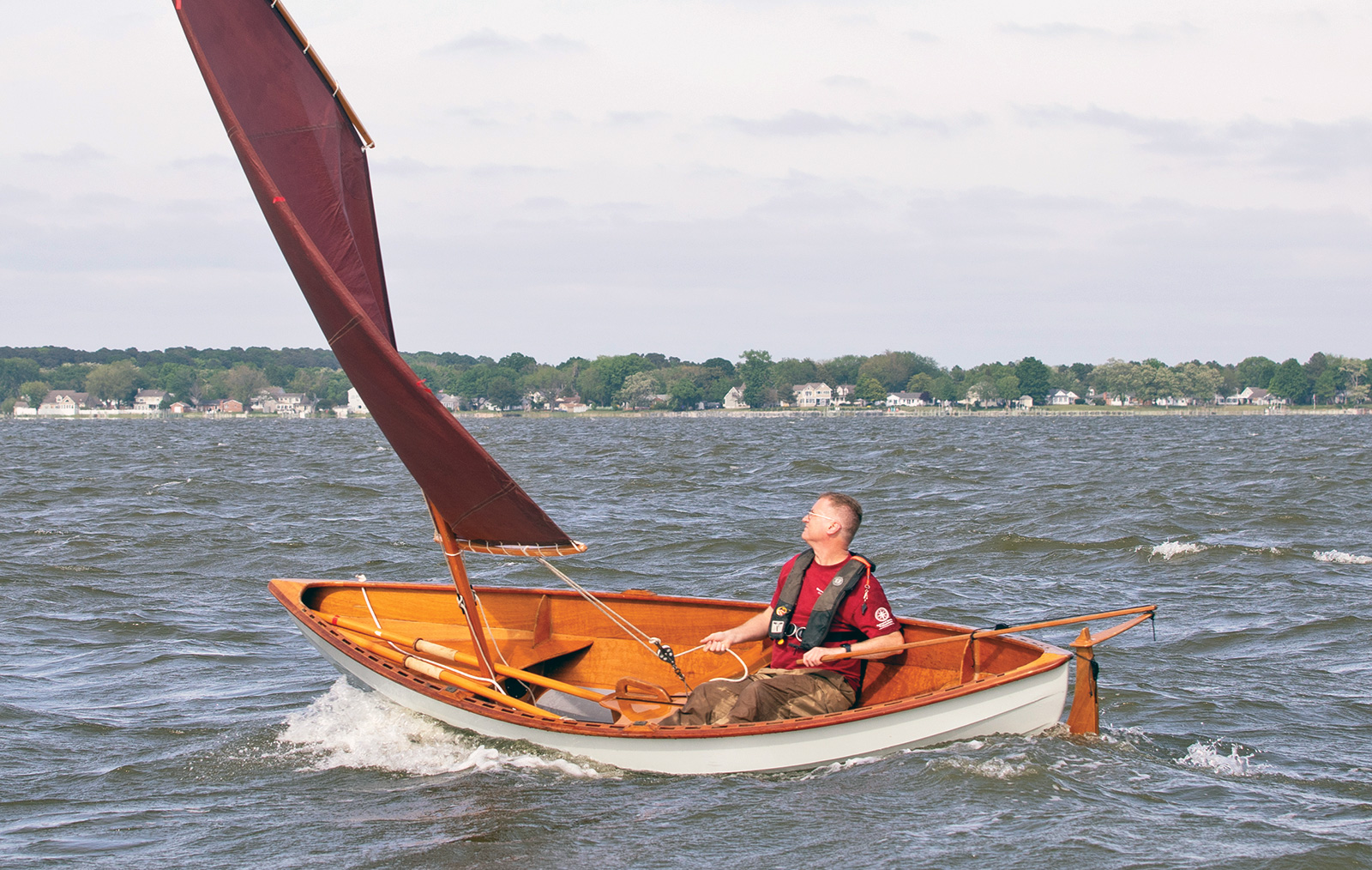
John Harris, shown here at the helm of one of his creations, the Skerry Skiff, has greatly broadened and deepened the kit catalog of Chesapeake Light Craft, the company he has led for 25 years.
In the 25 years that John Harris has owned and operated Chesapeake Light Craft (CLC) of Annapolis, Maryland, the company has delivered more than 45,000 boat kits to aspiring builders in about 70 countries. The company’s offerings have expanded from a couple of easy-to-build kayaks with basic templates, precut parts, and blueprints to 120 designs for paddling, rowing, sailing, and power.
Over the years, customer support has broadened to include robust technical assistance and easy-to-follow instruction manuals and videos. Also, each boat kit includes everything needed to complete a project, which in addition to precut plywood parts can include—depending on the chosen boat—sandpaper, sanding blocks, finishing tools, gloves, paint, varnish, fiberglass fabric, stainless-steel fastenings, cordage and rigging essentials, sails, oars, paddles, vinyl lettering, laser-cut nameplates, brushes, rollers, respirators and filters, mixing cups, masking tape, squeegees, flotation foam, sliding seats, foot braces, oarlocks, oar leathers, trailers, cartop racks, life jackets, a build-it-yourself tool box, safety gear, bailing sponges and pumps, and even waterproof beanie caps, socks, and gloves. It’s pretty much everything except the launching ramp and open water.
Along the way, CLC has built tow-tank models for the U.S. Navy and shipyard contractors; keels, centerboards, and rudders for sailboat manufacturers; airplane parts; computer desks; school woodshop projects; large architectural elements; thousands of scale-model boats; crash-test dummies; surgical masks during the Covid-19 pandemic; and “whatever keeps the CNC machine busy,” Harris says. In 2015, he designed an ultralight marine-plywood Teardrop Camper trailer light enough to be towed by an ordinary car and outfitted for road travel with a queen-sized bed and a tailgate galley. CLC has delivered nearly 1,000 of those kits so far.
CLC has dealer and support relationships with companies in England, France, Germany, Australia, and Japan. The CLC staff hosts weeklong boatbuilding classes in Annapolis; at WoodenBoat School in Brooklin, Maine; and in Washington State at the Center for Wooden Boats in Seattle and the Northwest Maritime Center in Port Townsend. Between classes, the staff stays busy with custom boatbuilding and design commissions. CLC also makes Nutshell Pram and Shellback Dinghy kits for The WoodenBoat Store.

Left—WoodenBoat’s Launchings section mentioned a rowing shell that Harris designed and built as a teenager, which encouraged him to build this, his second boat—a Phil Bolger–designed Teal—before graduating from high school. Right—Harris recalls always building things in his youth, including this tethered glider he developed at age 10.
An Obsession with Boats
Harris’s earliest memories are of his obsession with boats. His father was a keen sailor and PhD engineer at the U.S. Department of Energy’s Savannah River National Laboratory in Aiken, South Carolina. As part of his work, he often traveled to national laboratories, including the one at Los Alamos, New Mexico, and the Lawrence Livermore lab in California. “I’m still not sure what he did there,” Harris says, “but I know he helped build things like the radioisotope thermoelectric generators for NASA’s deep-space probes.” His father also built whatever the family needed at home: furniture, a Heathkit color television, and even an air compressor, which is still in use. “I grew up with the ethic that if you wanted something, you built it,” Harris recalls.
By age 10, Harris was cleared for solo outings in the family’s Sunfish sailboat. He read and reread Robert Manry’s Tinkerbelle and Gerry Speiss’s Alone Against the Atlantic, stories about ordinary people who built small boats and went adventuring. “I was, and still am, absorbed by the notion of building a boat in the garage and sailing away.”
In 1984, the family transferred to Wilmington, Delaware, a seafaring town wedged between the Delaware River and upper Chesapeake Bay. “The libraries and bookstores had robust maritime collections, where I discovered Howard Chapelle, Harold ‘Dynamite’ Payson, Philip C. Bolger, John Gardner, WoodenBoat magazine, and The Small Boat Journal,” he recalls. “When it came to boats, I had the ‘rage to learn’ thing. But, long before it was a familiar diagnosis, ADHD [attention deficit, hyperactivity disorder] wrecked my classroom experience. I could recite long passages from books on naval architecture, but I couldn’t do my homework.” He sketched boats day and night, read L. Francis Herreshoff and William Atkin, and practiced making scarf joints in his dad’s shop.
Harris took up the trombone in middle school. “I was reasonably good at it, and, unlike boat design, music was a sanctioned academic subject.” Good grades in music helped drag his grade-point average off the shoals, but his academic struggles were attributed to his boat obsession. His parents barred him from boatbuilding, which triggered a singular teenaged rebellion: “I secretly cut out parts for my first boat design—a dreadful rowing shell—and hid the parts in the crawl space of the house.” He waited until his parents were away, then dragged the parts into the garage and quickly assembled the hull while calculating—correctly—that his parents would be angry, but not so much as to make him cut up the boat.
The shell floated and could be rowed, after a fashion, with home-built oars and a sliding-seat apparatus he made with furniture casters. WoodenBoat’s Launchings section mentioned the boat, which encouraged him to begin another clandestine project with an “Instant Boat” design from Phil Bolger and Dynamite Payson. When it was finished, he sewed up a cockpit tent and explored the upper Chesapeake, once finding himself sharing an anchorage with small-boat legend Frank Dye in his Wayfarer dinghy.
As high-school graduation approached, Harris reckoned his logical path would be to find a boatbuilding apprenticeship program of some kind. His parents disagreed. The compromise was Washington College along the Chester River on Maryland’s Eastern Shore. The school had a sailing team, a highly regarded writing program, and a music department in need of trombone players. The campus was also near notable boatyards that Harris had read about in WoodenBoat.
Harris regards his classical-music education as a template for functioning in an artistic realm similar to small-boat design. “There’s the discipline—I really did practice for 10,000 hours in the early years,” he says. “Working musicians toil in obscurity but follow a simple formula: If you have chops, you get work. If you don’t have chops, then no work. And it helps to be a decent person. A jerk with chops might be tolerated, but jerks with no chops don’t work.” For Harris, “discipline, chops, and be nice” became a working principle.
“I conjured up a vision of my dream career,” he recalls. “I would design and build wooden boats, but I would need to cultivate some kind of production line to pay the rent. I had no idea what this might be, but the custom-boat-design feast-or-famine cycle terrified me.
“Bolger once remarked that he liked projects for amateurs, in contrast to production boatbuilders, because they have the most interesting design briefs. And the boats actually get built,” Harris says. For Bolger, this was fertile ground for experimentation, but Harris noted that many of Bolger’s published designs were never actually built. Harris saw this as a flaw in the system. Just as he had wanted to compose music and conduct it, too, he had a vision: “I imagined a small-boat atelier where I could design the boats, oversee the prototypes, refine as necessary, and release polished designs.”
In college, Harris built a portfolio of boatbuilding projects, worked as a rigger, and labored by the hour in boatyards. He heeded Herreshoff’s recommendation that design students should do as much freehand drawing as possible to gain an appreciation of proportion, and he spent hundreds of hours developing a coherent drafting style. He built up his chops.
The CLC Connection

Harris worked at CLC as an employee, cutting kit parts on CNC machines, before buying the company in 2000. He also taught himself computer-aided design. Both skills served him well as he refined the company’s cutting processes for a high-end three-axis machine (top left); reimagined the kit components, as for a Wood Duck 12 kayak (left); adapted puzzle-form scarf joints (top right); and heeded customer questions and feedback to clarify CLC’s instruction manuals (above).
Upon graduation in 1994, he landed an $8-per-hour boatyard job. It was a bare-bones operation surviving from one small project to the next, but over in one corner the business was cutting and shipping kayak kits for a Virginia-based company: Chesapeake Light Craft. Harris’s job was to make patterns, cut the parts, and package the kits. Kayak popularity was exploding at the time, and Harris realized that the kit-boat contract was carrying his employer’s business. He thought, “Could this fuel a career as a boat designer?”
In 1995, Chesapeake Light Craft’s founder, Chris Kulczycki, hired Harris to move kit production to a dedicated shop in Annapolis. The margins were good. “Our most popular kayak comprised less than a cubic foot of wood,” Harris recalls. “With epoxy and fiberglass, the kit cost us $288 in labor and materials, and we sold it for $694.” CLC eventually shipped hundreds, even thousands, of kits. Soon there were more employees, and the company bought a big CNC machine to cut the kit parts out of marine plywood panels and keep up with demand. Harris taught himself computer-aided design (CAD) by lofting a Washington County peapod from Howard I. Chapelle’s American Small Sailing Craft.
“Most backyard boatbuilders of the 1990s were resourceful enough to read blueprints and use a scale ruler,” he says. “They were handy with tools and glue.” But the company’s success in courting first-timers meant that they were reaching customers who had never given a thought to building a boat. “For those builders, our kits and assembly manuals weren’t good enough,” he recalls. With the arrival of widespread computer communications, “Customers and potential customers were finding each other on the Internet and comparing notes. We needed to get a lot better.”
In 1999, business remained brisk, and the timing looked good for the founder to sell the company. “I was the general manager and starting to flex my chops to solve the boat-kit design and assembly-manual issues, but it seemed likely that with the sale of the company, I would be replaced,” he recalls. “I was 27 and had about $4,000 in the bank. But CLC’s profit-and-loss numbers looked good, and the market for acquisitions was bullish. I could articulate a clear vision for CLC as a point of entry for amateurs. I found investors, and we bought the company.”
In January 2000, Harris found himself at the helm of his dream job, with plans to “fix the 1990s-era kayak designs and figure out the assembly manuals,” he says.
“Kayaks built CLC,” Harris says. “I love the sleek, sculptural aspects of something that can be built in 80 hours, weighs 45 lbs, can be stored under the eaves of the house, and can be cartopped on a Honda Civic. You can load a kayak with 120 lbs of gear and disappear into the wilderness. Magical stuff.” CLC’s catalog lists more than 50 kayak designs. Pressured to pick his favorites, Harris chooses the Eric Schade–designed Shearwater Sport and the Wood Duck 12, marques that have grossed over $10 million in kit sales since 2005.
He bought a big truck and trailer and took a fleet of CLC samples on the road. “It seemed logical to me that someone undertaking a boatbuilding project might want to get a close look at a demo model first, even try it on the water.” Harris reasoned that if CLC showed up with demo boats in the city where you lived, you were more likely to buy the CLC kit. Early venues were Sacramento, California; Pensacola, Florida; Hopkinton, Massachusetts; and Duluth, Minnesota—and hundreds more were added over the next 20 years. “To my knowledge, no other boat-kit company has ever traveled on such a scale,” he says.
He also revisited his earlier design inspirations, for example with the Northeaster Dory of 2007, a rowing-sailing design 17′ long and weighing 120 lbs that fuses classic dories from books by Gardner and Chapelle. The design has been the most popular kit in CLC’s catalog for years. It was optimized to go together easily in five-and-a-half-day classes and to look good in the process, thanks to refinements such as limiting the number of epoxy fillets. A builder working alone should be able to complete the boat in about 120 hours. CLC has shipped about 1,500 Northeaster kits so far, and there’s a long scroll of options and add-ons for this highly evolved boat.

Eric Schade’s design for the Shearwater Sport.

Kayaks were a natural fit for boat-kit projects early in CLC’s history, and Eric Schade’s designs for the Shearwater Sport (top), Petrel (right), and Wood Duck 12 (bottom left) have been among CLC’s most popular boats. With their light weight, they are easily cartopped and launched; the top left photo shows a Wood Duck 12 on the ground and a Wood Duck 10 slung over a shoulder.
New Obsessions: Instructions and Marketing
Harris recalls that improving assembly manuals for CLC’s catalog of designs became “a defining challenge.” He put together a team to write new manuals from scratch. “And that was my first big mistake,” he says. “Turns out, no one wants to read about how to build a boat. They want pictures and diagrams. Lots of them, and good ones too.”

Under Harris, CLC has had ambitious class, workshop, and demonstration schedules. At the 2012 WoodenBoat Show at Mystic Seaport Museum in Connecticut (left), 16 families built glued-lapstrake 16′ Sassafras double-enders from kits over three days. CLC regularly displays a variety of boats at the Port Townsend (Washington) Wooden Boat Festival (right).
The first wave of improved manuals felt text-heavy to Harris and his customers. Meanwhile, the sales growth and technical-support pressure kept outpacing CLC’s ability to staff up. Harris poured time and money into better guides, but progress was incremental. It was enough to aggravate investors but not enough to stay ahead of customer needs and expectations.
“A great assembly manual is a tricky thing,” Harris says. He cites the example of a manual the company created in 2002 for the Arctic Hawk, a beautiful stitch-and-glue kayak designed by Mark Rogers: “People wanted detail, so we gave them a 450-page manual, with 1,600 staged photos.” The effort cost $100,000, and it was an “abject failure,” according to Harris. “The hull wasn’t assembled until page 100. The deck wasn’t installed until page 200. Customers told us that they got bored and found something quicker to build.” Few Arctic Hawks were completed, and the design found no traction in the marketplace.
The lesson learned was that projects for first-time builders need to be accessible and achievable in a realistic time. The best manuals are illustrated, not written, which calls for professional photography, clear line art, and an obsession with concise, careful caption-writing.

At the CLC headquarters in Annapolis, Maryland, classes focus on specific designs, including the popular Teardrop Camper (left) and the 15′7″ Skerry Skiff (right).
Harris illustrates the challenge with a sentence from an early CLC manual:
Wait for the epoxy to dry, then move the side panel assemblies to sawhorses for the next step. “Epoxy doesn’t dry. It cures, and if you move the part too soon, the bond might fail, and now you have an angry customer,” Harris says. He reprinted the manual with curing in place of drying. But epoxy has a hard time curing in a 50-degree, wintertime garage. More customer question calls followed…and then it was back to the document to rewrite the text to read, Allow the epoxy to cure for 24 hours at 70 degrees F, then move the side panels.…
“Ah, but you aren’t done,” Harris says. The next page might direct builders to apply a coat of clear epoxy resin and allow it to cure for 24 hours at 70 degrees F. “Great,” Harris says, “but some first-time boatbuilders will just brush on epoxy resin…without mixing in the hardener.” Reprint the manuals to read, Mix epoxy resin and hardener, without fillers, and then apply a second coat of epoxy, and allow it to cure for 24 hours at 70 degrees.
“Eventually we found an artful balance,” Harris says. “And you have to be incredibly patient. I’ve wondered if creating assembly manuals is punishment for something terrible I did in a past life.”

CLC’s numerous small sail-and-oar boats include the new 13′5″ Lighthouse Tender Peapod (left); the 7′9″ Eastport Pram (top right); the 18′10″ Southwester Dory (bottom right).
Harris’s initiatives took longer and cost more than expected. He recalls an investor remarking: “You’re in a niche that’s about an inch wide and a mile deep.” The investors were patient, but they wanted to trim costs, and in the early 2000s the cuts took the legs out from under CLC’s growth. In December 2004, Harris was able to convert investor ownership into a loan agreement. “They deserved better returns than they got, but CLC is an odd little business, and I just never generated private-equity-type returns,” Harris says. By 2010 he had paid off the loans.
This investment in what Harris calls “the builder experience” is expensive. “The folks at CLC doing kit design and development and prototyping and assembly manuals aren’t working for free, and if a new design is fun and a lot of them get built, it’ll be the result of a lot of things you didn’t think about.”
Harris says that he is flooded with ideas and proposals for new kit boats. “Releasing a new boat kit is maybe 5- to 10-percent design work and prototyping. The rest is figuring out how to manufacture the kit affordably and creating explicit instructions for assembly. By the time a newly designed kit is packaged for shipping, product development costs are into six figures,” he says. “We have to move a lot of those kits to amortize those costs.”

The 10′ Tenderly Dinghy (left); and the 10′ Lake Union Swift (right), designed as a variant of the Tenderly for The Center For Wooden Boats in Seattle, Washington.
CLC’s best-selling kits tend to have long gestations and the best assembly manuals. Those costs add up and somehow must be accounted for in order to stay in business, which brings us to the “Harris Rule,” a principle he developed early on: “You aren’t going to sell many kits if there’s something similar, cheaper, and already built for sale on Craigslist.”
Using solid wood, as opposed to plywood, is an obstacle to simplifying assembly and keeping costs down. “Sourcing timber in the kind of industrial quantities CLC needs has always been a major challenge, and the bending characteristics of solid timber vary,” he says. “Take two stitch-and-glue kit boats that have cypress sheer clamps, for example,” Harris says, “and one pair of sheer clamps is drier or has more vertical grain. We’re not building over a mold or strongback, so one boat is going to form up into a different plan-view shape than the other boat. The bulkheads fit in one boat but not the other, and now that’s a tense email or a tech call.” The CLC solution is to engineer stitch-and-glue kits so they don’t depend on the various bending characteristics of solid wood components—and to limit millwork that can’t be done quickly and efficiently on a CNC machine.
To that end, CLC has kept pace with advances in kit-boat technology. They’ve developed and trademarked a new and simpler “LapStitch” approach to lapstrake construction by combining stitch-and-glue techniques. In the LapStitch process, the plank shapes of a traditional hull form are unwrapped in CAD, as with any modern stitch-and-glue hull, but with the refinement of the plank overlaps being machined on the CNC table. The planks are wired together through predrilled holes so they neatly interlock, and the hull pops into its 3D shape with the help of a couple of bulkheads. Epoxy is injected into the plank seams, and when it has cured, the stitches are removed. Thus, the LapStitch hulls are as stiff as any glued-lap design.

Harris built on the success of CLC to expand the company’s line, which ranges from rowing boats such as the 17′9″ solo Annapolis Wherry (top left) and behind it the 17′ Northeaster Dory; the 18′5″ cruising canoe yawl Autumn Leaves (bottom right); the 15′2″ Peeler Skiff (bottom left); and the 14′9″ runabout Rhode Runner (top right).
By the year 2000, when the Skerry was designed, the CLC design team had refined the LapStitch method of building lapstrake plywood hulls. According to Harris, “The Skerry is just good at everything: elegant, quick to build (120 hours, give or take), and affordable. She’s that very rare boat that rows as well as she sails. In basic trim the interior is spartan, but it’s easy to dress up with inwales and alternate rigs. About a thousand of them are afloat. These days a Skerry is $4,000 for a sailing version—cheaper than a Sunfish.”
Harris says that he is not concerned that anyone might try to duplicate the method. “The LapStitch thing is full of hairy details that took us decades of repetition and heartburn to sort out.”
Over the years, Harris has broadened and expanded his catalog, with everything from a boat inspired by the traditional proas of the Pacific islanders to an interpretation of a thousand-year-old Viking Age boat. One recent addition is his re-envisioned reinterpretation of a Maine double-ender.

Harris has taken on serious experimental design and kit-creation challenges. The best examples of these are the 22′6″ Faering Coastal Cruiser (bottom left); the 18′7″ Guider (top right) for performance coastal cruising and “raid” sailing; the 30′8″ Madness Pacific Proa (bottom right) for fast cruising; and the 25′4″ CLC Gislinge Boat inspired by Viking Age craft (top left). All require experience to build, and all pushed the envelope of kit-boat development.
In fact, Harris thinks his Lighthouse Tender Peapod, 13′5″ long, represents the state-of-the-art in DIY kit boats. It’s elegant, stiff, quick, and fun to sail or row. Harris designed her to match the looks and functionality of the classic Maine lobstering and lighthouse-tender boats, which were robust, stable, and steady enough for lifting lobster traps over the rail. “The 250-lb Lighthouse Tender Peapod won’t skitter out from under you at the dock,” Harris says. “It’s the first time I’ve ever deliberately made a boat heavier.” For the builder, everything is there—IKEA-like parts with predrilled holes for wire stitches, planks with puzzle joints to assure alignment, and bulkheads tabbed and slotted to fit into place. “You don’t need to own a tape measure, much less a scale rule, to build this boat,” Harris says. There’s a choice of a single lugsail or a cat-yawl rig. Kits start around $3,000; sailing-component kits will more or less double it.
Perfecting the Chops
When asked about CLC’s future, Harris points to spiraling costs of shipping and materials. “Bigger and more complicated designs aren’t going to be the answer.” He remains dedicated to the “Harris Rule,” that any boat kit project must represent a better value than something in the used-boat market. “Most amateurs building wooden boats in 2026 are doing it for the journey. Because it’s fun. But they’ll still do that calculation, especially if the kit is expensive,” he says. “That’s how we decide what goes in the catalog. The design has to be either a great value or there’s just nothing like it out there.”
“People want capable, lightweight boats that fit on trailers and can be towed by small cars—power and sail in particular,” Harris says. “Good thing we’ve been designing those for decades.” There are electric boats in the pipeline, and CLC has partnered with several motor and battery manufacturers already. “And we’re building tons of video content. I think we all work for YouTube now.”
The biggest headache? “Email,” he says. “That’s how most people get in touch—10, 20, 30 emails a day. And for about 15 years I could keep up by working night shifts on top of the seven-day work weeks.” Then came marriage, parenthood, and getting older. “I hate it when a company doesn’t respond to my email. It’s not nice, right? But even with all these smart people at CLC answering most of the email, I was still at the computer until 11 p.m., trying to keep up. Email on weekends, email while on vacation, email when my three-year-old wanted to play. About 10 years ago, I had to start triaging.

For Harris, getting on the water—as he is here at the helm of a Skerry Skiff—is crucial to continual experimentation.
“I’m proud that I’ve helped people build their own boats,” Harris says. “People have been incredibly kind. I get photos from all over the world. Many say they were sad when they finished the project because they missed coming home to work on the boat every evening.
“I’d like to think that if you stripped away the millions of marketing dollars, the acres of ad copy, and you ignored my talking YouTube head, and just pinned my designs up on a wall, someone would walk by and say, ‘Look at that. Nice work! This one has chops. And I hear he’s a nice guy, too.’” ![]()
Joe Evans was a sail designer at North Sails before building performance boats, including designs by Bruce Farr, German Frers, and Rob Humphreys. He subsequently produced films and articles for National Geographic, CuriosityStream, HBO Max, and various fishing and sporting magazines. He served as editor-in-chief of Chesapeake Bay Magazine. He has also been an Orvis-endorsed fly-fishing guide on Chesapeake Bay.
Chesapeake Light Craft, 1805 George Ave., Annapolis, MD 21401; 410–267–0137; www.clcboats.com.