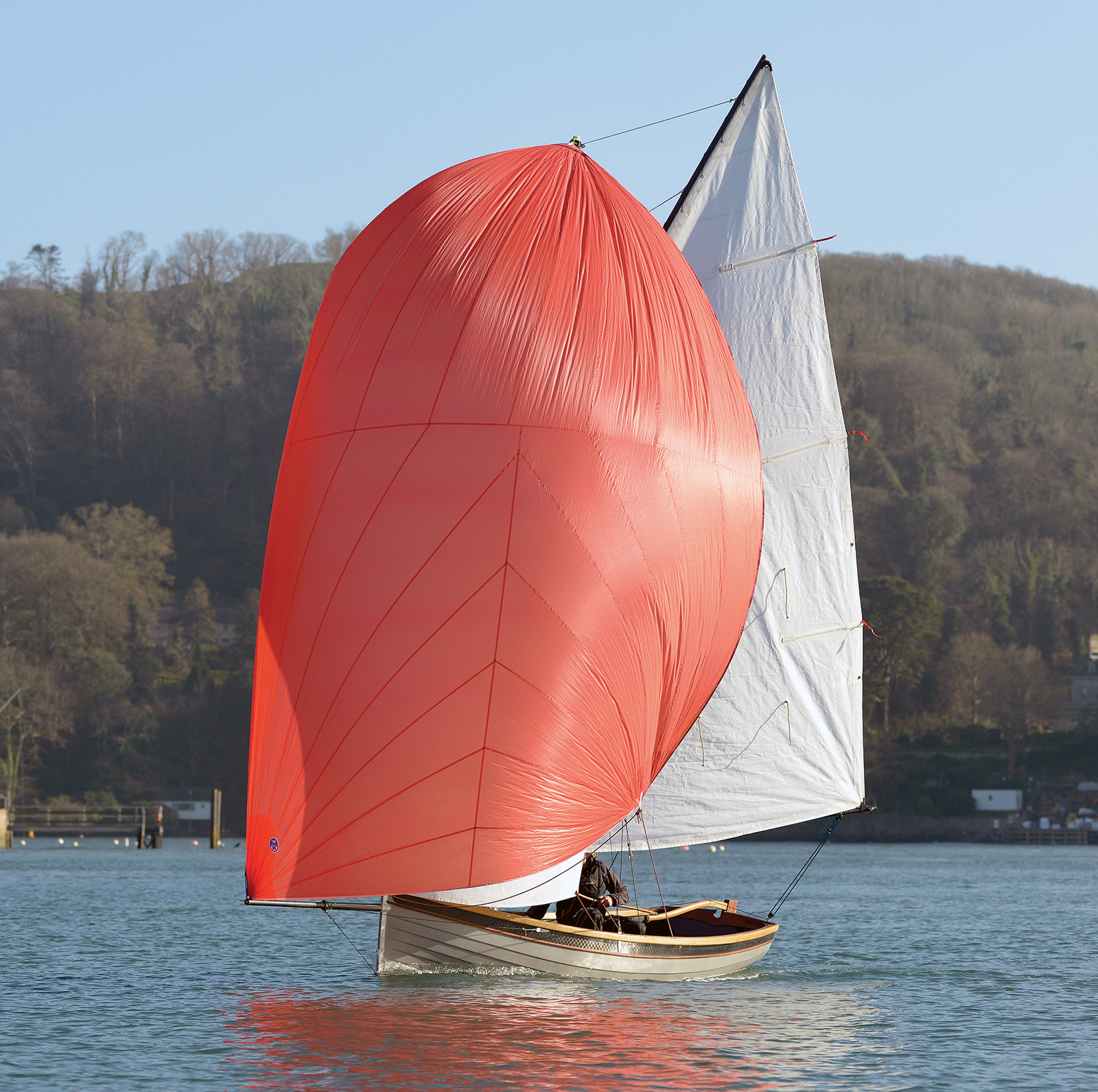
The 15′ dinghy RÆDWALD achieves high performance under a traditional gaff rig.Nic Compton

The 15′ dinghy RÆDWALD achieves high performance under a traditional gaff rig. Here she displays her maximum sail area, which includes the jib of a Wayfarer dinghy and the 300-sq-ft spinnaker of a B14 dinghy.

Thirteen point nine knots. That’s the top speed Sam Doman has so far recorded on his newly launched 15′ dinghy, RÆDWALD. It’s surely some kind of record for a gaff-rigged dinghy, if you exclude Australia’s 18′ Sydney Harbour skiffs, which regularly clock speeds of 15 knots and more. Even the gaff-rigged sandbaggers of New York, with their huge sail areas, only occasionally reached that speed, and they can hardly be described as dinghies.

A slightly simplified version of the designPete Weller

A slightly simplified version of the design is currently being developed as a CNC-cut kit.

“When I built the boat, I wanted to be able to do 15 knots,” Sam says. “My unofficial target was to be the fastest gaff-rigged boat built outside Australia.” While he reckons that the Sydney Harbour skiffs are “pretty untouchable,” he aspires to “beat the round-Britain record for an open boat, which at the moment is 15 days. That’s an average speed of just over 3 knots. It’s quick, but I think it’s not unbeatable.”

If Sam sounds like a young man in a hurry, that’s because in many ways he is. Speed was his main focus when designing RÆDWALD. But there was something else: Sam is a keen dinghy-cruiser and wanted a boat he could stick a tent over and sleep on. He wanted a boat that would be strong enough and—crucially—stable enough to sail around Britain, which includes some of the gnarliest coastlines in Europe.

It sounds as if those requirements—speed, seaworthiness, and comfort—should be incompatible and yet, probably because he’s young and doesn’t always play by the rules, Sam seems to have achieved the impossible. What’s more, he’s done it while sticking to his preferred genre: a wooden boat with a traditional rig.

When I first saw the videos of RÆDWALD planing along under spinnaker, with Sam’s girlfriend, Jess, leaning out on a trapeze (yes, a trapeze on a gaffer!), my first thought was, why not just build a modern planing hull and be done with it? Even when I came face-to-face with the boat and was duly impressed by the quality of Sam’s workmanship, I was still thinking maybe he’d mixed up his priorities. Out at sea, the lack of wind and big swell made it hard to get a sense of the boat’s real character. It was only when we came into the calmer estuary and I saw her sailing serenely, and at considerable speed, in the evening breeze that I realized that Sam’s quest for speed had also resulted in a boat that performs very well in light airs. When I eventually joined him aboard, I saw that his desire for all-weather performance had also produced a boat that is extremely comfortable and pleasant to sail. It’s a remarkable achievement for a first design from someone with no formal qualifications in the subject.

Prototype model.Sam Doman

The designer, Sam Doman, made 12 models before building the prototype.

Sam has long had his feet in two camps, with a lifelong appreciation of both traditional and modern boats. Brought up in Woodbridge on the East Coast of England, he started sailing when he was eight. While his father raced Merlin Rockets and Flying 15s, Sam started out on Optimists and Mirror dinghies before graduating to high-performance boats such as B14s and 49ers. It was in these that he learned how much fun you could have on a trapeze. Meanwhile, like every boat-mad East Coast boy worth his salt, he was being inculcated into the world of smacks, bawleys, and Thames barges. It was in these that he learned about the beauty of traditional rigs and became a passionate advocate of the gaff rig in particular.

This well-rounded approach to sailing continued into adulthood, with a course in boatbuilding at the International Boatbuilding Training Centre in Lowestoft, 37 miles north of Woodbridge. He then served as crew aboard the three-masted schooner CREOLE—said to be the largest wooden boat in the world, with a sparred length of 214′ and LOD of 190′—followed by an adventuresome voyage on a 120′ ferro-cement ketch in Papua New Guinea and the Philippines. Smaller boats were, however, always his passion.

“At heart, I’m a dinghy sailor,” he says. “I’ve always enjoyed sailing dinghies and small boats the most. You’re closer to the water, and you have more of a connection with the boat. The bigger the boat gets, the less involved you are in the actual sailing.”

When the renowned East Coast author Robert Simper approached Sam to take a mold off his 1950s barge tender, Sam jumped at the opportunity. The idea was that they would have a boat each, and Sam could then build the boats commercially if he wanted to. The result was the 13′10″ LONGSHORE, which Sam built in 2019 and, just for fun, fitted with a rig. He still sails the boat most summer days when he’s at home, in any weather, and regularly sleeps aboard while tucked up in some muddy creek on the River Deben or the nearby River Orwell.

Barge boats were built as beasts of burden to carry crews and provisions to and from barge to shore under oars; they were not designed for sailing or for speed. With their plumb stems, slab-sided topsides, and short ends, they look every bit like the workboats they were intended to be. Which is why Sam was surprised to find that, if the wind was strong enough, his boat could be induced to plane. And that got him thinking.

“I really enjoyed sailing her,” he says, “and she kind of did everything I wanted her to do. But I just thought, how could I make her sail better and be more versatile? So, I stretched out her shape and then looked at it and thought, ‘I want it a bit flatter here, a bit fuller here, a bit finer here.’ At each step I made a few minor adjustments until I was happy with the shape. It didn’t all happen in one go. I had the idea of a boat I wanted to build a few years ago, and I suppose I’ve been designing it in my head ever since. So, I knew what I wanted it to look like.”

Although Sam is a confident sailor and boatbuilder, his skills didn’t extend to operating a CAD program. Each stage of the boat’s evolution was therefore developed by making scale models out of cardboard or modelmaker’s plywood. Sam reckons he made a total of 12 models, culminating in a full-sized half model “just to make sure everything was fair.” It was a massive amount of work before he’d even cut a single plank, but it allowed him to develop the hull shape in a visual and tactile way, which ultimately saved him time in construction, since he had a full-sized mock-up for reference.

A full-sized half-model.Sam Doman

Sam built a full-sized half-model to ensure that the plank runs were smooth.

“The new boat is almost 18″ longer than LONGSHORE,” Sam explains. “She’s got a much finer bow over a plumb stem, which really helps her, especially sailing upwind. The shape goes from a fine bow and flares to really full shoulders quite quickly, which generates a lot of lift and gets her up on the plane. The midsection’s flatter, which aids with planing and stability.” The result is a “buoyant hull, which carries weight well. The stern is slightly more pinched than the old boat, which reduces drag at displacement speed.”

The box-sectioned keel.Sam Doman

The box-sectioned keel, which is sheathed with carbon fiber, gives extra rigidity.

The boat’s construction was similarly uncompromising. Bearing in mind his stated ambition to set a new round-Britain record in an open boat, Sam wanted to build a boat capable of taking the worst that would be thrown at him by the North Sea; the Pentland Firth, a notoriously dangerous strait between Scotland and the Orkney Islands; the Atlantic Ocean; the Irish Sea; and the English Channel. He decided to reinforce the boat’s hull with carbon fiber, arriving at a composite structure of plywood, carbon fiber, fiberglass, solid wood, and ample epoxy.

The boat’s deep forefoot.Sam Doman

The boat’s deep forefoot is a distinctive feature partly inspired by barge boats.

It’s certainly an impressive and bullet-proof structure, with a hollow keel made of 12mm plywood, and 6mm plywood planking. The keel and garboards were sheathed with carbon fiber, along with the sheer plank, the transom, and the hull interior from gunwale to gunwale on either side of the maststep. Metal fastenings were eliminated except for the bolts holding the maststeps together. The whole hull exterior was then sheathed with fiberglass set in epoxy. The result is a carbon-fiber-reinforced framework that not only protects against impact collision but also improves the boat’s longevity. Ultimately, it also aids sailing performance because it allows the rig tension to be maximized.

The stepped lapstrake planking.Sam Doman

The stepped lapstrake planking is probably a first for a gaff-rigged dinghy.

For another level of safety, the bottom of the boat is double-skinned, providing extra buoyancy as well as housing tanks for water ballast—which adds an extra 154 lbs (70kg) of weight when required. Perhaps not surprisingly, given Sam’s style of sailing, he’s barely used the water ballast, but others might find it reassuring in windy weather.

Crucially, the reason for using lightweight materials wasn’t to make a light boat. Rather, it was to add strength and effectively overbuild the structure, while keeping the weight moderate. In this, as in other aspects of the design, the Wayfarer set the benchmark not just as one of the most successful dinghy-cruisers ever designed but also due to the fact that all three records for sailing around Britain in an open boat have been set by Wayfarers. By comparison, RÆDWALD weighs 353 lbs (160kg) all up, just 20 lbs (9kg) lighter than a Wayfarer, which is 10″ longer.

“I think this shape needs a bit of weight behind it to sail well,” Sam says. “If she’s too light, she bobs around a lot. I wanted to keep a bit of weight in the boat and have a finer bow, to help her sail upwind.”

But it wasn’t all about strength and performance. It was also about aesthetics and having a bit of fun. Maybe even ruffling a few feathers along the way.

“I used a special tow-weave carbon fiber around the gunwale because it’s a lightweight cloth that doesn’t absorb too much epoxy, but it’s quite impact-resistant. It’s also pretty. It looks like a chessboard. It’s an aesthetic thing. I wanted the boat to look quite modern, even though it’s a traditional design with a traditional gaff rig.”

Elsewhere, for example on the transom, he used a chevron-twill weave, which is heavier but stronger than the tow weave, to provide a solid base for the rudder and, perhaps, an outboard motor. Even the wooden quarter knees are reinforced with carbon fiber, for decorative reasons as much as for strength. And there’s something I’ve never seen before: Sam used filler to create small “steps” on the five bottom planks, filling the gaps created by the lapstrake construction, in the style of a stepped speedboat. The jury is still out on whether this has actually added any extra speed.

Above all, Sam wanted the boat to sail well, to be an ambassador for his beloved gaff rig, which he thinks is often unfairly maligned.

The RÆDWALD’s trapeze.Nic Compton

Sam’s background racing modern dinghies is evident in the RÆDWALD’s trapeze, which might outrage traditionalists but helps the boat reach its 15-knot target speed.

“If you look at a lot of traditional-style dinghies, they don’t tend to have great pointing ability,” he says. “I think a lot of that comes down to the cut of the jib. Wayfarers go well upwind, and the headsail is the first point of entry, so I knew that was a good starting point. And if you’ve got a nicely shaped jib, obviously it helps with flow over the mainsail.”

Sam duly bought an off-the-shelf Wayfarer jib and roller-furling system and used these as the basis for RÆDWALD’s rig. I should say “rigs,” because RÆDWALD has five different set-ups. Four of them use the same wooden mast (borrowed from LONGSHORE) combined with spars mostly made from repurposed windsurfer masts, in a variety of configurations:

  • Sloop: gaff mainsail combined with the Wayfarer jib, using the aft maststep;
  • Catboat: gaff mainsail without jib, using the forward maststep;
  • Lugger: the same gaff mainsail rerigged as a balance lug without a jib, using the forward maststep;
  • Yawl: the balance-lug rig set up with mizzen and optional jib set on a bowsprit;
  • Sporty: carbon-fiber mast and big mainsail, with the same Wayfarer jib as the sloop but set fractionally instead of from the masthead.

Sam has repurposed a 150-sq-ft RS400 spinnaker, which can be flown from the masthead of the short mast or fractionally from the tall mast. For maximum effect—and to reach that 15-knot target—he has also repurposed a 300-sq-ft B14 spinnaker, which he flies from the top of the carbon-fiber mast. And that’s not to mention the topsail. As he puts it: “No wonder this boat has so many bits of string!”

RÆDWALD’s interior.Nic Compton

RÆDWALD’s interior is extremely spacious, although quite a lot of string is needed to cater for the five possible rig configurations.

Sam reckons the yawl rig is probably the best all-rounder, especially for dinghy-cruising, because having the sails at either extremity makes the boat very maneuverable, while clearing space between the masts. For camping purposes, he’s made a set of carbon-fiber hangers that hook around the deep-set gunwales and will support a canvas sleeping platform. He has also designed a tent that can be either fitted over the boom, when in single-mast mode, or slung over a line stretched between the two masts when in yawl mode.

In fact, there isn’t much Sam hasn’t thought of, and the boat is full of nice little details, such as carbon-fiber tubes that drain any errant water from the forward locker into the bilge; similar tubes serve the side benches, which drain into the self-bailer sumps. The seats themselves are covered with a layer of EVA closed-cell foam, which is comfortable to sit on and feels particularly nice underfoot.

Our test sail didn’t quite go as planned. First, we had crossed wires about the meeting place, so Sam arrived two hours late, having had to tow the boat through several miles of narrow lanes and then onto a ferry across the River Dart. No sooner had he arrived than the fresh breeze that had been blowing solidly for three days vanished, leaving a much gentler breeze and, once we got outside, a lumpy swell. Then the halyards got in a tangle (all those bits of string!) and Sam was unable to raise the topsail, which mortified him though it didn’t bother me a bit. For a real gaff aficionado, the topsail is the rig’s master stroke, whereas to me it’s just icing on the cake (and sometimes I prefer my cake without icing).

Testiing RÆDWALD.Nic Compton

There wasn’t enough wind to get RÆDWALD on plane during the author’s test, but the boat coped well in the nasty swell running across Start Bay.

But it didn’t matter at all. The wind wasn’t enough for planing, but I had seen videos showing that aspect, so I already knew she was fast. And I could see she coped well with the ugly swell that was throwing us all around. I was, however, impressed by the boat’s buoyancy when Sam deliberately capsized her to sort out the halyards and, once he released her, we discovered she was virtually self-righting.

The deliberate capsize was a first for me on a photo shoot. But the magic really happened when we gave up all hope of getting the boat on plane and sailed back into Dartmouth Harbour. There, the water was flat calm, and the breeze funneled down the headland, pushing RÆDWALD along on a broad reach. Even without any water ballast, the boat stayed bolt upright, thanks to the considerable form stability. And, of course, Sam sailed her to perfection. I don’t think she broke any records at that moment, but she looked as pretty as a picture. For although speed is an important trait in a boat, beauty and character also play important roles.

Stepping aboard RÆDWALD, there’s a feeling of generosity in that wide beam and open seating. Sam has been careful to keep the interior uncluttered, and this shows in how easy it is to move around. Sailing her takes a bit of getting used to, because that deep forefoot means she doesn’t spin around like a modern dinghy or even a Wayfarer. You have to sail her through each tack with a bit more attention than most of the boats I’ve sailed recently. The benefit is that she tracks beautifully and is fast off her marks even in the light breeze we had that evening.

RÆDWALD is exceptionally versatile and user-friendly.Nic Compton

Is RÆDWALD a new boat with old ideas, or a new spin on an old concept? Regardless, Sam has mixed it up and produced a boat that is exceptionally versatile and user-friendly.

Sam’s original plan was to take molds off the prototype, which he has done, so he could build the boat in fiberglass, but he has become increasingly enthusiastic about selling plywood kits for home-based builders. A lucky connection with a tutor, Pete Weller, at Falmouth Marine School has made that possible, and Sam was just on his way back from delivering the molds and demonstrating RÆDWALD when he called by to see me.

Pete is now transferring Sam’s hand-drawn lines to CAD and developing the design into a kit that can be CNC cut and shipped to clients in the United Kingdom or potentially cut by local CNC facilities anywhere in the world. There will be a few subtle changes to the original: the nicely curved bulkheads will be replaced by flat ones, and the after buoyancy tank will go away completely. But the hull shape will be the same. Sam doesn’t, however, expect or even recommend that amateur boatbuilders slap around the carbon fiber the way he has. In nearly all cases, simply sheathing the hull, or even just the bottom panels, with fiberglass set in epoxy will provide ample strength—and make the boat lighter. At which point those ballast tanks might come in useful after all.

RÆDWALD’s success hasn’t happened by accident. Sam has drawn on years of experience and intense visual study—not necessarily formalized in the form of a degree in naval architecture, but very knowledgeable nonetheless—to create the best boat he could. And yet, I can’t help feeling there’s something fortuitous in the way his hunger for speed and adventure has produced a boat that could work equally well for family sailing. It feels almost like a sleight of hand, or some piece of wizardry I can’t quite figure out. Regardless, I’m just happy to enjoy the magic.  Article ends.


Nic Compton is a contributing editor for WoodenBoat.

For more information visit www.modernclassicboats.com.