
 Artisan Boatworks
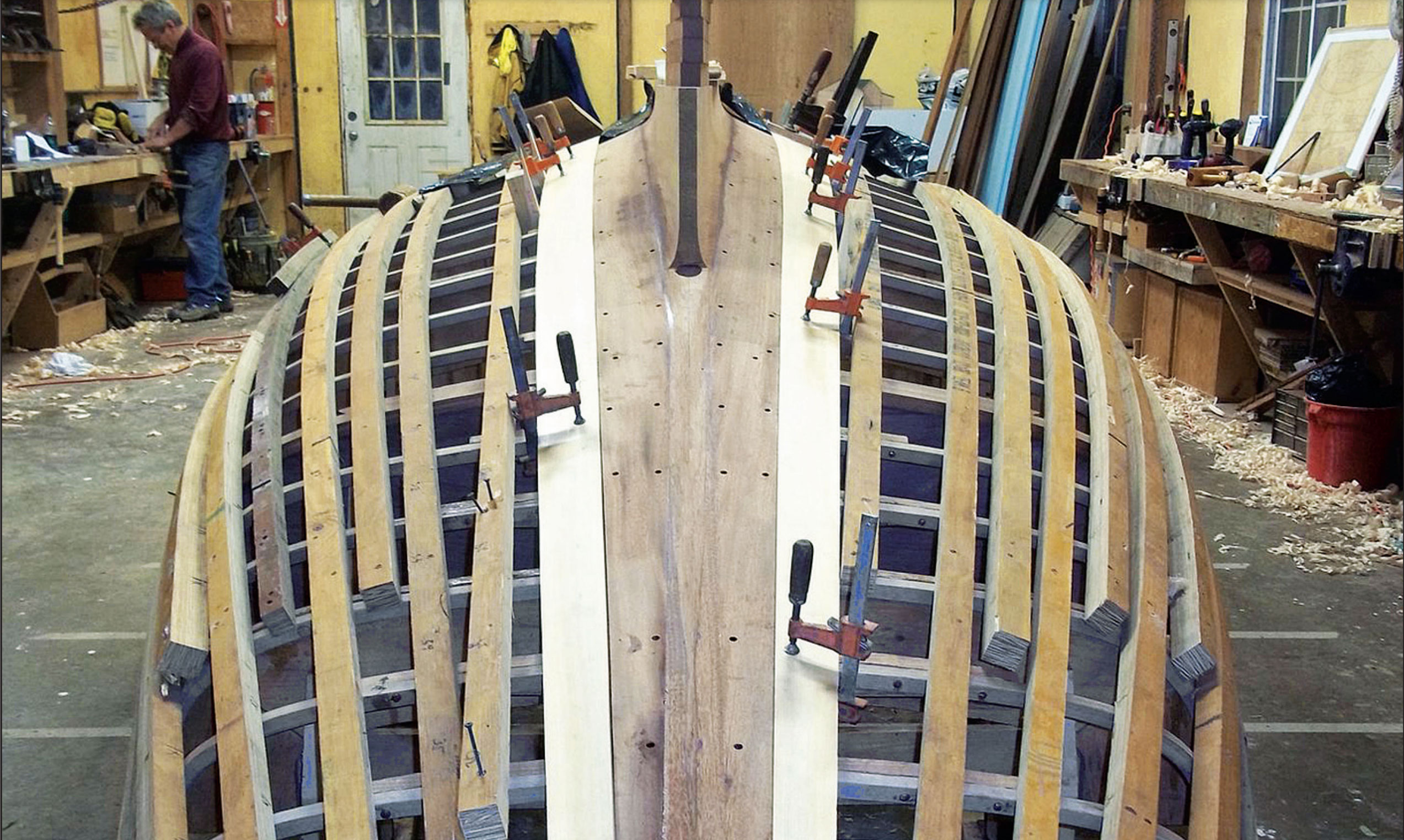
Artisan Boatworks of Rockport, Maine, has built a fleet of fine daysailers whose cedar planks are glued together rather than caulked and payed. The Buzzards Bay 15 pictured above has its mahogany garboards glued and screwed in place, and the first broadstrakes, of northern white cedar, are fitted and about to be fastened.
The daysailers built by Artisan Boatworks of Rockport, Maine, are planked in a seemingly common manner, with a single layer of fore-andaft cedar screwed to closely spaced oak frames and floor timbers. But the conventional aspects end there, for instead of being caulked in the usual way, with a strand of cotton driven into a beveled plank seam and covered by putty (Figure 1), the planks of these boats are simply glued together, edge-to-edge (Figure 2).
I recall the first time I saw one of Artisan’s boats built in this manner. It was at a late-winter boat show in 2008, and the boat was a newly built, yet-to-be launched Watch Hill 15 named KITTY. Her topsides were blue a difficult color because it shows up imperfections so easily—and there were no flaws to be seen in her topsides or bottom. Despite KITTY’s superb finish, I was startled by this bold departure from conventional caulking. After all, the tried and true method of caulking and puttying (aka, “paying”) is meant to allow for wood shrinkage when the planking dries: The seams might open up a bit in the event of such shrinking, but they’ll reliably come back together when the boat is launched and the planks swell tight. If you restrict their ability to shrink by gluing the planks together, the logic goes, the planks might well split when they dry out due to the resulting tension. There’s ample anecdotal and engineering evidence to prove this, and so I wondered what this boat’s hull would look like after several seasons of cycling between wet summer service and dry winter storage.