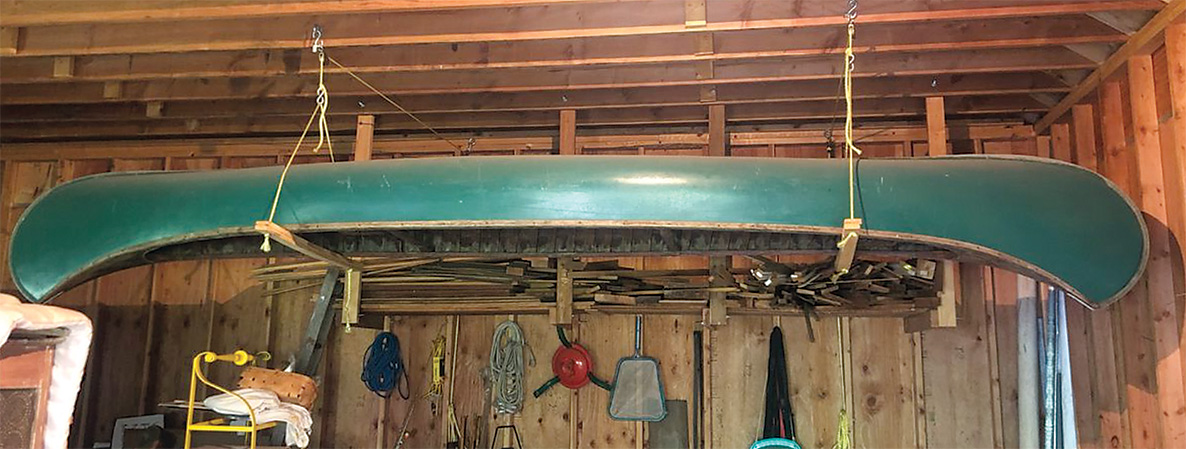
The 1929 canoe inside the barn.Greg Hatten

The 1929 canoe as the author first saw it inside a barn in his hometown of St. Joseph.

When the barn door swung open, I saw the vintage, dark-green canoe suspended upside down from the joists in block-and-tackle slings. The only thing missing was a blinding light and a church choir singing the “Hallelujah Chorus.” My visit to the barn in St. Joseph, Missouri, was intended to be a boatbuilder’s “house call,” in response to the request of a friend to have a look at an old wooden boat and render an opinion before a fast-approaching estate sale. This was easy—my opinion, upon first glance, was, “I must own this canoe.”

Alone in my truck on the drive to the barn, I had reminded myself (in case I had a Hallelujah moment) of all the reasons that I didn’t need another boat. On the drive away from the barn, I made a list of reasons to justify the acquisition of another boat I did not need and had no room to store. As usual, when it comes to wooden boats, “want” trumps “need” and “heart” rules over “head.”

It was a 16′ canoe built by one of the oldest manufacturers in the United States, Old Town Canoe Co., which was named for the town in Maine where it was founded. I could tell from the holes in the bottom, the cracked ribs, and the rotten leather straps in the paddlers’ seats that it hadn’t been used in many years. I could also tell that at one time it had been a showpiece, with red-tinted cedar strips, a white-oak stem, and mahogany gunwales, all of them weathered, worn, and slightly warped with age and neglect. What I could not tell, and no one in the family seemed to know, was how in the world a boat that was built in an East Coast boatshop 1,600 miles away ended up hanging from the joists of a barn in St. Joseph, my home town.

I bought the canoe, hauled it home, and launched a scavenger hunt to uncover its history and learn about the adventures this canoe had had along the way before being retired to the barn.

The author paddles the Old Town canoe.Lura Landis

The author paddles the Old Town canoe on the Platte River at Rochester Falls, Missouri, in October 2024, just after completing his restoration.

A Town in Missouri

St. Joseph is a historic little river town on the banks of the Missouri River with important ties to the past, most notably as a rendezvous for the 1804–06 Lewis & Clark Expedition, a primary launching pad for the Oregon Trail covered-wagon route to the west, the home of the Pony Express, the site of Jesse James’s death, and the birthplace of Walter Cronkite. In the 1800s, steamboats and ferries were the predominant boats of the “Muddy Mo,” shuttling pioneers, gold miners, and soldiers on the Missouri as part of their journeys west. Canoes, early in that era, were mostly dugouts of Osage orange wood, built and used by Native American tribes, trappers, and traders for transportation, hunting, and fishing.

The Missouri River is the longest river in North America and the primary body of water in northwest Missouri. By the time the river reaches St. Joseph from its headwaters in Montana, it has already wound its way through almost 2,000 miles of the high plains and sand hills of the Dakotas and through the prairie grass and loess bluffs of Iowa and Nebraska. Its pace is burdened by the weight of the silt, sand, and soil it picks up along the way as it enters the fertile valley between Kansas and Missouri. The dangers on the lower Missouri are the spring floods when the river jumps its banks, the shifting channels and nomadic sand bars, the numerous hardwood root wads and floating tree trunks just below the surface, and the powerful pull of countless eddies and whirlpools. It’s treacherous water and not at all conducive to recreation in tippy watercraft, making it all the more unlikely to find such a premium canoe in a region of the country populated these days mainly by flat-bottomed jonboats, powerful freight barges, big-bodied speedboats, and pontoon boats.

My sleuthing was off to a slow start, and my goal of solving the canoe mystery seemed unattainable. Not even the remaining family members knew where it had come from or exactly how it had ended up in the barn of the late Mary Helen Stuber. The trail was cold.

A Town in Maine

Old Town, with a current population of less than 10,000, was once a thriving hub for lumbermen. Huge quantities of logs were milled there to supply the massive construction needs of the East Coast in the 1800s. On the banks of the Penobscot River, the town’s location was ideally suited for sawmills, and it was thriving. Of the many lumber-related side businesses that sprang up, the Old Town Canoe Co. is one of the few that has survived to the present day.

In the 1890s, Herbert and George Gray began building and selling canoes under the Old Town name out of their family’s hardware business. In 1900, records show that Old Town manufactured 400 canoes. Sales increased every year as hunting and fishing in Maine attracted rusticators. In the days before motorcars, canoeing also became a popular way of courting. Almost every major city in America had a waterway of some sort—rivers, lakes, bays, canals, and water parks—and in the early 1900s, thousands of people of all ages would pursue romance in a canoe built for two. In 1904, the city of Boston, Massachusetts, imposed a $20 fine for kissing in a canoe, and city policemen even patrolled the Charles River by canoe for “morality enforcement.” In that era, the term “canoodling” took on a whole new meaning. Canoe sales soared.

Because of its dedication to quality and innovation, Old Town became the world’s largest, and what many consider the best, manufacturer of canoes and kayaks in history. Through the years, despite twists and turns of consumer demand, innovation in materials, foreign and domestic competition, mergers and acquisitions, the Old Town Canoe Co. remained true to the tradition and heritage of the original builders.

First Traces

When I reached out to the Old Town company with the serial number of the canoe, I heard back from them within 24 hours. They sent me a photocopy of the original work order, which showed that work on the hull of this canoe started in November 1929, and it was completed and shipped to Stone Lake, Wisconsin, in July 1930. It was an OTCA model, which is an acronym for Old Town Canoe. The type, first introduced in 1908, incorporated the best features of the wood-and-canvas canoes then available. With open gunwales, graceful 1′ 8″-long decks forward and aft, full and curvaceous stems at the bow and stern, slightly more beam than most canoes of the times, and a flat floor, it set a new standard for canoe design. It was advertised in the catalog as the “steadiest, safest, and most capacious canoe that we build…the sort of canoe one always takes pride in owning because of its true lines and details of fine craftsmanship.” With an upgrade to mahogany trim, the price was $84.

Stone Lake, Wisconsin

I followed the first clue to the tiny town of Stone Lake, which is nestled deep in the Northwoods region of Wisconsin. The town is surrounded by a collection of tranquil small lakes and streams, and starting in the late 1800s it became a popular destination for fishermen and families from all over the Midwest. Not only was it a great place to fish but also, in a time before household air conditioning, it was a great way to escape the heat and humidity of summer. At the various lodges and cabins that sprung up, days and nights were cooled by the clear water and the north wind off the lakes. Some would stay for a week; some would stay all summer, until the first frost of fall turned the Northwoods into an eventual snowy wonderland for cross-country skiers, ice skaters, hunters, and ice fishermen.

As a follow-up to the first clue, I reached out to the Stone Lake Area Historical Society to see whether any families or lodges were linked to Frazer L. Ford or Harry Glaze, who were both listed on the work order. I was referred to Carol McDonnell, a local historian with Northwoods charm who published a book on the history of Stone Lake and sent me a copy pointing my attention to a chapter that “might” connect the dots between Stone Lake and St. Joseph.

I learned that in 1906, a dentist from St. Joseph came to the Stone Lake area on a fishing trip and found a summer paradise on one of the larger area lakes, Lac Courte Oreilles (pronounced “la-KOO-doe-ray” and meaning “lake short ears”). The dentist returned to St. Joseph with a plan to buy a lodge on one of the lake’s peninsulas, a place that would be a summer getaway for his family. He also bought enough land to accommodate additional cottages, then got some of his friends interested as well. Together, they formed the WisMo Club (combining the abbreviation for Wisconsin and Missouri) to give their summer paradise a name. The dentist was Dr. F.P. Cronkite, the grandfather of the famous CBS news anchorman Walter Cronkite (1916–2009), a famous son of St. Joseph and one of the most respected news journalists in history. His best pals included many of the “first families” of St. Joseph, who, in many cases, made their fortunes by the commerce that fueled the Oregon Trail migration, which starting in the 1840s was the largest human migration in the history of North America.

Frazer Ford and his family.Ford Family Collection

Starting in 1928, Frazer Ford (seated at left) and his family summered at Lac Courte Oreilles, Wisconsin. His daughter Margot, seated at right, was the most avid paddler of the family; her siblings are Jacob Ford (standing at left), Frazer L. “Boots” Ford Jr. (standing at right), and Marjorie (sitting at center).

A Second Clue

One of the names on the Old Town Canoe work order’s “ship to” address was Harry Glaze of Stone Lake. Harry and his wife, Mattie, became full-time caretakers of the main lodge at the WisMo Club on Lac Courte Oreilles in 1915 at a starting salary of $30 a month, and they remained the caretakers until 1940. The canoe was shipped to the lodge care of Glaze. The other name on the order, Frazer Ford, first appeared in the WisMo Club’s annual meeting minutes in 1928, when he and a few others were elected as members. Apparently, one of Ford’s first tasks was to order a top-of-the-line canoe from Old Town Canoe Co., which was slightly unusual; such boats were usually acquired from local boatbuilders.

In fall 1929, Ford ordered the 16′ OTCA and paid to have it shipped by rail to Stone Lake. The canoe’s construction began two weeks after the stock market crash of October 29, which precipitated the Great Depression and its widespread unemployment and more than 9,000 bank failures in an era when depositors’ insurance did not exist.

Midwest farmers were hit hard. Crop prices were low, and a prolonged drought compounded problems for the farm families. One in 10 farms changed ownership, mostly by foreclosure. As the Depression deepened, spending on goods and services fell dramatically, which caused manufacturing firms to cut output and lay off workers. Demand for canoes dropped; at Old Town, sales that reached a peak of over 7,000 annually in the 1920s crashed to fewer than 1,500 in 1932 and 1933.

Ford was born in 1884 in the small town of Forest City in northwest Missouri. He grew up in St. Joseph and returned there after graduating from Yale University. An ambitious young man, he formed an investment banking partnership in 1913 with George Porter, another WisMo Club member. He joined First National Bank as vice president in 1917, and by 1920 he was elected president. At the same time, he became president of First Trust Company; by 1934, he was named president of First St. Joseph Stock Yards Bank. In the most treacherous time in American history for the banking industry, Ford was president of three banks and an investment company in the midland empire of agriculture. It had to be incredibly stressful both professionally and personally.

Margot, here with Boots, and the Women’s Airforce Service Pilots.Ford Family Collection

Right—Margot, here with Boots as a passenger, had numerous canoeing adventures starting as a young teenager. Left—Margot (at left) went on to become a pioneering aviator; during World War II, she trained fighter pilots with the Women’s Airforce Service Pilots in North American Aviation AT-6 Texan aircraft.

He built a home on Lovers Lane, and his wife, his family, and his community service kept him grounded. In 1929, his three children were Frazer Jr., 9; Margot, 13; and Jacob, 14. Ford was involved in civic affairs and was instrumental in shaping the parks and the parkway system for the city of St. Joseph. The WisMo Club was more about family recreation than a personal fishing retreat, and the Ford family spent several summer weeks per year at their cabin on Lac Courte Oreilles.

Of the three children, his middle one, Margot, showed the most enthusiasm for outdoor adventure. She took to paddling, fishing, and exploring as soon as the new dark-green Old Town canoe arrived from Maine. The canoe was her passport to outdoor adventures on the blue open waters in the Stone Lake area and would fuel a lifelong passion for the great outdoors and physically challenging endeavors.

On the lake, Margot probably spent more time paddling than anyone else in her family, or in the entire WisMo Club, for that matter. Just a few years before her outdoor adventures began, a young woman named Amelia Earhart made headlines for being the first woman to complete a transcontinental flight, and more “female firsts” would follow. Perhaps no headlines were bigger than those printed in the city of St. Joseph, less than 30 miles away from Earhart’s home in Atchison, Kansas, and she must have been a role model and inspiration for young Margot, who graduated from Smith College in 1939 and was sporty and skilled at many things, particularly golf (she won St. Joseph Country Club, city, and state competitions) and aviation. Following in Earhart’s footsteps, Margot began her flying career with the Civil Air Patrol in St. Joseph and went on to become one of only 800 women to fly during World War II as part of the Women’s Airforce Service Pilots unit (WASPs).

When she married Thomas Reck and started a family of her own in St. Joseph, she brought her family’s green canoe from Stone Lake to her home in the St. Joseph countryside so she could share canoe adventures with her two daughters on the rivers and lakes of northwest Missouri.

A Treasure to Be Restored

In her twilight years, Margot had held on to the canoe and often told stories of her outdoor adventures to her best friend, Mary Helen Stuber. The canoe was more than an heirloom—it was a symbol of adventure that kept Margot connected to her past and the stories of her youth. The canoe represented freedom to explore the unknown, to blaze a trail, and to be independent, self-reliant, and have the courage to be curious. Before Margot’s death in 2003, she gave her prized canoe to Mary Helen for safekeeping. Mary Helen carefully hung the canoe in her barn, where it remained relatively untouched for 20 years before the estate sale in spring 2024. Honoring Margot by restoring the “WisMo” canoe was a privilege.

Before and After

Seats, before and after.

Seats

The original seats were in rough shape. Somewhere along the way, leather laces replaced the traditional reed caning that was a signature of Old Town Canoe seats. When I removed both seats from the canoe, the leather laces disintegrated in my hands. I took the seats apart, stripped off stain and lacquer with a light sanding, and applied several coats of marine varnish. The mahogany came to life and a beautiful rich, red tint shone through the high gloss of the new finish. I sent the refinished seats to Dennis King, who lives in Old Town, and he did a fantastic job replicating the caning pattern from 1930. He shipped them back in less than two weeks.

Holes in the bottom.

Holes in the bottom

Somewhere in its river-running history, the canoe suffered a couple of puncture wounds from pointed rocks, best described as “gouges,” that penetrated the outer canvas membrane of the canoe and caused some “push-ups” that cracked the cedar ribs on the interior. Because the canvas was otherwise in good condition, I chose to repair the fabric, using a filler and sealing it with a few coats of epoxy. For the interior floor push-ups and cracked cedar strips, I used epoxy and, in some of the worst cases, fiberglass cloth strips to repair the damage. After several coats of varnish, it was sealed and waterproof.

Bow rot.

Rot

A common problem to solve with wooden canoes is damage to the bow of the boat where the gunwales and stem come together. The tip of a canoe often gets battered by rocks, docks, and trailers, and it is the first line of defense when meeting an immovable object. Cracks and dry rot are typically the result, and this old canoe had it at both ends. Like a dentist removing decay from a tooth cavity, I dug out the rotten wood before custom-fitting graving pieces of mahogany and gluing them into place with epoxy.

Tarnished brass

Tarnished brass

I love a good brass patina, but in the case of a canoe with almost 100 years of history under its belt, the patina was more like grunge. So, I scrubbed the brass with Brasso and steel wool. The seat bolts and brass screw heads became bright gold again, but a coat of varnish toned down the glare. In the coming years, a natural patina will give the fastenings a nice seasoned and weather-worn look.

Repairing the gunwales.

Repairing the gunwales

Why anyone would cover mahogany trim with green paint is a mystery to me, but somewhere along the years, the entire boat was painted dark green. With a lot of scraping and sanding, the gunwales and their natural wood finish re-emerged to perfectly frame the elegant sheerline that is a signature of Old Town canoes. The dark mahogany accentuates the curvaceous arc of the sheer in contrast to the green-painted trim, which disguised one of the best features of this old canoe. One section of the gunwale was mangled; it needed to be removed and a new section scarfed into place, which was a relatively easy repair.

Revarnishing

Revarnishing

My two favorite scents in the process of building and restoring handcrafted wooden boats are the earthy outdoor smell of fresh-sanded wood and the intoxicating smell of varnish. The scents are bittersweet because they signal that the project is almost over, and with it the enjoyment of problems to solve, solutions to work out, the art of shaping wood to a vision, and the anticipation of results that combine creativity, wood, screws, epoxy, glue, clamps, hopes, and hunches.

Before varnishing, the accumulated dust, gunk, and grime of a hundred years had to be scraped, sanded, and stripped, a process that is tedious, time-consuming, and not a lot of fun. When the repairs were completed and the stripping was done, it was finally time to varnish.

The wood on this boat was dry from age, and the first few coats of varnish were barely noticeable. In all, it took about 10 coats to achieve the desired finish.

Repainting the hull.

Repainting

Painting the hull was the final job in restoring the WisMo canoe. I sampled several shades of green before choosing Kirby’s Blind Green as the closest match for the original finish. Several coats later, the canoe was ready for a test run on familiar water.

Soul of the boat.

Soul of the boat

Each handcrafted wooden boat has a personality and characteristics that are uniquely its own. Wooden boat builders call it the “soul” of the boat, forged by the builder and shaped by the owner. Uncovering the history of a wooden boat is the first step in discovering such a soul. A big part of the pleasure in restoring this particular canoe for me was learning its history and uncovering its stories. The essence of Margot’s dark green Old Town canoe is an extension of her personality, her passion for life, her sense of adventure, and her trailblazing accomplishments. I discovered the soul of the boat by learning about the history of the Old Town Canoe Co., the Ford family, the WisMo Club, and its primary paddler.  Article ends.

Greg Hatten is a boatbuilder and writer who lives in St. Joseph, Missouri. He wishes to extend thanks to his sleuthing partners: Suzanne Lehr, Chris Reck Everett, David Ford, Robb Ensign, Carol McDonnell, Bob Fitzpatrick, Carrie Flanagan, Old Town Canoe Co., Megan Wyeth, Bob Ford, and the team at Coin In a Log Creative.